For millions of rural households across India, the difference between a thatched hut and a solid, weather-proof home is not merely architectural; it is the difference between vulnerability and dignity. It is this difference that the Pradhan Mantri Awaas Yojana-Gramin (PMAY-G) has sought to bridge since the Ministry of Rural Development launched the scheme on 1st April 2016. A decade into its journey and with data now available for the last five financial years of FY 2021-22 to FY 2025-26, it represents the transformation, as well as the government’s willingness to enforce discipline within the programme; it also offers a revealing picture of how a flagship welfare scheme is meant to function in a democracy that takes both delivery and accountability seriously.
A Mission Rooted in Dignity
PMAY-G was conceived with a clear objective: to provide financial assistance to eligible rural households for the construction of Pucca houses equipped with basic amenities, thus advancing the larger national vision of “Housing For All” in the countryside. This is not a scheme confined to bricks and cement alone. It is anchored in the idea that shelter is a foundational right, one that enables health, safety, education and economic participation for families who have historically lived on the margins of formal housing infrastructure.
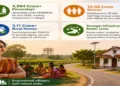
The scheme’s ambition has only grown with time. The government now aims to extend assistance for the construction of 4.95 crore houses by 31st March 2029, a target that speaks to the scale of Indian rural housing deficit as well as the state resolve to close that gap within a defined timeline. At present, a target of 4.18 crore houses has already been allocated to States and Union Territories, setting the stage for the next phase of construction activity across the country. This scheme has not been implemented in the Union Territories of Delhi, Chandigarh and Puducherry, while Telangana did not participate during the earlier phase of the scheme between FY 2016 and FY 2024, factors that shape the state-wise distribution of targets.
Five Years, Over a Crore Homes
The last five financial years present a story of steady progress of the Modi Government. Against a total target of 2.13 crore houses allocated to States and UTs during this period, 1.95 crore houses have been sanctioned, and construction has been completed on 1.21 crore houses. Another 74.59 lakh houses remain under construction, representing homes that are actively in progress rather than merely on paper.
 Behind these aggregate figures lies considerable state-wise variation. Bihar, Assam, Madhya Pradesh, Maharashtra and Chhattisgarh together account for a substantial share of both the sanctioned and completed houses, reflecting the sheer size of their rural populations and housing needs. Maharashtra, notably, has sanctioned over 31 lakh houses but has completed just over 11 lakh so far, leaving over 20 lakh houses under construction, the largest such pending pool among all States. West Bengal presents a starker contrast: of the 12.61 lakh houses sanctioned, only about 1.52 lakh have been completed, with over 11 lakh houses still under construction a gap that is closely tied to the suspension of Central funding to the State.
Smaller States and Union Territories, meanwhile, show near-total completion. Arunachal Pradesh, Sikkim and Ladakh have completed virtually all their sanctioned houses, while Uttar Pradesh and Uttarakhand also report completion rates above 99 per cent a reminder that administrative efficiency and not merely the size of the target determines how quickly beneficiaries actually receive their homes.
The Money Behind the Mission
Physical progress in a scheme of this scale cannot be separated from the financial machinery that sustains it. Over the last five financial years, the Ministry of Rural Development has released a total Central share of Rs. 1,31,100.02 crore to the States and Union Territories. Against this, a total of Rs. 2,17,896.40 crore, a figure that includes both the Central and State share, has actually been spent under the scheme, indicating that States have supplemented Central assistance with their own contributions to keep construction moving.

Madhya Pradesh, Assam, Bihar and Uttar Pradesh figure among the States that have received and utilised the largest sums, consistent with their high physical targets. Interestingly, several States have reported utilisation figures considerably higher than the Central share released to them. Bihar, for instance, has utilised nearly double its released Central share, and Jharkhand’s utilisation is more than double what it received from the Centre. This gap is bridged by the State’s own share of expenditure, underscoring that PMAY-G, despite being a Centrally sponsored flagship scheme, operates as a genuine Centre-State partnership rather than a one-way transfer of funds.
When Funds Are Withheld: A Story of Accountability
What distinguishes the recent functioning of PMAY-G is the government’s demonstrated willingness to pause the flow of funds wherever serious irregularities surface, rather than allowing disbursement to continue on autopilot. The release of PMAY-G funds has, in specific instances, been withheld or delayed where credible reports of implementation lapses emerged and where the concerned State failed to take satisfactory corrective action.
The case of Odisha illustrates how this accountability mechanism has been designed to work, and to eventually resolve itself. Complaints alleging irregularities in the implementation of PMAY-G in the State were examined through inquiries conducted both by the State Government and by Central Teams deputed by the Ministry. These inquiries uncovered a range of deficiencies and issues relating to how beneficiaries were selected, the quality of construction, the rigour of inspections, the proper branding of PMAY-G houses, and adherence to scheme guidelines more broadly. Faced with these findings, the State Government was directed to initiate corrective and disciplinary action and to submit an Action Taken Report (ATR). When the State’s initial ATR was found unsatisfactory, the Ministry withheld the release of subsequent instalments of Central assistance, a step that effectively paused fresh funding until compliance was demonstrated. Odisha has since undertaken the necessary corrective and disciplinary measures and submitted a satisfactory ATR, following which the release of PMAY-G funds to the State has now resumed. The episode reflects a model of enforcement that is firm but not punitive for its own sake; funding resumes once genuine course correction is evident.
The situation in West Bengal, by contrast, remains unresolved and considerably more prolonged. Following the allocation of targets drawn from the finalised Awaas+ 2018 survey lists in November 2022, the Ministry received complaints regarding irregularities in the implementation of PMAY-G in the State. These complaints were examined through National Level Monitoring (NLM) teams as well as Senior Officers Teams deputed for the purpose. As a consequence of these findings, the release of the Central share of funds to West Bengal has been withheld from FY 2022-23 onwards meaning the State has gone without fresh Central assistance under PMAY-G for several consecutive financial years. The ATR submitted by the State Government is, as of now, still under examination by the Ministry. This prolonged suspension helps explain the unusually low completion rate observed in West Bengal’s housing data, with the sanctions far outpacing completions and a disproportionately large number of houses left under construction compared to other large States.
Reading Between the Numbers
Taken together, the data describes the scheme that is simultaneously ambitious in scale and increasingly rigorous in its checks. Over 1.2 crore rural families have received completed Pucca homes in just five years, funded through a genuine partnership of Central and State resources exceeding Rs. 2.17 lakh crore. At the same time, the government’s readiness to pause disbursement to States such as Odisha and West Bengal even at the cost of slowing physical progress in those States signals that the scheme’s credibility is being treated as seriously as its coverage.
With 4.18 crore houses now targeted for allocation and a broader goal of 4.95 crore houses by 2029, PMAY-G’s next phase will likely be judged not only by how many homes rise from the ground, but by how consistently every rupee spent and every beneficiary selected withstands scrutiny. For a scheme that touches the most basic human need for shelter, that combination of scale and accountability may well be its most important achievement yet.