Verona: Highlighting that the foreign funding regulations in India are not a new phenomenon, Senior Analyst and Advisor on India-Italy relations, Carlo Lombardi, has pointed out that the Foreign Contribution (Regulation) Act (FCRA) was first introduced under the government headed by then Prime Minister Indira Gandhi in 1976 and later the law was made even harsher during the Manmohan Singh-led UPA government.
Speaking with ANI, Lombardi emphasised that while Non-Governmental Organisations (NGOs) contribute positively to humanitarian causes, they also can frequently function as instruments of a foreign policy, making government oversight of international funding essential.
“Let’s not forget that the first FCRA was passed by the Indian Parliament in 1976. It was done by Indira Gandhi. It was then overhauled in 2010 by Manmohan Singh’s government and it was actually harsher in the day”.
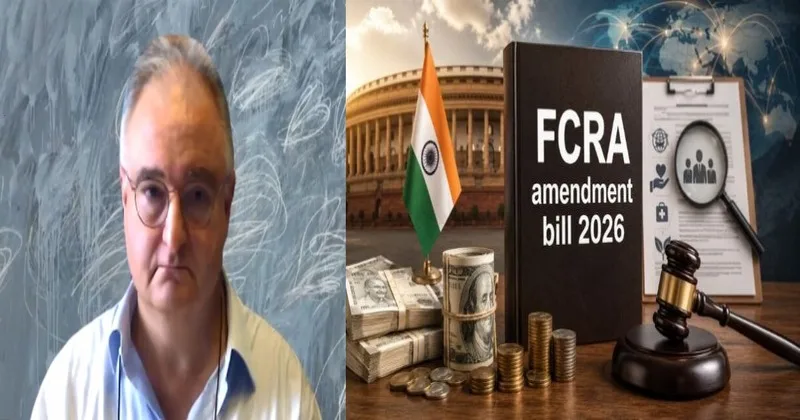
#WATCH | Verona, Italy: On FCRA Bill, Analyst and Advisor, India-Italy relations, Carlo Lombardi says, "… Let's not forget that the first FCRA was passed by the Indian Parliament in 1976. It was done by Indira Gandhi. It was then overhauled in 2010 by Manmohan Singh's… pic.twitter.com/ywOCxPKwDg
— ANI (@ANI) August 12, 2026
Technology facilitates easier foreign funding for vested interests
Carlo Lombardi further added, “We also have to consider that the technology that is spreading all around the world is making this kind of influence extremely easy. Financial openness also allows for the transfer of funds through many channels that didn’t exist in the past. Historically, there’s really nothing new”.
Elaborating on the strategic role played by non-profit entities internationally, the foreign policy expert noted that the concept of utilising non-governmental groups for geopolitical objectives is well-established globally.
NGOs: A secret tool of foreign policy
“My basic point is that NGOs are great; they do a lot of good work for humanity, but they are also an instrument of foreign policy. This is not a secret. In 1983, the National Endowment for Democracy was created in the United States and became the mother of all NGOs. And one of its co-founders, Allen Weinstein, actually went on record in The Washington Post in 1991 saying, ‘Much of what the NED, National Endowment for Democracy, does today, the CIA did covertly 25 years earlier’. So, NGOs are also an instrument of foreign policy”, he exposed the hidden face of the international NGOs.
Govt oversight inevitable to maintain transparency & sovereignty
Underlining the necessity for transparency regarding international cash flows entering the country, Lombardi asserted that sovereign governments must ensure foreign money is strictly utilised for its declared objectives rather than driving political agendas.
“And it’s only right that a government knows who’s funding what and for what reasons, and assures that the money which is coming in from foreign NGOs is actually used for the purposes which are stated and not misused. For example, money coming in for educational purposes, and then the NGO uses it for protests against the government, driving a political agenda under the umbrella of charitable, non-profit goodwill organisations”, he stated.
US criticisms to FCRA stems from Christian evangelical lobby
Carlo Lombardi also pointed out that political commentary from a US lawmaker regarding India’s Foreign Contribution (Regulation) Act (FCRA) often aligns with domestic political interests rather than objective standards. Lombardi highlighted that statements opposing the FCRA regulations stem from “Christian evangelical lobby” within the US political system.
“On the one hand, you have Congressman Riley Moore, who has a track record of advocating for the protection of Christians abroad. Now, the irony of it is that that’s a political statement made by a high-ranking member of what we might call the Christian evangelical lobby in the United States. So it sort of proves the point”, Lombardi said.
Elaborating further on the internal contradictions within Washington’s institutional positions, Lombardi, highlighted structural shifts in how US foreign aid and non-governmental organisations (NGOs) are operated and perceived domestically.
“And then you have other powers and other centers of power. For example, USAID was dismantled and Secretary of State Rubio actually went on record saying that NGO is an industrial complex built at the taxpayers’ expense. The American major NGOs fund other NGOs using public money. And it operates in countries like India without coordinating with host governments and sometimes creating political interference”, he stated.
Lombardi’s observations come following recent international remarks regarding India’s foreign funding rules. On Friday, August 7, the Ministry of External Affairs (MEA) rejected international criticism of India’s foreign funding framework, asserting that statutory regulations remain a strictly internal domain subject to parliamentary sovereignty.
The MEA’s response followed remarks by US lawmaker Riley Moore, who claimed that proposed statutory modifications to the Foreign Contribution (Regulation) Act (FCRA) could impact religious organisations and potentially influence broader diplomatic relations between New Delhi and Washington. Expressing concern over the legislative proposals, the West Virginia Republican lawmaker falsely alleged that the draft provisions targeted specific religious institutions, cautioning against enacting the measure in its present structure.
What is FCRA? Tracing its tarjectory since 1976
The Foreign Contribution (Regulation) Act governs the acceptance and utilisation of foreign contribution received from a ‘foreign source’, as defined in the Act. Foreign contribution may take the form of an article, currency or a foreign security and also includes specified income arising from such contribution.
Administered by the Ministry of Home Affairs (MHA), the Act does three things – it identifies who may accept foreign contributions and on what conditions; it specifies how that money must be received, accounted for and reported; and it restricts a narrow, defined set of foreign-funded activities that could affect India’s sovereignty, security or public order.
The law has its origins in 1976 and has been strengthened through successive amendments. The law was replaced with a new law in 2010 which was later amended in 2016, 2018, 2020 and now 2026. FCRA does not impose a general prohibition on foreign donations. It permits eligible associations to receive foreign contribution after obtaining registration or prior permission and requires such contribution to be received, utilised and reported in the prescribed manner.
Many democracies across the globe have also introduced laws to improve transparency and accountability in relation to foreign funding or foreign influence. The countries include United States (FARA), Australia (FITS), the United Kingdom (FIRS) and Canada (FITAA). The scope and legal design of those laws differ from country to country, but they reflect a common concern that cross-border funding and influence should be transparent and subject to appropriate safeguards.
A 1984 amendment to FCRA made registration with the Home Ministry mandatory for all NGOs receiving foreign funds. The current FCRA, 2010, replaced the 1976 Act with stronger compliance architecture. The 2020 amendment introduced mandatory Aadhaar/passport identification for office-bearers, confined foreign contributions to a single SBI New Delhi account, prohibited sub-granting, cut the administrative-expense ceiling from 50 per cent to 20 per cent and extended the suspension period.
The 2022 Rules raised the limit on contributions from relatives abroad from Rs 1 lakh to Rs 10 lakh. The 2024-25 Rules allowed unspent administrative-expense allocations to be carried forward and strengthened renewal documentation. Each reform has moved in the same direction greater disclosure, stronger accountability and improved governance.
The government on Wednesday decided to send the Foreign Contribution (Regulation) Amendment Bill, 2026 to a Joint Parliamentary Committee(JPC) for closer scrutiny. Minister of State for Home moved the motion in Lok Sabha to send the FCRA Amendment Bill to the JPC. The bill was introduced in the Lok Sabha on March 25 this year.
(With Inputs from ANI)