The Bharatiya Janata Party’s sweeping victory in West Bengal, securing 207 out of 294 seats and ending the Trinamool Congress’s 15-year rule, marks more than a political transition. It represents a major strategic setback for radical Islamist networks operating across the India-Bangladesh border and within Bengal’s vulnerable border districts. With the BJP crossing the halfway mark comfortably and pushing its vote share to 45.8%, the verdict signals a decisive rejection of the political ecosystem that, for years, allowed radical groups, extremist preachers, illegal infiltration networks and transnational Islamist organisations to deepen their influence across the region.
The result comes amid a sharp rise in radical and fundamentalist Islamic activities in Bangladesh following the August 2024 regime change, which Indian security agencies increasingly viewed as having direct spillover implications for West Bengal and eastern India.
Border radicalisation and expansion of Bangladesh-based terror networks
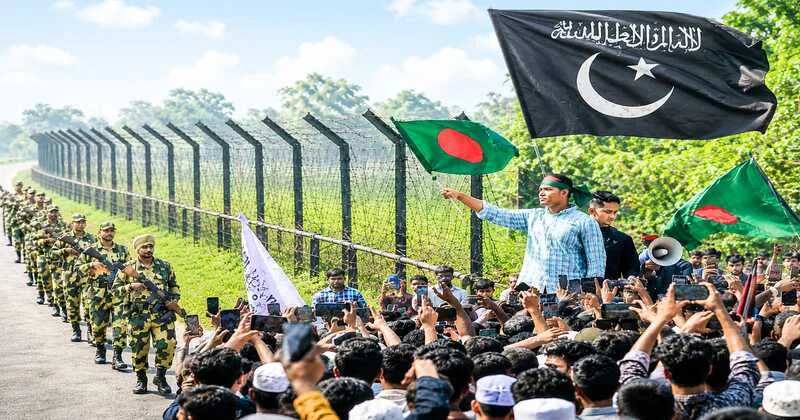
The ethno-linguistic geography of Bengal, Muslim-majority Bangladesh in the east and Hindu-majority West Bengal in the west, has long created a complex security environment. The border enables illegal migration, cross-border smuggling, movement of extremist operatives and ideological penetration into Indian territory. Districts such as Malda, Murshidabad and North 24 Parganas emerged as highly sensitive zones because of sustained activities by Salafist elements and Bangladesh-linked radical organisations. Bangladeshi Islamic preachers frequently entered the interior regions of these districts to conduct religious discourses and influence local religious practices. Security agencies also identified the rapid growth of religious institutions near the border and the increasing circulation of Bengali extremist literature on social media platforms.
The Jamaat-ul-Mujahideen Bangladesh (JMB), including both its pro-Al Qaeda and pro-Islamic State factions, significantly expanded its footprint in West Bengal. The group exploited cross-border marriages, linguistic familiarity and religious similarities to establish shelter networks and logistical bases inside the state. JMB supporters were believed to have strong roots in northwestern Bangladesh while simultaneously cultivating operational links in West Bengal. The neutralisation of terror modules linked to JMB and the Ansarullah Bangla Team (ABT) across West Bengal, Jharkhand, Uttar Pradesh and Madhya Pradesh reflected the widening spread of Bangladesh-origin extremist influence into India’s hinterland. Investigations repeatedly showed these groups using Bengal as a staging ground because of shared language, cultural overlap and weak political resistance against radical networks.
The Islamic State also attempted to exploit this environment. Intelligence agencies warned that IS modules in Bangladesh were focusing heavily on pushing recruits into West Bengal and Bihar. Security assessments described the Bangladesh route as the most active infiltration corridor for Islamist recruitment into India. A Dabiq article titled “The Revival of Jihad in Bengal” openly called on Bengali Muslim youth to dedicate themselves to jihad, marking one of the earliest organised attempts by Islamic State-linked elements in Bangladesh to directly target India ideologically.
TMC rule, radical ecosystems and political protection
For years, New Delhi has accused the Trinamool Congress government of being soft on extremist elements due to electoral dependence on sections of the Muslim vote bank. The state government faced repeated allegations of ignoring radical activities carried out under the cover of religious and social mobilisation. The most prominent example remained the October 2014 Khagragarh blast in Burdwan. Two suspected Indian terrorists were killed and another injured after an explosion in a house stocked with 55 improvised explosive devices, chemicals and bomb-making equipment. The building belonged to Nurul Hasan Chowdhury, a TMC leader. The ground floor had previously functioned as a TMC party office and election office, turning the incident into a defining symbol of political proximity between extremist networks and local political structures.
The growth of illegal migration from Bangladesh also significantly altered demographic patterns in the border districts of West Bengal, Assam and Tripura. Security agencies repeatedly linked this demographic transformation with increasing radical influence, particularly as fundamentalist preachers and Islamist organisations expanded their ideological reach among economically vulnerable populations. Bangladesh-based extremist groups leveraged these conditions aggressively after the 2024 political transition in Dhaka. Several radical figures either escaped prison or were released during the regime change period. These included ABT chief Mufti Jashimuddin Rahmani, Ikramul Haque, Indian operations head of ABT Jamat-ul-Ansar Fil Hindal Sharqiya, along with Shamim Mahfuz and Sheikh Aslam.
As a result, Indian agencies assessed that Islamist radicals and terror entities were now operating with unprecedented freedom inside Bangladesh. One particularly alarming development was the public appearance of Golam Sarowar Rahat, the second-in-command of the banned JMB, alongside Bangladesh interim government head Mohammad Yunus during a visit to the secret detention centre Aynaghar in Dhaka.
Simultaneously, the JMB intensified organisational activity and explored alliances with Hefazat-e-Islami (HeI), Bangladesh’s largest radical Islamist organisation. Maulana Mamunul Haque, Joint Secretary General of HeI, worked alongside Jamaat-e-Islami Bangladesh to build a unified Islamic political platform. Pakistani nationals attended some of these meetings. Indian agencies further assessed that Jamaat-e-Islami leaders openly encouraged supporters to work towards establishing an Islamic state under party chief Shafiqur Rahman.
Rise of caliphate networks and radical Islamist consolidation
The resurgence of Hizb-ut-Tahrir (HuT) represented another major concern. The pro-Caliphate transnational Islamist organisation, despite being banned, re-emerged openly after the regime change and organised nationwide demonstrations in Bangladesh, including the “March for Khilafat” rally in Dhaka on 7 March 2025. HuT’s influence reportedly extended into sections of Bangladesh’s interim establishment. Individuals, including Asif Nazrul, Nahid Islam, Asif Mahmud Sajeeb Bhuiyan and Mehfuz Alam, were identified as backing the organisation. Nasimul Gani, one of HuT’s founder members, was appointed Home Secretary.
HuT aggressively targeted educated youth by projecting the Caliphate as an alternative to secular democratic governance. Indian investigations by the National Investigation Agency found HuT-linked radicalisation activities in Delhi, Madhya Pradesh, Karnataka, Tamil Nadu, Telangana and West Bengal. The Ministry of Home Affairs eventually proscribed the organisation in India.
At the same time, the Al-Qaeda-linked Harkat-ul-Jihad-al-Islami Bangladesh (HuJI-B), dormant for nearly a decade, began resurfacing. HuJI-B reportedly penetrated Hefazat-e-Islami and expanded its influence through Qawmi madrassas. The organisation also significantly increased its social media activity after the Bangladesh regime change.
Another serious security challenge involved over 1.3 million Rohingya refugees living in Bangladesh. Intelligence agencies warned that terror outfits were attempting to radicalise sections of the refugee population. The Pakistan-backed Arakan Rohingya Salvation Army sought to establish control over camps to strengthen narcotics networks and create a dedicated pool of radicalised recruits capable of targeting India in the future.
Rohingya infiltration routes through Tripura, Assam and West Bengal also intensified as refugees attempted to escape overcrowded camps in Cox’s Bazar and Bhashan Char. Security agencies additionally warned that Islamic State planners were looking to channel recruits from the Maldives, Sri Lanka and Bangladesh into India because travel routes from these countries remained comparatively easier.
BJP victory and the collapse of the Islamist political narrative
Against this backdrop, the BJP’s decisive Bengal victory carries significance far beyond electoral arithmetic. The result directly undermines years of anti-Hindutva propaganda and religious polarisation campaigns carried out by Islamist groups operating from Bangladesh and within West Bengal.
The political shift disrupts the ecosystem that extremist organisations relied upon for ideological expansion, demographic consolidation, logistical shelter and political protection. Bengal’s new political direction is expected to strengthen coordination between state agencies and central security institutions in monitoring infiltration routes, dismantling terror modules and scrutinising radical religious networks operating in border districts.
The BJP’s rise also signals the rejection of the larger Islamist political narrative that sought to portray Bengal as fertile ground for anti-Hindutva mobilisation. Despite sustained propaganda campaigns, radical messaging, cross-border ideological influence and attempts to communalise the political atmosphere, voters handed the BJP a massive mandate. The outcome is likely to produce far-reaching changes in border management, surveillance of illegal migration, scrutiny of madrassa networks suspected of radical activities, monitoring of extremist funding channels and tighter policing of transnational Islamist organisations.
For Bangladesh-based extremist groups such as JMB, ABT, HuT and HuJI-B, the Bengal verdict removes what many Indian security officials viewed as a permissive political environment. Their long-term objective of embedding Islamist influence within Bengal’s socio-political structure now faces a far more hostile state apparatus. The BJP victory, therefore, represents not merely a change of government but a strategic reversal for radical Islamist networks attempting to transform West Bengal into an ideological and operational extension of the growing fundamentalist upsurge inside Bangladesh.