Abuja: Gunmen killed at least 29 people in northeastern Nigeria in a brutal assault now claimed by Islamic State West Africa Province (ISWAP), with the group stating it had “killed at least 25 … Christians” in the attack. The violence unfolded on Sunday in Guyaku community in Gombi Local Government Area of Adamawa state, a region bordering Cameroon and known for recurring jihadist activity. Residents said the attackers struck a football gathering, where young people had assembled. Witnesses reported that gunmen entered the area and opened fire indiscriminately on the crowd. “Our people converged at a football pitch in Guyaku community … [and] were attacked by insurgents who entered with guns and began shooting randomly,” a resident told AFP. Most of the victims were youths, including women who had gathered to watch the game. Local accounts described widespread destruction, with homes, vehicles and Churches set ablaze during the assault.
Christians targeted as ISWAP claims responsibility
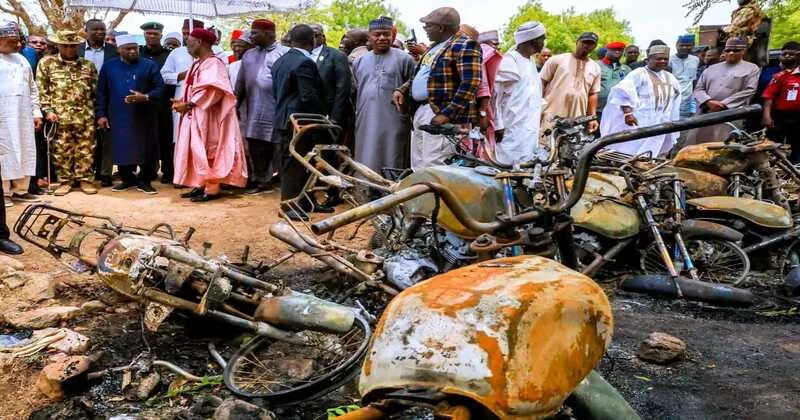
Adamawa State Governor Ahmadu Umaru Fintiri visited the site and confirmed that “no fewer than 29 people were killed in a deadly attack on Guyaku community,” according to his office. He condemned the killings and vowed swift action, stating that security operations would be intensified immediately to restore order. While authorities initially blamed Boko Haram militants, ISWAP later claimed responsibility through a statement reported by the SITE monitoring group. The group said it had “killed at least 25 … Christians” and “torched a church and nearly 100 motorcycles,” underscoring the scale and targeted nature of the attack. Television footage from the area showed a burned church and several charred motorcycles, reinforcing eyewitness accounts of destruction. Community leaders said the attackers operated for several hours, attacking civilians and destroying property without immediate resistance.
Rising violence deepens Nigeria security crisis
The attack highlights the continuing security crisis in Nigeria’s northeast, where jihadist insurgency has persisted for over a decade. Since 2009, violence involving Boko Haram and ISWAP has left tens of thousands dead and displaced millions, according to the United Nations. The conflict has also spread into neighbouring countries such as Niger, Chad and Cameroon. The latest attack has drawn particular attention due to the explicit claim and the targeting of civilians gathered in a public space. The violence comes amid growing scrutiny of Nigeria’s security situation, especially with general elections less than a year away. Authorities are under increasing pressure to contain the insurgency and prevent further escalation.
In a separate incident on the same day, another attack occurred more than 100 kilometres away in Lamurde area, where local officials attributed the violence to communal clashes over farmland disputes. “Lives were lost, properties were also lost,” a local government chairman said. The Guyaku attack, however, remains one of the deadliest recent incidents, with ISWAP’s claim that it “killed at least 25 … Christians” and “torched a church and nearly 100 motorcycles” highlighting the group’s continued operational capacity and the persistent threat facing civilians in northeastern Nigeria.