When funds received from abroad are spent on declared objectives such as education, healthcare, disaster relief, assistance to the poor and social service, no one objects to their transparent utilisation. The question arises when a discrepancy begins to appear between the source of foreign funds, their stated purpose and their actual use. If such a situation exists anywhere, it is natural that foreign contributions begin to appear as a challenge to financial transparency, national security and sovereignty.
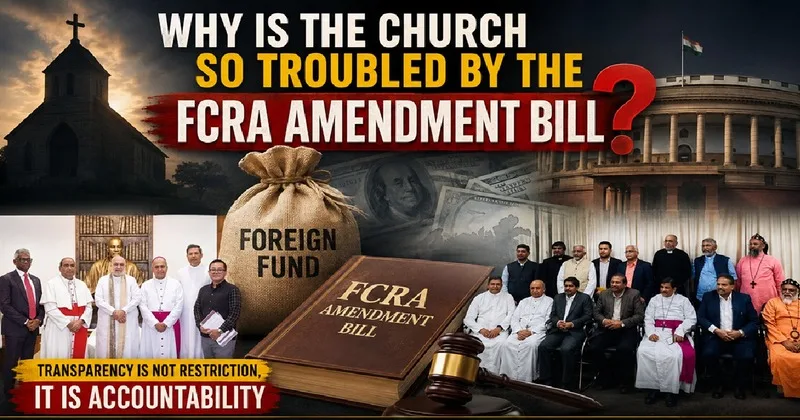
At a time when representatives of various Christian denominations and minority organisations have demanded the withdrawal of the proposed FCRA Amendment Bill, 2026, several questions naturally arise. Why is there such concern over the proposed provisions of this law when the government has already made it clear that its objective is to make the use of foreign funds more transparent and accountable?
Is the Question About Rights or the Monitoring of Foreign Funds?
Recently, a delegation representing various Christian denominations and minority organisations met Union Home Minister Amit Shah and urged him to withdraw the proposed FCRA Amendment Bill. The delegation was led by MP and Chairman of the Joint Action Forum on Minorities (JAFM), P. Wilson. It included senior representatives of various organisations, including the Catholic Church, the Church of South India, the Church of North India, the National Council of Churches in India, the United Evangelical Lutheran Church, the Baptist Church and the Mar Thoma Church. Their principal objection relates to Section 15 of the FCRA. Their argument is that provisions for government control over foreign contributions or charitable properties created from such contributions could affect religious and constitutional rights.
Here, before Home Minister Amit Shah, all these Christian church leaders, including Archbishop of Delhi Anil Couto, Moderator of the Church of South India K. Reuben Mark, founder of Jesus Calls Paul Dhinakaran, General Secretary of the National Council of Churches in India Asir Ebenezer, Executive Secretary of the United Evangelical Lutheran Churches Bishop Joshua Peter, Bishop Paul Noel Walker Swaroop of the Church of North India, Deputy Secretary General of the CBCI Mathew Koyikal, and representatives of several other Christian denominations and organisations, have argued that the FCRA Amendment Bill is affecting the rights of the Church! In fact, however, they have all failed to explain how these rights are being affected.
It is now necessary to examine the fundamental question by separating it from an emotional religious debate. For what purpose does foreign money come to India, which organisation receives it, into which account does it go, and what is it ultimately spent on, is there no need to monitor these questions? If an organisation receives funds for education, they should be used for education. Funds received for healthcare should be used for healthcare. Money received in the name of relief should not be used for any other activity. This is the basic principle of financial accountability.
What Exactly Does the Government Want to Change?
According to the government, the proposed framework is by no means intended to stop the charitable activities of any religion or community. The proposed provisions concern situations in which the FCRA registration of an individual or organisation has expired, been cancelled or been surrendered. In such a situation, the foreign contributions and properties created from them would come under the designated authority. If the organisation subsequently succeeds in having its registration restored, there is a provision for the return of the foreign contributions and properties.
The rationale behind this arrangement is that property created from foreign funds should not remain indefinitely in the hands of an organisation whose statutory right to receive foreign funds has ceased to exist. The government also faces the challenge of determining who should protect and manage such properties after the cancellation of registration. The proposed amendment seeks to fill this administrative gap. The Bill proposes arrangements including a designated authority, temporary vesting, the return of property if registration is restored within the prescribed period, and permanent vesting thereafter.
If It Is a Religious Organisation, How Can It Be Exempt from Financial Scrutiny?
One of the major concerns expressed by church representatives is that the proposed provisions could affect educational institutions, hospitals, orphanages, old-age homes and organisations serving vulnerable sections of society. This argument may sound humanitarian, because the social contribution of such institutions can be significant. However, an equally important question arises alongside it: should the transparency of an organisation’s foreign financial transactions cease merely because it is charitable or religious in nature?
Keeping an organisation engaged in charitable activities outside the ambit of the law would mean weakening an important aspect of the monitoring of its use of foreign funds, while the very framework of the FCRA requires an account of the source, receipt and utilisation of foreign contributions. According to the available material, the FCRA does not eliminate the possibility of foreign funding for legitimate religious activities of any faith, the maintenance of places of worship, religious education and faith-based welfare activities. Therefore, the debate should not be about whether the Church will receive foreign funds or not. The real question should be under what conditions foreign funds will be received and how their proper utilisation will be ensured.
Why Should There Be Any Problem with Transparency?
The proposed 2026 amendment places emphasis on arrangements such as information regarding the source and utilisation of foreign funds, project-wise and location-wise expenditure details, information relating to digital activities and social media accounts, identification of the ultimate foreign donor, and online disclosure of financial transactions. It also makes clear that foreign funds received for charitable purposes should be spent for those very purposes.
Here, the basis for opposition would appear stronger only if it could be established that these provisions are intended to prevent legitimate charitable activities. Merely stating that greater scrutiny would affect the rights of organisations is not, in itself, a sufficient argument. In a democracy, accountability is ensured alongside rights. How can demanding transparency in the use of funds whose source lies outside the country, in itself, be considered an attack on the religious freedom of an organisation?
The FCRA Is Not a New Law
It is also important to understand that the regulation of foreign contributions is not taking place in India for the first time. The journey of the FCRA began in 1976, followed by a new law in 2010. Subsequently, changes were also made to the framework in 2016, 2018 and 2020. The 2020 amendments strengthened provisions relating to designated bank accounts for foreign contributions, controls on sub-grants and limits on administrative expenditure.
This means that the monitoring of foreign funds cannot be viewed as a sudden priority that has emerged under any one government. Over time, foreign financial flows have increased and their channels have become more complex. Therefore, it is natural for the mechanisms of oversight to evolve accordingly.
Foreign Funds and the Question of National Interest
Today, foreign funding has extended to areas ranging from policy research, public campaigns, environmental movements and legal activities to media narratives and digital campaigns. This is why it would not be appropriate to regard foreign funds merely as ‘donations’ and describe their monitoring as unnecessary. For any sovereign nation, it is essential to know the source of funds behind activities that generate economic or social influence within its territory.
Allegations of Religious Conversion Have Made the Debate Even More Sensitive
A sensitive aspect of the debate over the FCRA is the allegations relating to religious conversion. Allegations of misuse of foreign funds and their use in conversion activities against some Christian organisations and NGOs have, in certain cases, been found to be substantiated. There are also recorded instances in which action has been taken to suspend or cancel FCRA registrations. In such circumstances, the government has also stated that the proposed framework would retain space for legitimate religious activities, while seeking to prevent forced conversion through foreign funds or activities that could affect social harmony. What, then, is inappropriate about this? The Constitution also seeks to ensure that conversion does not take place through inducement, fear, coercion or the display of miracles.
The Real Test: Source, Purpose and Use of Funds
The entire debate over the FCRA can be summed up in three words, which may be described as: source, purpose and use. Where did the money come from? For what purpose was it received? And where was it actually spent? If clear answers to all three questions are available, there should be no reason to fear a transparent system.
The problem arises when an organisation receives foreign funds in the name of one purpose but uses them for another. In such a situation, any action would not be against a particular religion, but against a violation of financial regulations. In fact, this is precisely where the debate over the FCRA amendment needs to be taken beyond the binary language of religious rights versus government control and viewed in the broader context of financial accountability and national interest.
This is also the question to which representatives of the Church are expected to provide an answer: if foreign funds are received transparently, spent on the declared purpose and all legal conditions are complied with, then what is the real objection to a system involving greater transparency and accountability?
Monitoring Foreign Funds Is Not Against Democracy
In fact, portraying the monitoring of foreign contributions as being against democratic rights is an argument that requires wider scrutiny. Democracy gives citizens and institutions the freedom to conduct their activities, but it must be remembered that this freedom does not exempt them from financial accountability. When funds come from outside the country, it is natural for the government to know their source, the purpose for which they were received and where they were used. It must be said that the FCRA is a mechanism for implementing this fundamental principle.
If an ordinary donation received by a religious organisation from within the country is subject to accounting and income-tax regulations, why should additional scrutiny of funds received from abroad be considered unusual? Foreign funds can also be accompanied by foreign interests, foreign priorities and, at times, the possibility of foreign influence. Therefore, from a policy perspective, treating such funds in the same manner as ordinary domestic donations may not be sufficient.
The Link Between Foreign Funding and Influence
Foreign assistance is not inherently wrong. In India, numerous organisations have used foreign assistance in areas including education, healthcare, disaster relief, women’s empowerment, child welfare and social service. The problem arises when financial assistance gradually becomes part of a broader mechanism of influence.
When an organisation receives foreign resources on a sustained basis, its activities may expand, its public outreach capacity may increase and its access to different sections of society may become stronger. This is not, in itself, illegal. However, it is precisely for this reason that transparency becomes even more important. The government has to ensure that foreign funds are used in accordance with India’s constitutional framework, laws and public interest.
This is why it would be an incomplete approach to regard the FCRA merely as a law governing donations. It is a law regulating the financial channel through which foreign resources enter Indian social life.
Can There Be a Separate Financial Framework in the Name of Religion?
Church organisations have expressed concern about religious freedom and the rights of charitable institutions. Such concerns can certainly be raised in a democratic discourse. However, the other side of the issue is equally important. How can being a religious organisation exempt an entity from transparency regarding the source and utilisation of foreign funds?
Charitable Service and Foreign Funds Must Be Viewed Separately
Church-run hospitals, schools, orphanages, old-age homes and social service centres are understood to work for vulnerable sections of society. However, weakening the regulation of foreign funds on this basis is not the solution. On the contrary, a better approach would be to provide genuine charitable organisations with a clear, transparent and time-bound compliance framework. Organisations with a clean record should be protected from unnecessary administrative hurdles, while where there is concrete evidence of financial irregularities, the law should be enforced with full rigour. This would make two things possible at the same time: charitable services could continue, while accountability for foreign funds would also be maintained.
Strictness Under the FCRA Does Not Mean Every Organisation Is a Criminal
While debating the provisions of the FCRA, it is important to maintain an essential distinction. The cancellation of an organisation’s FCRA registration does not, in itself, prove that the organisation has committed a serious criminal offence. Administrative violations, documentary deficiencies, non-compliance with rules and deliberate misuse of foreign funds can have very different characteristics. Therefore, government action would also be based on evidence, due process and the law. If an organisation complies with the rules, it should have no reason to face any difficulty. However, if an organisation misuses foreign funds, its religious identity cannot provide it with protection from the law. That much is certain.
The Real Concern Begins Where the Boundary Between Service and Influence Becomes Blurred
The line between charitable service and religious influence can at times become extremely sensitive. Providing food to a poor person, treating someone who is ill, educating a child or helping a disaster victim is, in itself, social service. However, if foreign funds are being used behind such activities to expand a particular ideological or religious influence, questions are bound to arise.
Many countries around the world have stringent regulations governing foreign funding. The reason is that, in the modern era, influence does not arise solely through military power. Influence can also be created within a country through economic resources, non-governmental organisations, research institutions, media networks, digital campaigns and social movements. In this context, it is not unusual for India to strengthen its foreign contribution law in keeping with changing circumstances. Everyone must understand here that national security means maintaining financial sovereignty alongside security at the borders, so that funds coming from outside cannot be misused.
Criticism from America or Western Countries Is Not the Final Test
Comments by foreign parliamentarians, organisations or international institutions regarding the FCRA may form part of the debate. However, whether a law should be enacted in India must be decided on the basis of the Indian Parliament, the Indian Constitution and India’s national interest. Every sovereign country has the right to establish rules governing foreign funds entering its territory. If India regulates foreign contributions, other countries also have their own frameworks concerning financial matters and foreign influence. Therefore, it would not be appropriate to regard disagreement from any foreign organisation or politician as the final standard for India. India will have to formulate policy based on its own experience and requirements, and that is precisely what it is doing today.
The Church’s Objection Can Be Addressed Only Through Transparency
Let us return to the fundamental question: why is the Church facing such difficulty with the FCRA Amendment Bill? If the Church and other charitable organisations want their social service activities to remain free from unnecessary administrative pressure, the most effective approach is to maintain complete financial transparency. In principle, a legitimate organisation should have no difficulty making public the identity of every foreign donor, the purpose of the funds, project-wise expenditure, details of assets and accounting information.
The Solution to the Debate Lies Not in Confrontation, but in Clear Rules
Reducing the debate over the FCRA amendment to categories such as religious versus secular, government versus Church, or majority versus minority only makes the issue more complicated. The real issue is far broader. It is true that India needs foreign funds, particularly in the fields of development, healthcare, education, disaster relief and social service. At the same time, India must also safeguard the institutional independence of the country from foreign influence. There is no inherent conflict between these two objectives.
The Final Question Must Also Be Put to Institutions
In a democracy, it is essential to question the government, but it is equally important to question civil society institutions. If transparency is expected from the government, it is equally natural to expect transparency from non-governmental and religious organisations. For an organisation that works for society, public trust is its greatest asset. Providing a complete account of foreign funds does not weaken that trust; it strengthens it. If the funds have been used in accordance with their declared purpose, transparency will work in the organisation’s favour.
Therefore, the strongest approach to the debate over the FCRA is this: foreign funds should come into the country, be used for legitimate purposes, reach the poor and those in need, and charitable organisations should be able to serve independently. At the same time, the Government of India and the Indian public should receive clear answers regarding the source and utilisation of those funds. In fact, this is financial transparency. This is in the national interest. And this is also the fundamental spirit of democratic accountability.