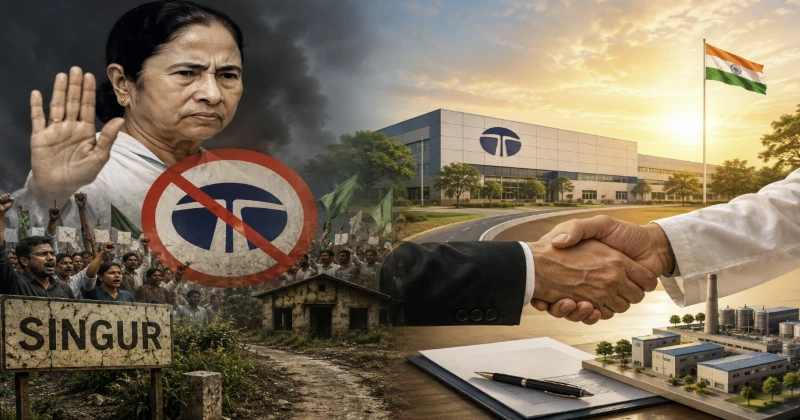
Kolkata: Nearly two decades after Mamata Banerjee’s agitation drove Tata Motors out of Singur, West Bengal is now trying to bring the Tata Group back to the state. The dramatic U-turn comes as the BJP government seeks to reverse years of industrial stagnation and rebuild Bengal as an investment and employment hub.
West Bengal is knocking on the doors of the Tata Group once again.
Commerce and Industries Minister Tapas Roy has confirmed that the state government is in talks with the Tata Group to bring fresh investments to Bengal, potentially opening a new chapter in a relationship that was badly damaged by the Singur controversy.
“We are in touch with Tata, discussions are ongoing to bring them to the state,” Roy said. The government is exploring opportunities beyond automobiles, with Tata Group businesses spanning IT, metals, hospitality, retail and other sectors already having a presence in Bengal.
In 2008, Tata Motors abandoned its Nano project at Singur after a prolonged agitation led by then-opposition leader Mamata Banerjee against the acquisition of land for the plant. The company subsequently shifted the project to Sanand in Gujarat.
The Singur agitation became one of the defining political movements that propelled Mamata Banerjee and the Trinamool Congress to power in 2011. But the industrial consequences of that politics have remained a subject of intense debate in Bengal.
Now, 18 years later, the political equation has changed and so has the government’s message to industry.
The BJP government that came to power in Bengal in 2026 has made industrial revival a central priority. Roy, who heads the Industries Department, has repeatedly said that the government wants to create an environment in which businesses can invest, expand and generate employment.
In an interview, Roy said that after Tata’s departure from Singur, numerous small, medium and large industries also left Bengal, and claimed that 6,688 companies had exited the state. He said the government was now seeking to invite industries back, including the Tatas and overseas companies.
For years, Bengal’s industrial story was overshadowed by disputes over land acquisition, political agitation, allegations of syndicate raj and concerns over the business environment. The result, critics argue, was a state that struggled to translate its enormous human capital, strategic location and industrial legacy into sustained large-scale manufacturing investment.
The new government is attempting to change that narrative by putting investment, industrialisation and employment at the centre of its economic agenda. And bringing Tata back would be more than just another corporate investment. It would carry enormous symbolic significance.
The Singur saga has also left West Bengal with a substantial financial liability.
An arbitral tribunal in October 2023 awarded Tata Motors Rs 765.78 crore, along with 11 per cent annual interest from September 1, 2016, and Rs 1 crore in costs, in connection with the company’s withdrawal from the Singur project.
The West Bengal Industrial Development Corporation challenged the award before the Calcutta High Court. However, the court declined to grant an unconditional stay on the award. WBIDC was given eight weeks to secure the award amount by furnishing details of unencumbered properties or depositing cash, failing which the protection would lapse. The court also imposed Rs 50,000 in costs on WBIDC.
The dispute therefore represents a striking paradox, Bengal once lost a major automobile project amid political agitation and is now facing a hefty financial liability connected to that very exit while simultaneously attempting to persuade the Tata Group to invest in the state again.
The significance of the Nano project cannot be measured simply by the number of jobs inside the proposed factory.
A large manufacturing plant creates an ecosystem around itself component manufacturers, logistics companies, transport operators, warehouses, service providers, hotels, restaurants, engineering firms and thousands of direct and indirect employment opportunities.
That is precisely why a fresh Tata investment could be transformational.
If Tata were to establish a major manufacturing facility in Bengal, it could create direct employment while simultaneously generating thousands of indirect jobs through ancillary industries and supply chains. It could also send a powerful signal to other domestic and global investors that Bengal is once again open for business.
The Sanand story itself underlines what Bengal missed. What began with Tata Motors’ Nano project helped create an automobile and manufacturing ecosystem in Gujarat, attracting suppliers and other investments.