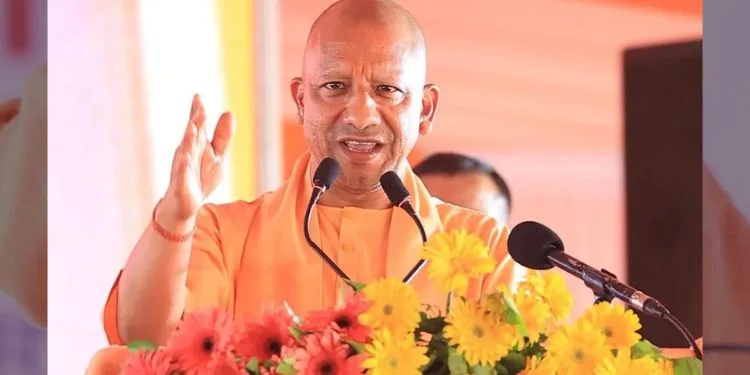
This time, Yogi ki Paati is not about a highway, a welfare scheme or an election promise. Chief Minister Yogi Adityanath wrote to citizens about palm-leaf manuscripts, pandulipiyan and asked them to become guardians of the knowledge their own families may have silently kept for centuries. The letter, published under the “Yogi Ki Paati” series by the Department of Information and Public Relations, Uttar Pradesh, carries a specific ask: if you have an ancient manuscript, handwritten text or palm-leaf document at home, register it on the Gyan Bharatam Mobile App or portal. That ask deserves serious attention, not as political messaging, but as a civic duty that has a deadline written in decay.
What Is Already Being Lost
The Indian manuscript tradition is the largest in the world. Written on palm leaves, birch bark and paper, these texts span over 80 languages and cover subjects such as philosophy, medicine, astronomy and governance. The total count is staggering, and the total number is estimated at more than one crore manuscripts, many of which are in private collections and are at risk of decay, theft or simple neglect.
Approximately 80 per cent of these manuscripts are held by private collectors. That means the fate of India’s intellectual heritage rests not with governments or universities; it rests with ordinary citizens who may not even know what they hold.
The Mission That Changed the Scale
For over two decades, India has attempted manuscript preservation through the National Mission for Manuscripts, launched in 2003. The effort was earnest but underfunded. Under that mission, nearly 100 manuscript resource centres were established, tracking and cataloguing up to 55 lakh manuscripts, with more than 3.5 lakh digitised and nearly 1 lakh uploaded online for public access.
The Gyan Bharatam Mission changed the ambition entirely. Launched in the Union Budget 2025-26, the mission carries a total budget of more than Rs 490 crore for 2025–2031, up from a previous allocation of just Rs 3.5 crore for the older mission.
Prime Minister Narendra Modi launched the dedicated Gyan Bharatam portal on 12 September 2025 at Vigyan Bhawan, New Delhi, during an international conference held under the theme “Reclaiming India’s Knowledge Legacy through Manuscript Heritage”. The results are already visible. As of February 2026, over 7.5 lakh manuscripts have been digitised under the Gyan Bharatam initiative, with 1.29 lakh available on the dedicated portal, Union Culture Minister Gajendra Singh Shekhawat informed the Lok Sabha. From about 3.5 lakh digitised manuscripts in November 2025, the number rose to 7.5–8 lakh by February 2026, following standardised reformatting processes.
Uttar Pradesh: The Ground Is Moving
Yogi Adityanath’s letter arrives in a state that carries an intellectual past and has an extraordinary opportunity. Uttar Pradesh is home to Ayodhya, Kashi, Prayagraj, Mathura and Gorakhpur, the ancient centres of learning with temples, ashrams, Sanskrit schools and private collections that have never been formally surveyed.
The Yogi government has issued directives to all districts to identify and document manuscripts at the district level, designating the Chief Development Officer of each district as the nodal officer. The action is already underway on the ground. A district-level committee meeting was held in Kanpur Nagar under the chairmanship of District Magistrate Jitendra Pratap Singh, where a detailed action plan was prepared for the survey, documentation and digitisation of ancient manuscripts, with survey teams directed to upload the GPS location, photographs, quantity and current condition on the Gyan Bharatam Mobile App.
There is also one critical assurance that private holders must understand. CM Yogi said that the manuscripts will remain in the custody and ownership of the respective collectors or institutions, and the government will undertake only their digital preservation. No one is asking you to surrender what your family has kept. They are asking you to share their existence.
Why Citizens Must Act
Every year that a palm-leaf text sits in a damp storeroom without documentation is a year closer to permanent loss. No bureaucratic circular can reverse that. Only a citizen who walks to their family temple, asks the pujari about the handwritten texts on the back shelf and photographs them with the Gyan Bharatam app, that citizen becomes the actual conservation force.
The mission objectives include a nationwide survey to locate ancient Indian literature, collection and compilation from academic institutions, museums, libraries and private collectors, and the use of modern techniques and technology to conserve and restore manuscripts under trained conservationists. AI-assisted transcription and blockchain-based provenance tracking are being built into the infrastructure. But none of that technology works if the manuscript is never found.
The CM letter ends with an instruction: donate manuscripts to the Uttar Pradesh State Archives if possible, or upload details on the Gyan Bharatam Mobile App or portal. That is a five-minute civic act. It is also, in the most literal sense, an act of nation-building.
India is not short of ambition on this mission. With a total outlay of ₹482.85 crore for 2024–2031, the initiative aims to safeguard India’s intellectual legacy and make it accessible for research, education and global knowledge exchange. The infrastructure is being built. The app exists. The portal is live. The district machinery has been activated. What the mission cannot manufacture is the awareness and willingness of the private citizen who holds the last surviving copy of a 400-year-old Ayurvedic text.
That is the gap Yogi Adityanath is trying to close. Whether it closes depends on whether readers treat it as a political advertisement or as a genuine call to a civic responsibility that their grandparents, whether they knew it or not, have been fulfilling simply by keeping these texts alive. The manuscripts survived invasions, famines and centuries of neglect. They should not die in an era when a smartphone can save them in three minutes.