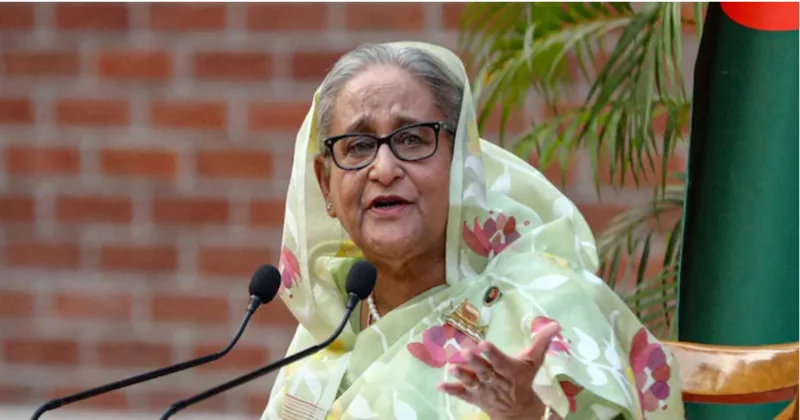
Statement by H.E. Sheikh Hasina: (Virtual Address to the Foreign Correspondents’ Club of South Asia Ahead of Her Homecoming | 5 August 2026)
Distinguished journalists, members of the Foreign Correspondents’ Club of South Asia, respected guests, friends of Bangladesh, ladies and gentlemen, Assalamu Alaikum.
I thank the Foreign Correspondents’ Club of South Asia for giving me this opportunity to speak to you. I also thank the journalists who continue to follow events in Bangladesh with seriousness and courage. Journalism has a duty to seek truth, especially when power tries to hide it. In difficult moments of history, that duty becomes even more important.
Today, I speak not only as someone who had the honour of serving Bangladesh five times as Prime Minister, but also as the daughter of the Father of the Nation, Bangabandhu Sheikh Mujibur Rahman. I speak as someone who has spent her life with the people of Bangladesh. I was forced away from my country, but I was never separated from my people.
Before I speak about the present crisis, I pay my deepest homage to the Father of the Nation, Bangabandhu Sheikh Mujibur Rahman, to the slain national leaders, and to the three million martyrs of our War of Liberation. I also remember with profound grief the members of my own family whom I lost on 15 August 1975. Today is also the birthday of my beloved brother Sheikh Kamal. He was a valiant freedom fighter, a youth leader, a sports organiser and a cultural activist. His life represented the courage, creativity and patriotism of the young generation of Bangladesh. I remember him today with deep love, pain and pride.
For the last two years, I have watched my beloved Bangladesh suffer. I have spoken to mothers who lost their sons, workers who lost their jobs, families struggling to buy essential goods, women living with humiliation and fear, and young people who no longer see a future in their own country. Leaders and activists of Awami League have been forced into hiding. Fear has entered homes, workplaces and campuses. This is not the Bangladesh we built. This is not the Bangladesh for which three million people sacrificed their lives in 1971.
Let me begin with the truth about July and August 2024. A great falsehood has been repeated before the world: that the movement was only a peaceful student movement. That is not the truth. From the beginning, my government tried to resolve the issue peacefully through dialogue, legal process and patience. But behind the language of reform, organised groups were working to turn student’s demand into a violent political instrument.
In 2018, responding to student demands, we abolished the quota system. In 2024, when the High Court annulled that decision, the government appealed because we wanted to uphold the abolition. I personally took the initiative for dialogue with the students and invited them to Ganabhaban. Three ministers also held discussions with them. Their reasonable demands were accepted. We said that, if necessary, a permanent solution could be made through legislation. We chose dialogue. We chose patience. We chose a peaceful path. But the movement had no visible or responsible leadership. Whenever talks moved forward, new instructions came from invisible places. Demands changed. A quota reform movement was turned into a one-point demand for my resignation. False propaganda was spread in a planned way. Genuine students were emotionally manipulated, while organised groups used their movement as cover for violence and regime change.
Later, Muhammad Yunus himself said this was a “meticulously designed” movement led by a “mastermind.” His own words exposed the truth. It was not simply a spontaneous student protest. It was organised, directed and used to create a path to power outside the ballot box.
From 15 July, the character of the movement changed. Killings, arson, attacks and looting began. State property was destroyed. Bangladesh Television was attacked and set on fire. Setu Bhaban, the Directorate General of Health Services, the EPI vaccination programme building, Farmgate Metro Rail station, Hanif Flyover, Mohakhali Elevated Expressway, science research facilities, the disaster management office, a national database centre, a Covid-19 special hospital, Dhaka Medical University, residential hotels, industrial facilities, businesses and prisons, including Narsingdi District Jail, were attacked, vandalised or burned.
Awami League offices were vandalised across the country. Leaders and workers were attacked and killed. Homes of ministers and senior figures associated with my government were looted and burned. The media was also targeted. Nearly 50 media centres, private television stations and newspaper offices were attacked or set on fire. Journalists were killed, including Md Shakil Hossain, Mehedi Hasan, Tahir Zaman Priyo, ATM Turab, Pradip Kumar Bhowmik and Sohel Akanji. Law enforcement agencies came under organised attack. Officers were killed. Bodies were hung from flyovers. Around 460 police stations and outposts were set on fire. Personnel were trapped inside buildings. Weapons were looted. Officers were beaten to death. According to persecuted police members, at least 3,000 personnel were killed, attacked, tortured or subjected to serious violence.
So, I ask a simple question. In such a situation, what is the duty of law enforcement? When police stations are burned, government buildings are attacked, public infrastructure is destroyed, officers are killed and weapons are looted, does the state have no duty to protect lives and property? In every country, law enforcement has a responsibility to protect citizens, state institutions and their own lives. That is not a crime. That is the duty entrusted to them by law.
At the same time, I wanted the truth to be known. That is why I formed a Judicial Inquiry Commission on 18 July. Its purpose was clear: every casualty had to be investigated, every incident of violence had to be examined, and every family deserved to know the truth. I met victims’ families, visited the injured and instructed the authorities to provide the highest level of medical treatment. On 1 August, I strengthened the inquiry into a three-member commission so that the investigation could be broader, more credible and more complete.
But after seizing power, the illegal interim government led by Muhammad Yunus stopped that investigation. They did not allow the truth to come out. They gave indemnity to those involved in the killings. If they truly wanted justice, why did they stop the inquiry? If they had nothing to hide, why protect the killers? That one decision tells the truth. They did not want justice. They wanted power. They did not want investigation. They wanted the evidence buried.
Their own words exposed the truth. An NCP leader said the “revolution” would not have succeeded if police had not been killed and the metro rail had not been set on fire. A BNP leader in Sirajganj also said publicly that Enayetpur Police Station was burned and police were killed to make the movement succeed. These statements show that the July-August movement was not merely a quota reform movement. It became a coordinated assault on constitutional order, driven by hidden instructions, organised violence and propaganda.
The conspiracy did not end on August 5. After August 5, violence became a campaign of political persecution. The killing that began on July 16 with the murder of Sabuj Ali, a Dhaka College student and Chhatra League activist, has not stopped. Awami League leaders and workers are being killed, disappeared, arrested, driven from their homes and buried under false cases. At least 10,000 have been killed or disappeared. Around 650,000 have been arrested over the last two years. Around 3,500 cases have been filed, naming nearly 450,000 leaders, workers and supporters as accused. More than 1,000,000 others have been listed as unnamed accused. Women activists of Chhatra League, Youth League and other affiliated organisations are facing abuse, humiliation and torture in custody. Many leaders and workers have also died in prison amid documented accounts of torture, denial of medical treatment, deprivation of food, negligence and denial of basic rights.
This persecution is not limited to the Awami League. Members of minority communities, judges, lawyers, intellectuals, cultural figures, journalists, professionals, workers, farmers and ordinary citizens have been attacked, arrested or accused in murder cases. No one who stands for the spirit of the Liberation War is safe. Symbols and memorials of our Liberation War have been destroyed. Freedom fighters have been humiliated with garlands of shoes. The historic residence of Bangabandhu Sheikh Mujibur Rahman at Dhanmondi 32 has been attacked and demolished in phases.
This is not random violence. This is an attempt to erase the spirit of the Liberation War from Bangladesh. Muhammad Yunus himself spoke of pressing a “reset button” to wipe away the country’s previous history. They want to erase the Liberation War. They want to erase Bangabandhu. They want to rewrite Bangladesh against the foundation on which it was born. Convicted war criminals have been released. Militants and top terrorists have been freed. Even after a staged election brought the BNP to power, the situation did not change. Bangladesh remains gripped by fear, terror, repression, economic hardship and deep insecurity.
Now look at the condition of the country. The progress we built is being destroyed, and ordinary people are paying the price. GDP growth has fallen to 2.22 percent, compared with 6.80 percent during the Awami League period. Industrial production has fallen sharply. For the first time in 54 years, the industrial sector has faced negative growth. Defaulted loans in the banking sector have reportedly risen from 13 percent to 47 percent. Poverty has increased from 18.60 percent to 46.8 percent. Investment has turned negative. Job creation has collapsed. More than two crore people have newly fallen into unemployment. Over 500 industrial factories have closed. More than half of industrialists and business owners are either in prison or forced into hiding. The government is running by borrowing 700 to 900 crore taka from banks every day. Project costs have been increased by 50 percent to 250 percent. At the same time, militancy is rising, women and children are facing torture, rape and humiliation, and ordinary people no longer feel secure in their own lives. Extortion, murder and kidnapping have become regular features of daily life. These are not just numbers or isolated incidents. Behind them there is a family, a worker, a farmer, a small business owner, a mother who cannot buy food for her child, and a young person who no longer sees hope.
But let me also remind you what Bangladesh had achieved. The welfare of the people has always been the purpose of my politics. The Father of the Nation, Bangabandhu Sheikh Mujibur Rahman, gave his life for that ideal, and I have carried that ideal with full commitment. Our development projects were not vanity projects. They were part of building national capacity. Our social programmes were not charity. They were investments in human dignity. We made Bangladesh stand tall. We made it known as the rising tiger of Asia.
During my five terms as Prime Minister, we used long-term planning, sound financial management and disciplined implementation to place Bangladesh on a strong foundation. After 2008, across 16 years and four consecutive terms, we implemented major projects such as the Padma Bridge, Metro Rail, Rooppur Nuclear Power Plant, Matarbari Deep Sea Port, Karnaphuli Tunnel and Bangabandhu Satellite. We maintained GDP growth between 6.5 percent and 7.5 percent. We raised the economy from 70 billion dollars to 450 billion dollars. Per capita income rose from 482 dollars to 2,784 dollars, the highest in South Asia. Poverty fell from 41 percent to 18.7 percent. Extreme poverty fell from 25.1
percent to 5.6 percent. We brought electricity to every citizen and increased power generation capacity from 3,782 megawatts to 28,563 megawatts.
We established about 14,000 community clinics so rural and marginalised people could receive free healthcare and 30 types of medicine. Maternal mortality fell from 370 to 184 per lakh live births. Child mortality fell from 84 to 21. Access to safe drinking water rose to 98 percent. Sanitary latrine use reached 97 percent. Average life expectancy rose from 59 years to 73 years. We gave two kathas of land, a semi-permanent house and livelihood support to 8.45 lakh landless families. At least 45 lakh people received a place to live. Through 145 social safety net programmes, nearly ten crore people received different forms of allowance and support.
And when more than one million Rohingya fled persecution and violence in Myanmar, Bangladesh opened its doors on humanitarian grounds. We gave them shelter, food, medical care and safety, even though Bangladesh itself is a densely populated developing country. We did it because humanity demanded it.
So today I ask those who celebrated my departure: what did you actually get? Did you get democracy? Did you get security? Did you get freedom of expression? Have prices come down? Can ordinary families afford daily essentials? Are people getting uninterrupted fuel and electricity? Has the economy become stronger? Have you seen even a little development in the last two years? Are women safe? Are children safe? Are minorities safe? Are journalists, teachers, artists and intellectuals safe? Bangladesh was moving towards prosperity, dignity and confidence. After August 2024, it has been pushed into fear, revenge, hardship and uncertainty.
I also want to speak directly to the young people of Bangladesh. Do not allow anyone to turn your strength into an instrument of destruction. Ask questions. Raise demands. Protest when you see injustice. That is your right. But see the truth with your own eyes. Understand who wants to build your future, and who wants to use your anger as a ladder to power. Do not become tools of extremism or revenge politics.
Bangladesh must be built with knowledge, technology, skills and humanity. A state is not built through destruction. It is built through hard work, discipline and responsibility. Look beyond personal likes and dislikes. Look at the reality of the country. To save Bangladesh, democracy, rule of law and the rights of the people must be restored. The young people of Bangladesh must take part in this struggle with unity and responsibility. You are the future of our country.
I also believe Bangladesh needs national reconciliation. The country needs healing. But reconciliation cannot mean impunity. Those who conspired against the country, committed crimes and caused suffering must face justice through proper legal process. Victims must receive legal protection and proper compensation.
Bangladesh’s crisis is not only a domestic crisis. It affects regional peace, security, trade, development and human dignity. That is why I call upon the international community and all friends of Bangladesh to stand with the people of Bangladesh in their struggle for democracy, justice and peace. A stable Bangladesh matters for South Asia, for the Bay of Bengal, for development partners, and for all countries that believe in democracy, rule of law and justice. The next decade can be a decade of recovery and renewal, but only if democracy is restored and the people are allowed to decide their own future.
That is why I make these demands clearly. The ban on the Awami League must be withdrawn. Political prisoners must be released. False cases must be dropped. Freedom of speech must be restored. Media freedom must be protected. Judicial independence must be guaranteed. Law enforcement agencies must serve the people, not those who use power for revenge. These are not demands for one party. These are necessary steps to save Bangladesh.
Whatever fate awaits me, I will return to my people. I cannot stay away while my beloved countrymen are suffering. I know I may be detained. I may be sent to prison. They may try to enforce verdicts issued in fabricated cases. But fear cannot decide my duty to the people. My life moved beyond calculations of personal safety long ago. In 1975, I lost my family. I spent six years in exile. After returning home, I fought against military rule, dictatorship, assassination attempts and political conspiracies. Even the grenade attack of 21 August 2004 could not stop me.
I am not worried about my own future. I am worried about the future of Bangladesh. I want to return because the people deserve security, development, prosperity and peace. They deserve a state that protects them, an economy that gives them opportunity, and a democracy that gives them rights. My return, and the return of the Awami League to the democratic process, is not about power. It is about putting Bangladesh back on the right track. It is about reviving the country’s path of development, progress, secularism and stability. I want to return to Bangladesh for one purpose: to stand beside the people and help improve their lives. The people are the source of all power. I believe in them. I trust them. And I will return to them.
Joy Bangla.
Joy Bangabandhu.
May Bangladesh live forever.