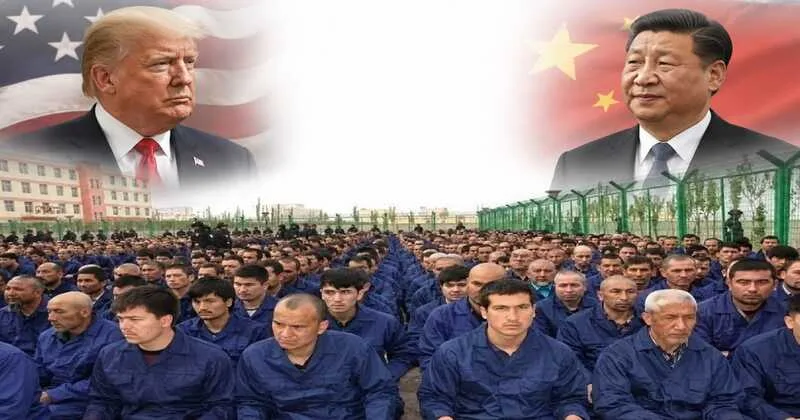
New Delhi: The Trump administration has significantly expanded its trade restrictions on Chinese companies by adding 43 firms to a US trade blacklist over their alleged involvement in human rights abuses and forced labour practices in China’s far-western Xinjiang region. The move marks the largest single expansion of the Uyghur Forced Labor Prevention Act (UFLPA) Entity List since the legislation came into force in 2021 and raises the total number of blacklisted entities to 187.
Announcing the decision on July 31, the U.S. Department of Homeland Security (DHS) said the newly designated companies are accused of participating in or benefiting from forced labour programmes targeting Uyghurs and other Muslim minority groups in Xinjiang. The UFLPA Entity List prohibits the import of goods produced wholly or partly with forced labour from listed entities into the United States.
According to U.S. government estimates, at least one million Uyghurs and members of other Muslim minority communities have been detained in an extensive network of internment camps in Xinjiang. Washington has previously determined that the Chinese Communist Party’s treatment of these communities amounts to genocide.
The newly blacklisted companies operate across a wide range of sectors considered important to global supply chains, including aluminium, apparel, copper, cotton, seafood and tomato products.
Among the prominent companies added to the blacklist is Shandong Gold Mining, one of China’s major gold producers. Also included are Xinjiang Nuziline Bio-Pharmaceutical, a chemical manufacturer, and Xinjiang Tianhongji Technology, which produces materials used in lithium battery manufacturing.
Another major addition is Tianshan Aluminum, one of the largest aluminium producers in Xinjiang. The company, along with seven of its subsidiaries, was designated after U.S. authorities said they had evidence that the firms source key raw materials from Xinjiang. Human rights organisations have previously linked Tianshan Aluminum to the Xinjiang Production and Construction Corps (XPCC), a regional paramilitary organisation that has already been sanctioned by Washington over alleged serious human rights abuses.
The blacklist has also been expanded to include Xinjiang Tianyun Organic Agriculture, a company engaged in producing and distributing cold-water fish, including salmon. U.S. authorities accused the company of participating in state-sponsored recruitment and labour transfer programmes involving Uyghurs and other ethnic minority groups.
US says move protects workers and global supply chains
DHS Secretary Markwayne Mullin said the expanded blacklist is intended to protect both American workers and fundamental human rights by preventing products made through forced labour from entering the US market.
“The American worker must not be undercut and cheated by foreign companies that use slave labour,” Mullin said, adding that the measures are designed to shield Americans from unfair competition while defending human dignity.
The US has added 43 more China-based companies to its import restriction list over alleged links to Uyghur forced labor, the largest single expansion of the list since 2021. pic.twitter.com/dzSCewd5rM
— TaiwanPlus News (@taiwanplusnews) August 1, 2026
The US State Department also described the action as part of a broader effort to eliminate forced labour from international supply chains. State Department spokesperson Thomas Pigott said forced labour distorts global markets and enables foreign actors to exploit the international trading system unfairly.
Pigott further stated that the United States expects its trading partners around the world to adopt and effectively enforce comparable laws that prohibit the import of goods produced using forced labour.
The expansion of the blacklist received support from Representative John Moolenaar, Republican chairman of the House Select Committee on the Chinese Communist Party. He described the latest action as strengthening the American economy against products allegedly manufactured with slave labour while sending a strong message to Beijing over what he characterised as genocide and human rights abuses in Xinjiang.
Moolenaar said the House committee would continue pressing for rigorous enforcement of U.S. laws aimed at preventing forced labour-linked products from entering the American market. Stressing the broader objective behind the measures, he said the United States, as a country committed to freedom, would not permit China to export products allegedly produced through slave labour into the country.
The latest expansion marks a fresh episode in the intensifying US-China trade confrontation, with Washington using trade restrictions against dozens of Chinese firms over alleged links to forced labour and human rights violations in Xinjiang, adding another layer of friction to an already strained bilateral relationship.