In a significant order, the Madras High Court has attached juristic personhood to the Thamirabarani River as a deity, banned the dumping of clothes during rituals, and permitted the immersion of ashes only in unfired earthen pots.
The Madurai Bench of the Madras High Court, comprising Justices G.R. Swaminathan and B. Pugalendhi, held that the Thamirabarani is worshipped as a deity by Hindus and, therefore, could be recognised as a person in law.
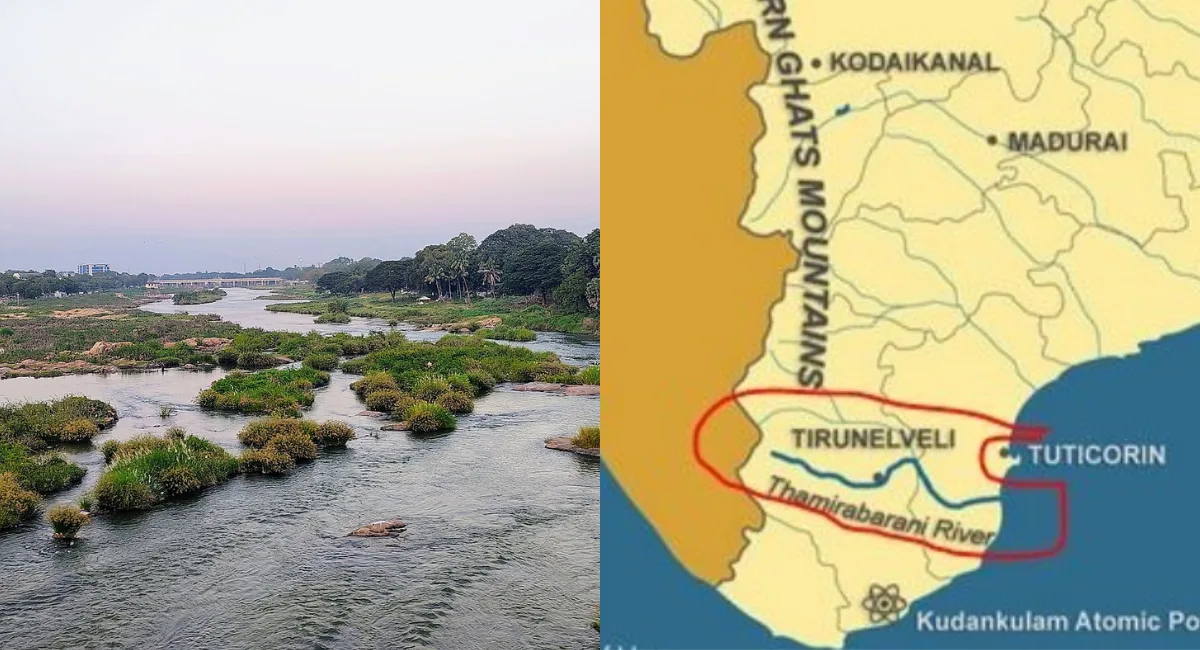
The Thamirabarani River originates in the Pothigai Hills, Agastyarkoodam Peak, in the Western Ghats, and is the lifeline for farmers and residents of the Tirunelveli, Thoothukudi (Tuticorin), and Tenkasi districts of southern Tamil Nadu by providing year-round water.
Sivanupandian of Tirunelveli filed a petition challenging his eviction from a 400-year-old mandapam situated on a bathing ghat along the river in Papanasam.
Dismissing the petition, the Division Bench observed in its 19-page order: “River Thamirabarani is admittedly worshipped as a deity by the Hindus. Therefore, it partakes the character of a person. We, therefore, make it clear that we recognise the personhood of Thamirabarani not because it is a river but because she is a deity. No one has a right to pollute her. That will not only be a breach of the statutory provisions found in various environmental laws and a breach of the fundamental rights of fellow citizens under Article 21 of the Constitution of India but also the rights of the river herself. She is hereby recognised for her own intrinsic value.”
The order, dated July 23, was pronounced on July 29. The court noted: “The writ petitioner challenges the impugned notice issued by the Assistant Executive Engineer (WRO), Upper Tamirabarani Sub-Division, calling upon him to remove the encroachment in question.
The writ petitioner is in charge of ‘Anandhavilas’, a mandapam (pavilion) situated in Papanasam village on a bathing ghat of the River Tamirabarani.
A pillared hall without any enclosed walls was put up for the benefit of pilgrims. This structure has existed for a very long time.
The petitioner appears to have made improvements and claims exclusive possession and management of the same. A fee is collected from the users of the bathing ghat.”
The court further observed: “As per the revenue records, it has been classified as river poramboke. The ‘A’ Register categorically describes the survey number as ‘Tamirabarani River’. The character of the property as a water body is beyond dispute.”
Justifying the eviction order, the judges said: “The writ petitioner cannot claim any title over what is actually an ancient monument. One should not tinker with or alter its features. A 400-year-old stone structure had been distorted beyond recognition by the erection of walls. The authorities rightly called upon the petitioner to vacate.”
Citing recent data, the court said: “We had a look at a small booklet titled ‘Thamarabharani Nadhineer Thooimai Vizhipunarvu’ authored by Smt. C. Kalavalli. Details of the waste discarded in the Thamarabharani River and collected during the period from 07.05.2026 to 28.05.2026 are as follows:
Clothes – 86.90 tonnes ; Holy ash – 2.20 tonnes; Slippers – 115 kg ; Plastic waste – 1,385 kg ; Glass bottles – 220 kg ; Sacks – 90 kg; Burnt bricks – 700 kg; Oil bottles, shampoo covers, etc. – 302 kg; Sanitary napkins/diapers – 374 kg; Residuary waste – 440 kg.
The statistics are alarming. No one has the right to pollute a water body even in the name of religion. This can be taken as an axiomatic proposition.”
The court further observed: “When these discarded clothes get stuck in the riverbed, they become a breeding ground for bacteria such as E. coli, thereby posing a serious health hazard. Tamirabarani is home to two particular species of turtle, namely the Indian Black Turtle and the Indian Flapshell Turtle.”
“Believers can do what is spiritually beneficial to them, provided it has no adverse implications for ecology and does not violate the rights of other members of society,” the court observed.
It further stated: “In the guise of performing rituals for the departed, the river cannot be polluted. One should not forget that Tamirabarani is the only perennial river catering to the drinking water needs of crores of people.”
The judges explained: “Since the polluters take umbrage behind Hindu faith and religion, apart from invoking the statutory provisions, we intend to approach the issue from another perspective. Our jurisprudence recognises deities and idols as persons. That which is reverentially worshipped as per the tenets of religion is a deity. Hinduism, being a pantheistic religion, acknowledges the existence of innumerable deities.”
The court further observed: “It was held that God is formless and shapeless, and it is for the benefit of the worshippers that there is a manifestation in the images of the Supreme Being.”
Tracing the legend, the judges noted: “River Tamirabarani finds mention in the Valmiki Ramayana, Vyasa Mahabharata, and Kalidasa’s Raghuvamsam.
Sage Vyasa composed ‘Tamirabarani Mahathmiyam’, an epic poem containing 6,300 verses. There is a particular sloka which states that bathing in the Tamirabarani destroys one’s karmas. The very name ‘Papanasam’ literally means the destruction of one’s sins. Tamirabarani Pushkaram is held once every 12 years.”
The court held: “We, therefore, make it clear that we recognise the personhood of Tamirabarani not because it is a river but because She is a deity. No one has a right to pollute her. That will not only be a breach of the statutory provisions found in various environmental laws and a breach of the fundamental rights of fellow citizens under Article 21 of the Constitution of India but also the rights of the River Herself. She is hereby recognised for Her own intrinsic value.”
The judges concluded their order with a caveat: “We, therefore, permit the immersion of ashes. We add a caveat. The ashes to be immersed in the river will be carried only in unfired earthen pots. If the pots are unfired, they will dissolve in no time.”
The petition-mentioned mandapam shall be taken over forthwith by the fifth respondent temple. The Executive Officer/Trustees will liaise with the ASI and carefully restore the mandapam to its original condition.