At a time when public discussion about J&K is frequently shaped by immediate political events, institutional announcements and competing narratives, a different kind of conversation unfolded in Srinagar on July 18, 2026. More than fifty research scholars assembled at the Government College of Education for the Young Thinkers Greet, organised by the Himalayan Policy and Research Foundation under the broader theme “Towards Progressive J&K.” The day-long programme was conceived not merely as an academic gathering, but as an attempt to bring locally grounded research into a wider conversation on public policy, social development and the future of the Himalayan region.
The programme emerged from HPRF’s earlier call for original papers inviting scholars, research associates, writers and journalists to examine subjects connected with progress, development and transformative change in Jammu and Kashmir. From the submissions received, participants were shortlisted for presentation before an expert jury. In this sense, the Srinagar gathering represented the culmination of a longer process of writing, evaluation and scholarly engagement rather than a stand-alone ceremonial event.
According to the organisers, the event was among the first initiatives of its kind to involve Kashmir-based scholars on such a scale in policy-oriented academic deliberation. The breadth of subjects represented at the programme was notable.
Discussions and submitted papers addressed governance, disaster management, peace education, the rural economy, environmental degradation, the Himalayan ecosystem, culture and heritage, and contemporary geopolitical and geoeconomic challenges. The underlying message was that Jammu and Kashmir cannot be adequately understood, much less governed and developed, through isolated disciplinary perspectives. Its social questions are linked to its ecology; its economic future is connected with the aspirations of its youth; and its political stability depends partly upon the quality of education, knowledge production and community engagement available within the region.
Creating Space for Region-Rooted Scholarship
The inaugural session established the intellectual direction of the programme. Mr Irshad Ahmad, Member of the Editorial Board of HPRF, opened the deliberations by emphasising the need to identify, mentor and promote young research talent. His remarks placed particular importance on scholarship that arises from the actual social, economic, cultural and environmental conditions of Jammu and Kashmir. This was an important distinction: the objective was not simply to encourage more academic writing, but to encourage research capable of interpreting local realities and contributing to practical policy choices.
Professor Mohammad Mubin, Vice-Chancellor of Cluster University of Srinagar, chaired the inaugural session as Chief Guest. He directed attention towards the ecological vulnerability of the Himalayan region and called for sustained efforts to conserve its lakes, water bodies, forests and other natural resources. His intervention gave environmental protection a central place in the discussion rather than treating it as an issue separate from governance or development. In a Himalayan society, ecological security is inseparable from water availability, agriculture, livelihoods, settlement patterns and intergenerational well-being.
Professor Seema Naz, Principal of the Government College of Education, Srinagar, attended the inaugural session as Guest of Honour. Dr Tawseef, Executive member, HPRF and Mr Fasil Ali Dar, Director, HPRF, also interacted with and guided the participating scholars. The presence of university leaders, educators, policy researchers and institutional representatives gave the programme a character that was both academic and public-facing. It enabled young scholars to place their arguments before individuals associated with higher education, research institutions and public policy platforms.
The significance of such engagement lies in the distance that often exists between research and decision-making. Universities and individual scholars may produce valuable work, but that work does not always travel beyond dissertations, journals or departmental seminars. Conversely, policymaking sometimes proceeds without sufficient access to reliable local data or sustained academic analysis. Young Thinkers Greet sought to narrow this gap by creating an intermediate platform where research could be presented, questioned, evaluated and connected with larger institutional conversations.
From Research Methodology to Public Policy
The technical session began with a presentation by Dr Zahid Sultan on evidence-based policymaking, rigorous research analysis and the creation of reliable databases. His intervention addressed a foundational challenge facing public scholarship: policy recommendations are credible only when they are supported by dependable evidence, transparent methods and carefully interpreted data. The development of authentic knowledge repositories is especially important in regions where public debates are frequently shaped by anecdotal claims, selective memory or politically convenient interpretations.
By foregrounding methodology before the paper presentations, the programme underscored that meaningful research requires more than compelling language or topical relevance. It must define its questions carefully, distinguish evidence from assumption, identify appropriate sources and acknowledge the limitations of its conclusions. The emphasis on databases was equally consequential because durable policy research depends upon the systematic preservation and accessibility of information rather than the repeated collection of disconnected facts.
Following this methodological presentation, the shortlisted participants presented their papers before the expert jury. The selected presentations addressed three particularly significant dimensions of Jammu and Kashmir’s contemporary condition: “Peace Education in J&K: A New Approach of Engaging Communities in a Violence-Affected Society”; “Climate Change in Kashmir and its Alpine Ecosystems”; and “Changing Dynamics of Youth Aspirations in J&K.”
The first paper placed peace education within the lived context of a society affected by prolonged violence. Its subject moved the idea of peace beyond official appeals or the mere absence of conflict and located it within education, community participation and social relationships. The title itself suggested the need to engage communities as active participants in peace-building rather than treating them only as recipients of institutional programmes. It also opened an important discussion about whether educational spaces can develop the capacities required for dialogue, empathy, responsible citizenship and the non-violent resolution of differences.
The second presentation, on climate change and Kashmir’s alpine ecosystems, directly echoed Professor Mubin’s concerns about the environmental future of the Himalayas. Alpine ecosystems are not distant landscapes with only aesthetic or touristic value; they form part of a wider ecological network connected with snow, glaciers, springs, rivers, biodiversity and downstream human settlements. By placing these ecosystems within the policy conversation, the presentation reinforced the need for development planning to recognise ecological thresholds and the particular vulnerability of mountain environments.
The third paper, examining the changing dynamics of youth aspirations in Jammu and Kashmir, brought the discussion back to the generation whose future will be shaped by present policy choices. The subject recognised that young people cannot be understood as a uniform demographic category. Their expectations are changing in response to education, technology, mobility, employment patterns, entrepreneurship, social media and expanding exposure to national and global opportunities.
Understanding these aspirations is therefore essential for designing credible policies relating to education, skills, employment, civic participation and leadership.
Taken together, the three papers reflected the interconnected nature of the challenges confronting the region. Peace cannot be sustained without engaged communities and responsible education; development cannot be durable if fragile ecosystems are damaged; and public policy cannot remain relevant if it fails to understand what younger generations expect from institutions and from their own futures.
Professor A. Ravinder Nath, Vice-Chancellor of the Central University of Kashmir, chaired the session. He situated the subjects under discussion within the broader ecological, intellectual and civilisational framework of the Himalayan region. This framing was important because it encouraged the scholars to look beyond narrowly administrative understandings of policy. The Himalayas are not merely a geographical category; they are also home to interconnected cultural traditions, environmental systems and intellectual histories that require interdisciplinary research.
Professor Naseer, who attended as Guest of Honour, appreciated the initiative and expressed support for the promotion of young scholars across the country. The papers were evaluated for originality, academic merit and analytical depth, and three presentations were selected for recognition. Dr Imran Muzaffar Parray and Mr Zahid Iqbal, while representing the jury, made essential comments on the overall quality and acumen of the papers and made some critical comments when it comes to writing good academic research papers.
Converting an Academic Gathering into Institutional Cooperation
The concluding session widened the programme from research presentations to questions of institutional continuity. Shri Ramdas Athawale, Union Minister of State for Social Justice and Empowerment, attended as Chief Guest. Mr Ashok Choudhary, Director, HPRF, welcomed the dignitaries and stressed that the ideas produced by young scholars should be channelled into meaningful public policy and social development.
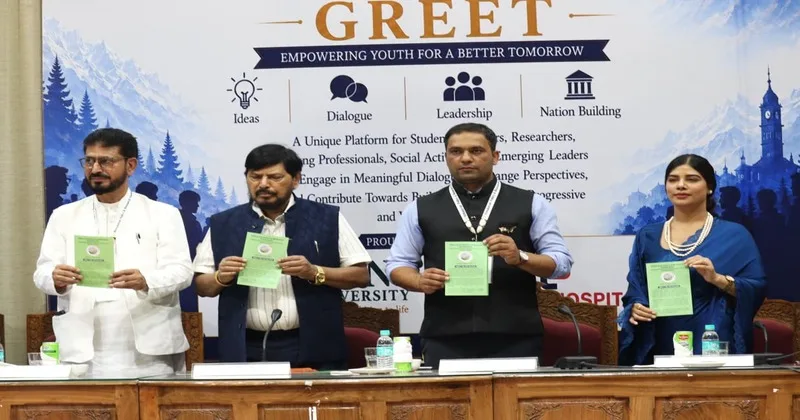
A major institutional development during the session was the signing of a Memorandum of Understanding between HPRF and ARNI University. HPRF was represented by Peer Gulzar and Mr Fasil Ali Dar, while ARNI University was represented by Shri Vivek Sawhney. The announced areas of cooperation included academic collaboration, research, knowledge exchange and capacity-building. The agreement potentially provides a framework through which the intellectual energy generated by the programme can be carried into joint research activities, academic interaction and longer-term institutional engagement. The HPRF brochure was also released, formally presenting the Foundation’s vision and areas of work to the participating scholars and dignitaries.
Surinder Ambardar, Founder Director of HPRF, used the occasion to articulate the Foundation’s broader intellectual ambition. He called for the creation of an indigenous think tank comprising young scholars, writers and researchers who could strengthen the knowledge ecosystem of the Himalayan region. His emphasis on an indigenous research platform was not a rejection of wider academic knowledge; rather, it reflected the need for institutions capable of producing scholarship from within the region’s own historical, cultural, ecological and social experiences.
He linked HPRF’s aspiration to nurture thousands of emerging leaders with the Prime Minister’s vision of bringing one lakh fresh leaders into public life. He also proposed the establishment of a Transcendental Knowledge Centre in Kashmir. Within HPRF’s larger intellectual framework, such a centre would seek to recover and reinterpret the region’s civilisational and philosophical inheritance while connecting it with contemporary scholarship and policy thinking. The proposal suggests an effort to position Kashmir not solely as an object of security or political analysis, but as a historic centre of knowledge capable of contributing to wider national and Himalayan conversations.
Addressing the gathering, Ramdas Athawale appreciated the Foundation’s efforts and assured support in connecting its young scholars with flagship programmes of the Ministry of Social Justice and Empowerment. He further stated that he would facilitate coordination with other ministries to advance HPRF’s academic and policy initiatives. Such institutional linkages could be particularly useful where research intersects with social justice, marginalised communities, education, capacity-building, youth development and welfare policy.
Recognition, Evidence and the Responsibility of Young Scholars
During the valedictory proceedings, the Minister felicitated the presenters of the three best research papers. The team of HPRF stated that nurturing young researchers could help produce a generation capable of replacing “fictional and unsubstantiated narratives with evidence, scholarship and grounded realities.”
The observation captured the central purpose of the programme. Research in a complex region is not only an academic exercise; it is also a responsibility. Scholars must question inherited assumptions without replacing them with new ideological certainties. They must distinguish documentation from assertion, analysis from advocacy and evidence from repetition. By recognising young researchers publicly, the programme sought to affirm that disciplined intellectual work has a place in the region’s social and developmental future.
Peer Gulzar, Convenor of the programme, delivered the vote of thanks, and the gathering concluded with the National Anthem. Yet the lasting significance of Young Thinkers Greet will depend less upon the formal conclusion of the event than upon what follows it: whether presented papers are refined and published; whether scholars remain connected through research networks; whether the MoU produces substantive collaboration; and whether the ideas discussed are translated into policy briefs, community initiatives, databases, academic programmes and future public deliberations.
Young Thinkers Greet demonstrated that the region possesses a substantial body of emerging researchers willing to engage with difficult questions. It also showed the importance of giving these researchers access to mentorship, institutional recognition and platforms beyond university departments. The programme brought peace education, climate vulnerability and youth aspirations into the same intellectual space because the future of Jammu and Kashmir will be determined not by any one of these concerns in isolation, but by the manner in which they are understood together.
For HPRF, the event marked an important step towards building a locally rooted but nationally connected research ecosystem. For the participating scholars, it offered both recognition and responsibility. And for the wider region, it presented a simple but consequential proposition: J&K must not merely be discussed by others; it must cultivate, support and listen to scholars capable of studying its realities with methodological seriousness, historical understanding and a commitment to the public good.