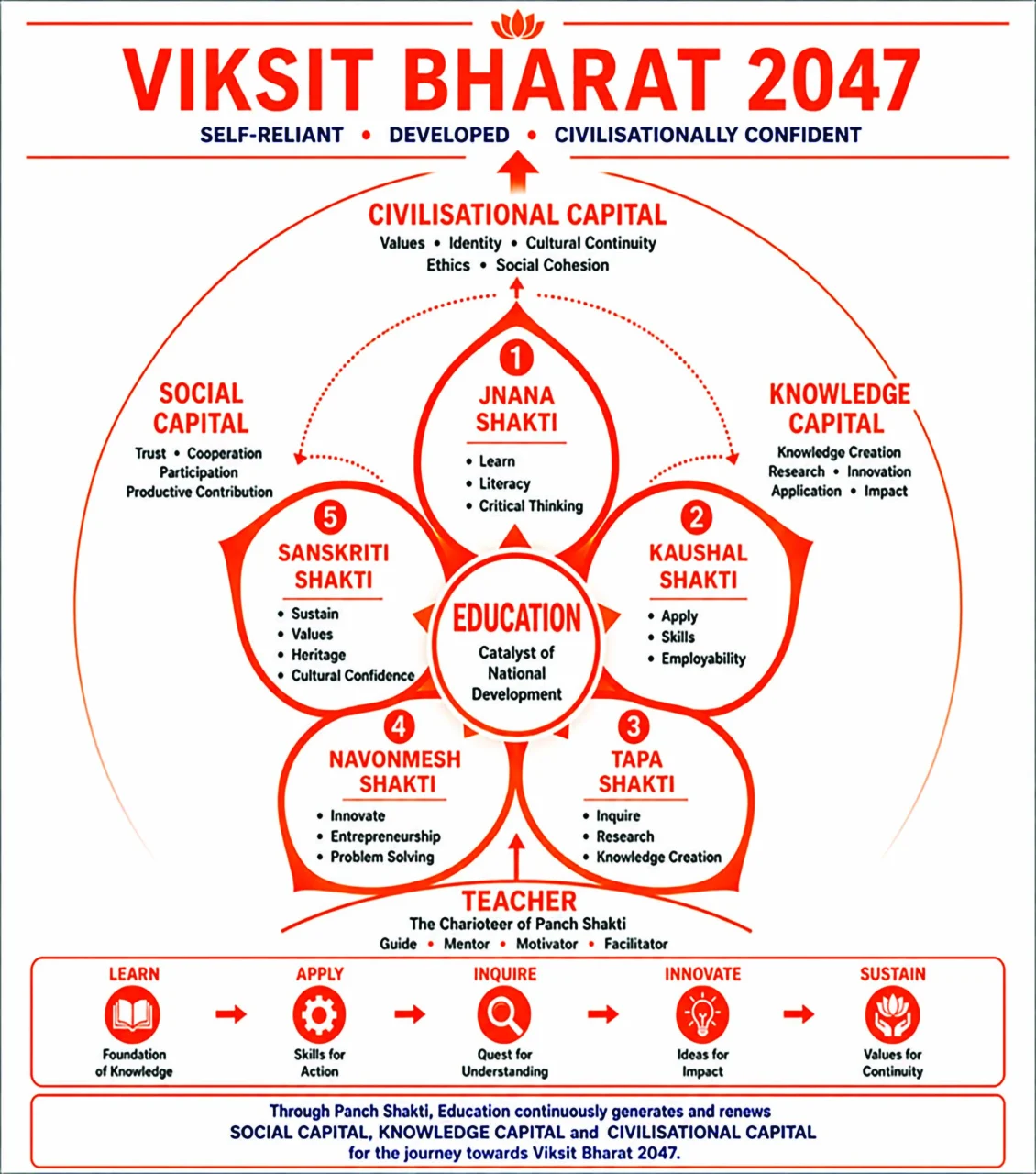
The strength of a Viksit Bharat fundamentally depends on three types of capital — Social Capital, Knowledge Capital, and Civilisational Capital. Education provided by all national institutions plays the most decisive role in generating these three. Social Capital refers to the collective responsibility, trust, cooperation, participation, and productive contributions of citizens that enable societies to progress together. Knowledge Capital means a nation’s collective ability to generate, preserve, disseminate, and apply new ideas in the development and betterment of the nation. Civilisational Capital is related to the value system, traditions, and cultural self-confidence that maintain intergenerational continuity, which fosters social cohesion and ethics to modernise societies without losing their identity.
As Bharat is moving towards achieving the vision of Viksit Bharat 2047, the central question does not merely lie in how much the Gross Domestic Product (GDP) will grow, but also whether the Bharatiya traditional knowledge can nurture these deep capabilities long-term, which are required for self-reliant (Atmanirbhar) development. Public discourse on development frequently prioritises economic growth, manufacturing output, digital infrastructure, military capability, and global influence. These vital indicators of national progress are ultimately outcomes of a deeper process. The development of any country is not limited to capital investment and the acquisition of technological knowledge. The empowerment, creativity, and self-confidence of its citizens are equally important for holistic and sustainable development. Bharat’s demographic dividend is often celebrated as its greatest asset. But demographics do not guarantee development alone. Absence of a strategic link between education and employability can shift a massive youth population from a demographic dividend to a developmental liability. This shift is crucial to achieving the objective of Viksit Bharat. Economic growth may build the physical infrastructure of a nation, but education shapes human resources, intellectual and moral foundations, with a strong and self-confident nation.
Education is a strategic enabler that influences outcomes across domains of national development. Hence, it requires a clear framework that links priorities of education with long-term national aspirations to fully realise its potential on the grassroots level.
Panch Shakti Framework
The Panch Shakti framework offers a proposed roadmap for synthesising ongoing educational reform with national development and positioning education as a catalyst for achieving the vision of Viksit Bharat 2047. Panch Shakti rests on a simple but powerful idea — a nation becomes developed when it can continuously learn, apply, create, innovate, and sustain. These five strengths form a complete cycle of national development.
In this framework, Jnana and Kala Kaushal generate Social Capital; Tapa and Navonmesh generate Knowledge Capital; and Sanskriti strengthens Civilisational Capital. The positive correlation of these three forms of capital determines the long-term developmental trajectory of Bharat. These Panch Shakti may function as an educational production tradition through which Social Capital, Knowledge Capital, and Civilisational Capital are continuously generated, renewed, and expanded.
These shaktis may also be viewed as a developmental continuum. Jnana provides the foundation for Kala Kaushal. Kala Kaushal develops the capacity for disciplined effort and mastery embodied in Tapa. Tapa generates new knowledge that fuels Navonmesh. Sanskriti ensures that innovation and renewal remain ethically grounded, socially responsible, and aligned with long-term civilisational goals. These Panch Shaktis are interconnected stages in the educational production of national capability.
If the Panch Shaktis are the horses that propel the chariot of education towards Viksit Bharat, the teacher is the charioteer who gives them direction and purpose
Nations across the world have transformed themselves through sustained investments in education, skills, research, and innovation. The world’s leading innovation economies invested heavily in education, research, and knowledge creation. Bharat’s challenge is a bit broader compared to other nations because it has to strengthen all three forms of national capital simultaneously. If Viksit Bharat is the destination, the Panch Shakti should be the educational compass that guides this journey.
National Education Policy (NEP) 2020 already reflects the elements of the Panch Shakti vision through its emphasis on foundational literacy and numeracy, multidisciplinary education, research promotion, skill integration, and Bharatiya knowledge system revitalisation. The challenge lies in grassroots implementation at a large scale. After seeing through the Panch Shakti lens, NEP 2020 is not merely a policy document of the developmental agenda enshrined in SDG 4 of the 2030. Rather, it should be seen as a resolve for nation-building to make a developed Bharat by 2047 on the foundational plank of Atmanirbharta.
Jnana Shakti: FILLIP to Learning
Knowledge of the 21st century extends far beyond baseline literacy. It encompasses critical thinking, scientific temper, complex problem-solving, and the capacity for lifelong learning. Efforts to strengthen foundational learning through missions like NIPUN Bharat, Vidya Pravesh, etc, are just the beginning. The objective is to make a strong foundation of literacy and numeracy for each child in the country and make them agile learners who can evaluate evidence and adapt to rapidly changing situations. The Panch Shakti potential can only be fully realised if quality education reaches rural communities, disadvantaged groups, and first-generation learners as effectively as urban communities, who collectively constitute the developmental aspirations of Bharat. In the era of Artificial Intelligence and hyper-automation, ‘learning how to learn’ is far more important than rote memorisation of a static syllabus.
Knowledge remains merely an abstract idea without its application. Kala Kaushal Shakti encompasses not only vocational and technical skills but also craftsmanship, creativity, and the ability to transform knowledge into meaningful action. A long-standing challenge has been the gap between academic degrees and job readiness. As a result, many graduates struggle to translate their knowledge into practical skills.
It is essential that skill development is not viewed merely in terms of the supply-demand gap for existing jobs, but also for the jobs of the future on the journey of Viksit Bharat. Vocational education, technical education, and experiential learning must be embedded seamlessly into all streams of school education and higher education. The workforce requires technical expertise balanced with human-centric soft skills like cross-cultural association and adaptability. Kala Kaushal Shakti converts demographic potential into productive national capability and ensures that Bharatiya youth can become creators of value rather than mere seekers of opportunity. Apprenticeship Embedded Degree Programmes are playing their roles in linking higher education with the requirements of the industry. At the same time, a structured roadmap for reskilling and upskilling graduates who have already completed formal education remains equally important for achieving the vision of Viksit Bharat by 2047.
Tapa Shakti: Research & Discovery
Tapa Shakti represents disciplined inquiry, intellectual perseverance, and the sustained pursuit of knowledge. History has witnessed nations that establish their global prominence when they become key producers of knowledge rather than mere consumers. Bharat’s share of global research output, patents, and high-impact innovation remains disproportionately low relative to its demographic scale and intellectual potential. Institutions that create and disseminate knowledge must make high-quality research a cultural priority and not be confined to a few elite ones.
Navonmesh Shakti
Tapa generates knowledge, and Navonmesh transforms that knowledge into value for society. The true measure of a nation’s intellectual strength lies in its capacity to convert ideas into products, services, technologies, and social solutions effectively.
The success of Digital Public Infrastructure platforms such as UPI, Aadhaar, etc and the startup ecosystem shows the potential of home-grown innovation. Navonmesh Shakti must expand beyond commercial domains and include innovative solutions of public policies, agricultural technology, and grassroots problem-solving. Navonmesh can ensure that brilliant ideas move beyond laboratories to address real-world challenges through harnessing a mindset of experimentation and calculated risk-taking.
Sanskriti Shakti: Rooted in Heritage
A nation may become economically prosperous without becoming civilisationally confident. However, it cannot become truly developed if progress is achieved at the cost of cultural continuity and social cohesion.
Bharatiya tradition has long viewed education not merely as the transmission of information but as the cultivation of the whole human being. Knowledge, skill, character, wisdom, and social responsibility were seen as complementary dimensions of learning. A developed nation requires skilled professionals and responsible citizens. The Panch Shakti framework seeks to revive this holistic understanding in a contemporary context. Sanskriti Shakti seeks to integrate Bharat’s civilisational heritage into contemporary learning.
Teachers: Builders of Viksit Bharat
No framework can translate into national transformation without those who implement it in classrooms and communities every day. No curriculum rewrite or policy document can succeed without empowered, professionally developed, and socially respected educators. If the Panch Shaktis are the horses that propel the chariot of education towards Viksit Bharat, the teacher is the charioteer who gives them direction and purpose.
To realise this vision, we must restore the teacher to the centre of our national development strategy. A nation can only match the ambition of its vision if it matches that ambition with sustained investment in the people who teach its children. Factories produce goods, laboratories give inventions, and markets produce wealth. Education produces the human beings who make all three possible. If Bharat succeeds in nurturing Jnana, Kala Kaushal, Tapa, Navonmesh, and Sanskriti, it will not merely become the largest economy in the world, but it will also reclaim its civilisation that the world learns from.