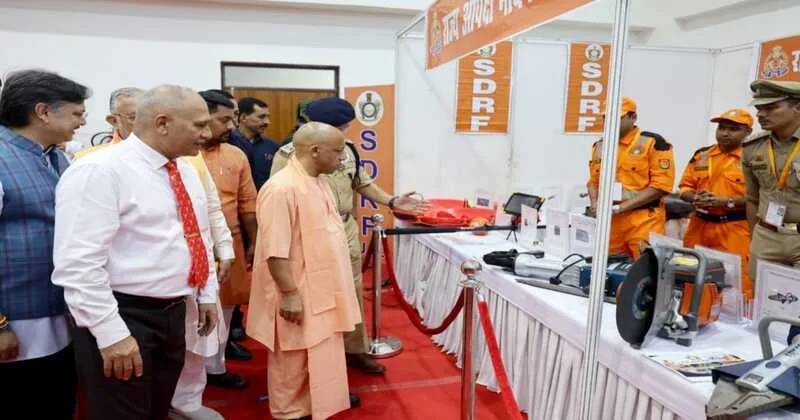
New Delhi: For decades, disaster management in India largely followed a predictable pattern: calamity struck, governments announced compensation, relief camps were established, and rehabilitation began. While such responses were necessary, the larger question remained unanswered: could many of these tragedies have been prevented in the first place? In a state like Uttar Pradesh, where floods, lightning, fires, building collapses, heatwaves and human-wildlife conflicts affect thousands every year, disaster preparedness is as important as disaster response.
The inauguration of the new Uttar Pradesh State Disaster Management Authority (UPSDMA) headquarters by Chief Minister Yogi Adityanath reflects a significant shift in governance. The message emerging from the Chief Minister’s address was clear: governance should not merely respond to disasters but anticipate, prepare for and minimise their impact through technology, awareness, institutional capacity and community participation.
A Long-Neglected Pillar of Governance
Despite the enactment of the Disaster Management Act, 2005, disaster preparedness remained a relatively underdeveloped area in many parts of the country for years. Administrative systems often focused on relief distribution after disasters rather than investing in prevention, early-warning systems, trained volunteers and public awareness.
In Uttar Pradesh, recurring floods, lightning fatalities and fire accidents repeatedly exposed the limitations of a reactive disaster management model. Training exercises were sporadic, coordination among agencies remained limited, and disaster awareness seldom reached schools or local communities in a structured manner.
This is not to suggest that previous governments ignored disaster relief rather, preparedness rarely became a sustained governance priority. Budgetary attention often favoured post-disaster compensation instead of creating institutional mechanisms capable of preventing large-scale loss of life. As climate change intensified extreme weather events and rapid urbanisation increased vulnerability, the need for a comprehensive disaster management ecosystem became increasingly urgent.
The Scale of Disaster Risk in Uttar Pradesh
-Uttar Pradesh is classified as a multi-hazard state, vulnerable to floods, earthquakes, droughts, heat waves, cold waves, lightning, fires, industrial accidents and biological disasters.
-Approximately 73.06 lakh hectares of Uttar Pradesh’s geographical area is flood-prone, making it one of India’s most flood-vulnerable states.
-The State Disaster Management Plan (2023) identifies 19 major disaster categories requiring specialised preparedness and response mechanisms.
Yogi Government Shift Towards Prevention
The Yogi Adityanath government has sought to redefine disaster management as an integral part of governance rather than an emergency response mechanism. During the inauguration of the new UPSDMA building, the Chief Minister emphasised that the true measure of success lies in preventing disasters from becoming human tragedies. He argued that awareness, preparedness and timely intervention can substantially reduce the loss of both lives and property. This philosophy represents a transition from a relief-first approach to a preparedness-first model. Instead of waiting for disaster to strike, the state aims to build systems capable of anticipating risks and protecting citizens before emergencies unfold.
Making Disaster Awareness a Social Responsibility
One of the strongest themes of the address was the need to embed disaster awareness into everyday life. The Chief Minister recalled how earlier generations routinely discussed fire safety, flood precautions and earthquake preparedness within families and schools. Over time, this culture weakened.
The government now proposes to restore this awareness by integrating disaster education into schools, community outreach programmes, teacher training and local awareness campaigns. According to the Chief Minister, disaster preparedness should become part of daily civic consciousness rather than remain confined to specialised government agencies. This community-centric approach acknowledges a simple reality: during the first few critical minutes of any disaster, ordinary citizens are often the first responders.
Strengthening the First Line of Defence
An important pillar of the state strategy is the expansion of trained volunteer networks. The government has integrated the Aapda Mitra programme with Home Guard recruitment, ensuring that trained disaster volunteers receive priority while also making disaster response training mandatory for Home Guard personnel.
The speech also highlighted improved honorariums, cashless healthcare facilities, insurance benefits and substantial financial assistance for families of volunteers who lose their lives while serving society. These reforms are intended to professionalise community disaster response while recognising the sacrifices made by frontline personnel.
Technology as a Force Multiplier
Perhaps the most significant transformation lies in the government’s emphasis on technology-driven disaster management. The Chief Minister outlined a future roadmap built upon:
-Artificial Intelligence-based risk mapping
-Satellite and remote sensing technologies
-Predictive analytics for early warnings
-GIS-enabled decision support systems
-Mobile-based citizen alert systems
-Drone-assisted search and rescue operations
Such technologies enable governments to move from reacting to disasters toward forecasting them, issuing timely warnings and coordinating faster responses. The objective is straightforward: every additional minute of advance warning translates into more lives saved.
Lessons from Lightning and Flash Floods
The Chief Minister referred to a tragic incident in which over one hundred people reportedly lost their lives in a single day due to lightning across several districts. Rather than accepting the event as inevitable, the government treated it as an institutional learning experience.
Subsequently, coordination among SDMA, NDMA, SDRF and NDRF was strengthened, and greater emphasis was placed on developing effective early-warning systems capable of informing citizens well before dangerous weather conditions emerge.
Another example cited during the speech involved a religious gathering near the Shivalik hills. Timely weather alerts enabled authorities to evacuate thousands of devotees before flash floods reached the area. Without those warnings, the loss of life could have been catastrophic. The incident demonstrated how technology, efficient administration and rapid communication can collectively prevent disasters instead of merely responding to them.
Recognising Emerging Risks
The government’s approach extends beyond conventional disasters. Uttar Pradesh became one of the first states to include human-wildlife conflict within its broader disaster management framework.
Increasing encounters involving crocodiles, leopards and other wildlife have emerged as a serious challenge in several districts. Instead of treating these incidents solely as forest department matters, the administration now emphasises awareness campaigns, mapping of vulnerable areas, rescue mechanisms and citizen education. This reflects an evolving understanding of disasters in which ecological conflicts are treated as public safety concerns requiring coordinated governance.
Building Institutions that Last
The newly inaugurated UPSDMA headquarters is intended to function as more than an administrative office. It is envisioned as a centre for coordination, research, training, simulation exercises, inter-agency cooperation and technological integration.
The Chief Minister called for partnerships with universities, research institutions, technical organisations, police, irrigation departments, schools, municipal bodies and disaster management professionals. He also advocated expanding mock drills from the state level to districts, tehsils, police stations, municipalities and village-level institutions. Institutional capacity, rather than temporary crisis management, forms the foundation of resilient governance.
Disaster Management and Good Governance
The Yogi government’s approach reflects a broader administrative philosophy in which disaster preparedness is viewed as an essential public service. Investments in technology, infrastructure, trained manpower, digital communication and community awareness reduce both human suffering and economic losses.
More importantly, disaster preparedness builds public confidence. Citizens develop trust when they know that warnings will reach them, trained personnel are available locally, and government agencies possess the capacity to respond quickly and effectively.
The Chief Minister also proposed recognising citizens, volunteers, rescue workers and ordinary individuals who save lives during emergencies. Such recognition helps build a culture where disaster preparedness becomes a collective civic responsibility rather than solely a governmental obligation.
As climate variability, rapid urbanisation and environmental pressures increase disaster risks across India, governance can no longer depend solely on post-disaster relief packages. Building resilient institutions, informed communities and technology-enabled early-warning systems has become indispensable.
The new UPSDMA headquarters symbolises this changing governance philosophy. It represents a state determined to move beyond compensation towards prevention, beyond emergency response towards resilience and beyond administrative formalities towards citizen-centric preparedness.
The transformation envisioned by the Yogi Adityanath government is not merely about constructing a new building. It is about constructing a new governance ecosystem, one where disaster management begins long before disaster strikes. If implemented consistently, this approach has the potential to make Uttar Pradesh a national model in proactive disaster governance, where preparedness, technology, public participation and institutional strength collectively safeguard every citizen against the uncertainties of nature and emerging risks.