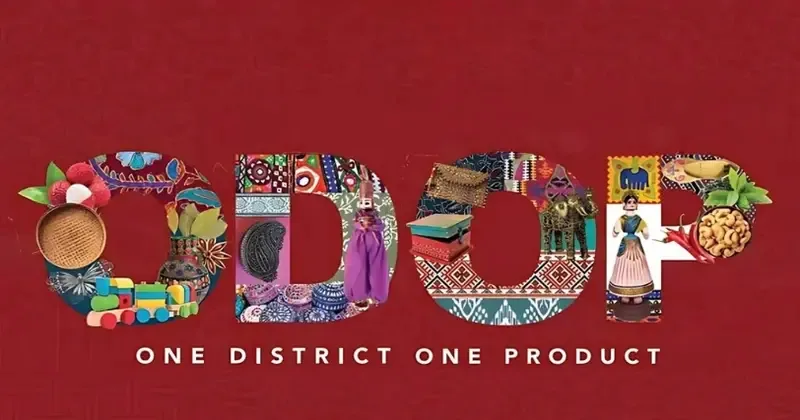
New Delhi: When the Central Government informed Parliament on July 24, Friday that 1,244 unique products had been identified across 773 districts under the ‘One District One Product’ (ODOP) initiative, it served as official confirmation of an economic transformation. This journey began six years ago when Uttar Pradesh Chief Minister Yogi Adityanath resolved to convert the traditional identity of each district into an economic powerhouse.
At the time, few could have predicted that this experiment by Uttar Pradesh would, within a few years, become an integral part of the Government of India’s economic policy and a robust foundation for national campaigns like ‘Atmanirbhar Bharat’, ‘Vocal for Local’ and ‘Local to Global.’ Today, this scheme has evolved into a comprehensive economic model, encompassing local production, employment, exports, skill development, branding, and global market access, that is being viewed as a new development strategy for India.
When development model moved beyond metropolises to reach the districts
In 2018, while launching the ‘One District One Product’ scheme in Uttar Pradesh, Chief Minister Yogi Adityanath conveyed a clear message: if a district’s traditional expertise were linked with modern technology, financial assistance, training and market access, those very local products could become engines of economic progress for both the state and the nation. This approach differed from conventional government schemes; the focus of development was not a large-scale industry, but the district itself and its unique identity. Yet, the results became evident within the very first few years of the scheme’s implementation.
Products such as Banaras silk sarees, Moradabad’s brassware, Bhadohi’s carpets, Firozabad’s glassware, Saharanpur’s wood carvings, Lucknow’s ‘Chikan’ embroidery, Aligarh’s locks and numerous other traditional goods were provided with new branding, designs, financial support and marketing avenues. Local artisans received training, banking support increased and product quality improved. Consequently, the demand for these products began to rise both domestically and internationally.
This model from Uttar Pradesh caught the attention of policymakers. The central government realized that if this concept were implemented nationwide, every district in India could develop in alignment with its specific economic potential. For this reason, the Department for Promotion of Industry and Internal Trade (DPIIT) subsequently adopted the model at the national level and, in collaboration with the states, launched a comprehensive campaign to identify unique products from every district. Today, 1,244 products have been identified across the country’s 773 districts. This signifies that development is now being driven by the distinct economic identity of each district.
PM Modi’s ‘local to global’ vision sets a new course
Over the past few years, Prime Minister Narendra Modi has consistently emphasized that India’s economic strength lies in its local capabilities. When he announced the ‘Atmanirbhar Bharat’ campaign during the COVID-19 pandemic, he also issued a call to be ‘Vocal for Local.’ Since then, he has repeatedly stated on various platforms, “If India aspires to become a leading global economic power, it must strengthen its local industries, artisans, micro and small enterprises, and traditional products. Every district in India possesses a unique specialty; we must take that specialty to the world”.
In his vision, local products are not merely cultural heritage but also the cornerstone of India’s economic competitiveness. This is why the Central Government has integrated the ‘One District One Product’ (ODOP) initiative with various national programs spanning exports, MSMEs, food processing, skill development, e-commerce and GI (Geographical Indication) tagging.
The defining feature of ODOP is that it represents a development model wherein a district’s traditional expertise is transformed into economic strength. In this model, the government’s role shifts from manufacturing the product itself to connecting the producer with markets, technology, training, quality standards and financial resources. Consequently, the initiative has expanded beyond handicrafts to encompass agricultural produce, food processing, forest products, the bamboo industry, handlooms, fisheries and local manufacturing sectors.
Districts emerging as export hubs; India’s economic structure transforming
A major success of the ‘One District One Product’ initiative is that it has provided local products access to the global market. The Central Government has linked ODOP with the ‘Districts as Export Hubs’ initiative. According to information provided in Parliament by Jitin Prasada, Minister of State for Commerce and Industry, products and services with export potential have been identified across 734 districts of the country. Exports are no longer viewed merely as an activity conducted from ports like Mumbai, Chennai, Kolkata or Kandla; instead, every district, leveraging its unique potential, is moving towards becoming a participant in global trade.
Union Minister of State Jitin Prasada explains, “To translate the set goals into reality, State Export Promotion Committees (SEPCs) and District Export Promotion Committees (DEPCs) have been constituted across all 36 states and Union Territories. Furthermore, 249 District Export Action Plans (DEAPs) have been formulated with the aim of streamlining the entire value chain, encompassing production, quality, logistics, packaging, marketing and export. This marks the first time that India’s export policy has reached the village, town and district levels.”
Market Access: A key strength
Jitin Prasada states, “The government has developed a dedicated ODOP (One District One Product) storefront on the Government e-Marketplace (GeM), featuring over 1,300 products across more than 500 categories. This has secured a place for local products within the government procurement system. Additionally, more than ten states have developed their own dedicated e-commerce platforms, enabling small producers to reach consumers directly.”
He added, “National trade fairs, exhibitions, and buyer-seller meets have also given these products a new identity. Today, there are many artisans whose products were once confined to local markets or fairs but are now reaching various states across the country and even international markets.”
India’s cultural heritage is now a global brand
It is noteworthy that the ‘One District One Product’ (ODOP) initiative is not only delivering economic benefits to the country but has also become a medium for gaining global recognition for India’s cultural heritage. Exhibitions of ODOP products have been organized in numerous countries with the support of the Ministry of External Affairs and Indian missions abroad. ‘ODOP Walls’ have been set up in Indian embassies, showcasing unique products from various states. The sale of Indian ODOP products at two international retail stores in Singapore and one in Kuwait serves as proof that local products are now attracting global consumers.
In another significant move, the Government of India has included ODOP products among the official gifts presented to foreign heads of state and delegates during various bilateral and multilateral meetings. This confluence of diplomacy and culture has given fresh momentum to the global branding of Indian products. Consequently, India is emerging before the world not merely as a vast market, but as a nation defined by unique traditional products and exquisite craftsmanship.
New strides in MSME, food processing and rural economy
A key factor behind the success of ODOP is the coordination established among various ministries. The ‘PM Formalisation of Micro Food Processing Enterprises’ (PMFME) scheme, under the Ministry of Food Processing Industries, has provided a robust foundation for the ODOP model within the food sector. Under this scheme, eligible projects receive a credit-linked capital subsidy of up to 35 percent (capped at ₹10 lakh).
Additionally, Self-Help Groups (SHGs) are being provided with facilities such as seed capital, entrepreneurship development training, product-specific skill development, shared infrastructure, common incubation centers and quality standardization. Provisions for grants of up to 50 percent to cover branding, packaging and food safety compliance are playing a crucial role in making small entrepreneurs competitive.
Similarly, the concept of the PM Ekta Mall (Unity Mall) is a significant step towards providing a sustainable market for local products. States and Union Territories with legislatures are being provided assistance of up to ₹200 crore in the form of 50-year interest-free loans for the establishment of these malls. These malls will boost the sale of ODOP (One District, One Product) items, GI-tagged goods and local handicrafts, thereby benefiting both domestic tourism and the local economy.
ODOP: The strongest scheme for an Atmanirbhar Bharat
The true achievement of the ODOP scheme today is that it has established that the path to self-reliance cannot be achieved solely through large industrial investments; empowering local talent, traditional skills and small enterprises is equally essential. This scheme has integrated millions of artisans, weavers, craftspeople, farmers, women’s self-help groups and micro-entrepreneurs into the mainstream economy. It has created new employment opportunities, boosted local incomes, and helped curb migration from villages to cities.
Prahlad Sabnani, a senior economic analyst, observes, “The way every district is emerging as a hub of production, quality, and exports based on its unique potential suggests that India’s development is becoming more balanced, inclusive and sustainable. In this context, ODOP now appears as a ‘district-driven economic development model’.”
National expansion of CM Yogi’s vision by PM Modi
Recent data presented in Parliament confirms that the initiative launched by Chief Minister Yogi Adityanath in Uttar Pradesh has now become a vital component of the national economic strategy. Under the leadership of Prime Minister Narendra Modi, it has been given a new direction by aligning it with broad campaigns such as ‘Vocal for Local’, ‘Local to Global’, and ‘Atmanirbhar Bharat’.
With 1,244 unique products identified across 773 districts and hundreds of districts being developed into export hubs, it is evident that India’s economic strength is expanding beyond metropolises to take shape in villages, towns and districts.
Indeed, ‘One District One Product’ has transformed the narrative of India’s development. Previously, development was synonymous with large industries and major cities; today, it signifies a unique identity for every district, a dedicated market for every product, and work for every artisan that upholds their dignity.
In such a scenario, it must be said that if this pace and policy continue, the day is not far off when every district in India will stand as a ‘local growth engine’ with a distinct identity in the global economy. At that point, the “Atmanirbhar Bharat Abhiyan” will no longer be merely a campaign; it will have become India’s economic reality.