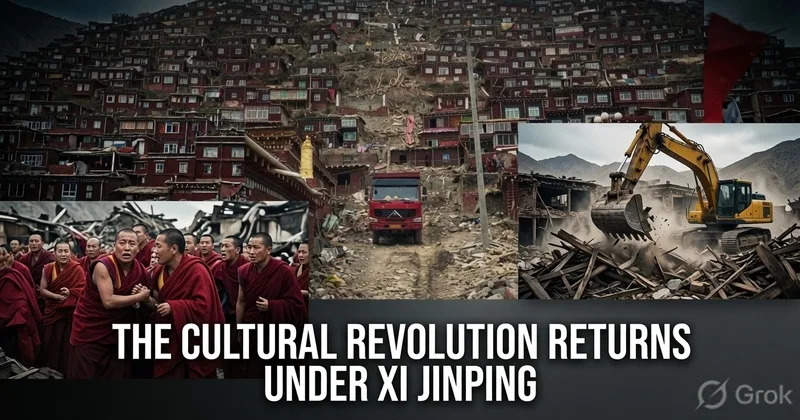
NEW DELHI: Tibet Times has reported that the Chinese government is now insensitively destroying a heritage monastery nestled in the remote, oxygen-thin Larung Valley of Serta County, eastern Tibet.
In these historic hills that once glowed with thousands of crimson wooden huts, thrived a sprawling monastic metropolis pulsing with the chants of monks and nuns deep in philosophical debate and meditation.
Today, those same hills now echo with the roar of bulldozers operating under cover of darkness.
Since July 13, 2026, Chinese authorities have systematically targeted at least 1,060 monastic residences at the famed Serta Larung Five Science Buddhist Academy, better known as Larung Gar, in what residents and exile groups describe as a ruthless campaign to shrink and subdue one of global Tibetan Buddhism’s most vital hearts.
As of July 15, at least six dwellings had already been reduced to rubble. By July 21, demolitions continued unabated. Authorities cordon off sections with fencing, spray water to mask dust clouds, and impose draconian rules: no photos, no videos, restricted movement, and heavy surveillance.
The precise number destroyed remains hidden, and the fate of evicted monastics is unclear. This is not a one-off event but the latest brutal chapter in a decades-long assault on a site that once housed up to 40,000 practitioners.
A source quoted by Tibet Times captured the despair: “Under the pretext of security risks posed by an excess of monastic quarters, the Chinese government began demolishing the residences…. Irrespective of whether the monks and nuns agree, any quarters falling within the boundary line previously set by the government are immediately being torn down.”
Pilgrims and outsiders are barred; information flow is throttled.
Chinese authorities have resumed demolitions at Larung Gar Buddhist Institute, the world’s largest Tibetan Buddhist institute, targeting approximately 1,060 monastic quarters belonging to Tibetan Buddhist monks and nuns, according to information received by the Tibetan Centre for… pic.twitter.com/i9shAvFs7C
— Tibetan Centre for Human Rights and Democracy (@tchrd_) July 20, 2026
Beacon Reduced to Rubble: The Rise of Larung Gar
Larung Gar’s story is one of miraculous rebirth and relentless suppression. The valley held sacred status long before modern times.
In 1880, the great Nyingma tertön Dudjom Lingpa established a hermitage there. During the devastating Cultural Revolution, when nearly all visible Tibetan Buddhist institutions were razed, Khenchen Jigme Phuntsok retreated to these mountains with a small group of disciples.
In 1980, he formally founded the academy with a handful of students. By 1987, the 10th Panchen Lama bestowed its full name: Serta Larung Five Science Buddhist Academy.
It blossomed into an unparalleled centre for the “five sciences” of Tibetan learning, philosophy, logic, grammar, medicine, and arts, alongside intensive study of sutra, tantra, and Dzogchen.
Monks, nuns, and lay vow-holders, including growing numbers of Han Chinese practitioners, built simple red huts by hand. The population exploded through organic growth: over 10,000 by the late 1990s, peaking estimates reaching tens of thousands.
Khenchen Jigme Phuntsok’s vision emphasized “Unity and Harmony, Pure Precepts, Listening-Reflecting-Meditating, and Spreading the Dharma to Benefit Sentient Beings.”
The academy produced hundreds of khenpos and khenmos who spread authentic teachings globally.
Khenpos and Khenmos are prestigious scholarly and teaching titles in Tibetan Buddhism, roughly equivalent to advanced academic degrees (such as a PhD or terminal master’s in Buddhist studies) combined with roles as teachers or preceptors.
Khenpos: The Tibetan term khenpo translates the Sanskrit upādhyāya, meaning “preceptor,” “religious instructor,” or “abbot.” It has both academic and institutional meanings.
Khenmo: This is the female equivalent of khenpo, recognizing nuns who have completed the same rigorous scholastic training and can teach at a high level, particularly to other nuns.
The Larung Gar centre fulfilled ancient prophecies and stood as a living refutation of the idea that Tibetan Buddhism had been crushed.
In a remote high-altitude valley, it became a vibrant university of faith, drawing seekers worldwide.
Decades of Crackdowns: From 2001 to the Present
Then the crackdowns began.
In 2001, after Jigme Phuntsok refused to cap numbers and amid demands to denounce the Dalai Lama, authorities demolished thousands of homes, expelled residents, and detained the founder.
Limits were imposed as low as 1,400. Further actions hit in 2002 and later years. The devastating 2016–2017 campaign ordered the population slashed to 5,000.
Thousands of dwellings were bulldozed; monastics were evicted, some funneled into “patriotic re-education” camps featuring forced dances and loyalty chants. At least one nun, Tsering Dolma, took her life in 2019, leaving a note decrying “unbearable oppression.”
Post-2017, CCP cadres assumed control of management, finances, admissions, and even textbooks. Grid-style surveillance, real-name registration, and color-coded tags (red for monks, yellow for nuns) were introduced.
Chinese student participation was curtailed to stem the “eastward spread” of Tibetan mysticism. By 2024–2025, over 1,000 more monastics were expelled under documentation pretexts.
Now, in 2026, coinciding with the Ethnic Unity and Progress Law’s implementation, the bulldozers have returned.
Netizens are raising their voices online
There is significant activity on X (x.com) criticizing the ongoing demolitions at Larung Gar.
Posts have surged in the past few days (especially July 22–24, 2026), with Tibetan advocacy accounts, human rights groups, and concerned individuals sharing reports, historical context, photos, and videos.
Many frame the actions as cultural erasure, religious persecution, and part of a broader Sinicization policy. Hashtags like #FreeTibet, #LarungGar, #SaveTibet, and #StandWithTibet are common.
@HistoryTibetan (Tibetan history in Pictures) shared explanatory videos and posts highlighting Larung Gar’s role in reviving Tibetan Buddhism post-Cultural Revolution, while noting current demolitions, evictions, and restrictions. Emphasizes resilience.
LARUNG GAR
📍 One of the world’s largest centres of Tibetan Buddhist learning
Founded: 1980
Purpose: Revive Tibetan Buddhism after the Cultural Revolution⚠️ Today, Larung Gar faces:
• Demolitions
• Forced evictions
• Restrictions on religious practice… pic.twitter.com/dBsTiC3fSk— Tibetan history in Pictures (@HistoryTibetan) July 24, 2026
@Polinautics_ has posted “Save Tibet” with an image, accusing China of “genocide” and seeking to eliminate Tibetan identity.
Save Tibet 💔
China has launched a new wave of demolitions at Larung Gar, the world’s largest Tibetan Buddhist institute.
China is seeking to eliminate Tibetan identity. This is “genocide” !!!! pic.twitter.com/6REv2kgXV7
— Polinautics (@Polinautics_) July 24, 2026
@BodpaW (Bodpa Warriors) shared details from TCHRD and ICT reports, noting nighttime demolitions targeting 1,060 homes and calling it part of Beijing’s campaign to Sinicize religion and erase Tibetan identity. Includes hashtags like #FreeTibet and #ReligiousFreedom.
China has restarted its demolition campaign at Larung Gar Buddhist Institute, one of the world's largest centers of Tibetan Buddhist learning.
Around 1,060 homes of monks and nuns are reportedly targeted, with demolitions carried out at night to limit public scrutiny. This… https://t.co/pZu7lzB3g2
— Bodpa Warriors (@BodpaW) July 24, 2026
Official Narrative vs. Alarming Pattern
Chinese authorities portray the demolitions as pragmatic governance: modernising a chaotic settlement, mitigating earthquake and fire dangers, and providing “ideological guidance” to align religion with socialism.
A 2016 order framed it as necessary for stability. Recent moves tie into broader Sinicization policies under President Xi Jinping, demanding religions “merge with Chinese culture” and submit to Party leadership.
Independent observers and Tibetan voices paint a darker picture. The International Campaign for Tibet (ICT) links the latest actions to tightened assimilation.
Free Tibet and Human Rights Watch argue the campaign aims to neuter Larung Gar’s influence as an independent centre of Tibetan identity and learning. Large monastic gatherings are inherently suspect after 2008 unrest.
Night-time operations and media blackouts suggest intent to evade global scrutiny and satellite imagery.
The human toll is shocking: families losing homes they built with their hands; scholars torn from libraries of priceless texts; young practitioners stripped of their path.
Evictees face dispersal, monitoring, or re-education. A once-thriving international community has been decimated. Satellite imagery and smuggled reports have repeatedly documented the physical slicing of the hillside “like a melon.”
International Condemnation and What Remains at Stake
International condemnation has been consistent: European Parliament resolutions, UN experts, U.S. State Department reports.
In 2020, 39 countries highlighted Tibet alongside Xinjiang at the UN. Yet on the ground, pressure only intensifies.
Larung Gar is more than huts and headcounts. It is a heritage site of living Vajrayana tradition, a bridge between cultures, and a symbol of post-Cultural Revolution revival.
Its destruction strikes at the core of Tibetan civilizational continuity, language, philosophy, contemplative science, in an era when global interest in these teachings surges.
As dust settles on fresh ruins in the Larung Valley, the world faces a stark question: Can a faith and culture survive when its most vibrant institutional home is repeatedly dismantled under the guise of public order?
Residents, watching their sacred red city shrink under floodlights at night, cling to the Dharma’s timeless truth that outer forms may fall, but inner realization endures. For now, however, the bulldozers are winning.