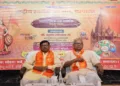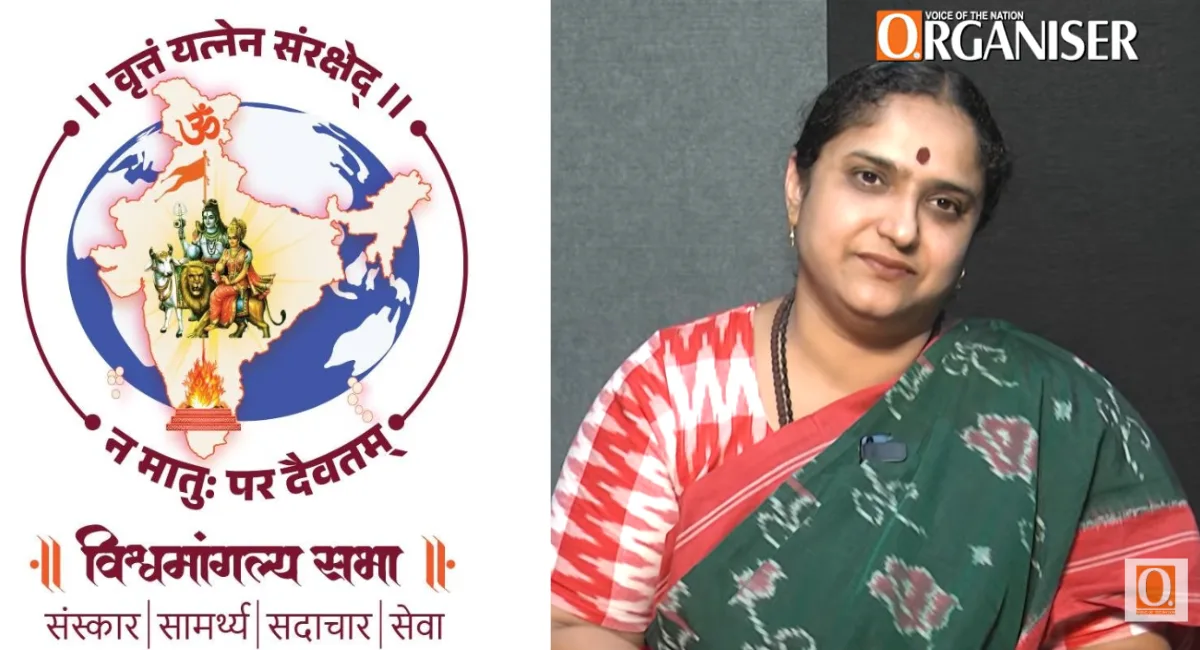
Ahead of two major lectures on Yuganukul Matrutva (Contemporary Motherhood) by RSS Sarsanghchalak Dr Mohan Bhagwat in Delhi on July 24 and Bhagyanagar on July 26, Organiser spoke to Dr Vrushali Joshi, All India Organising Secretary of Vishvamangalya Sabha. A physiotherapist by education, Dr Joshi has been associated with the organisation’s mission of promoting motherhood-centred social transformation across Bharat. In this interview with Kunti Surender Kumar, Bureau Chief (South), Organiser, she discusses the concept of Yuganukul Matrutva, the challenges facing mothers today, the organisation’s work over the past 16 years, and why it believes motherhood is central to nation-building, family-building and social transformation.
Question: Could you tell us about Vishvamangalya Sabha, how it was founded, and why the organisation focuses specifically on motherhood?
Answer: Vishvamangalya Sabha is an organisation that started 16 years ago in Nagpur on 19 January 2010. The idea of the organisation came from Param Pujya Jitendranath Maharaj, a Peethadheesh from Amravati district, and it later evolved into a social organisation.
We specifically work on motherhood because, in every home, the most important person is the mother. As a doctor, I often explain it from a medical perspective. Just as a disease is treated by addressing its root cause, we believe the problems facing the nation—from rising crime rates to various social issues—must also be addressed at their roots.
The roots of the nation lie in our homes, and the mother is the DNA of that unit. If we want to transform society, we must first transform our homes through the mother. Therefore, the mother’s role is central to nation-building, family-building and society-building, which is why Vishvamangalya Sabha specifically focuses on mothers.
Q: What are the regular activities of Vishvamangalya Sabha? Over the last 16 years, what kind of activities have you been conducting?
A: We have our own system of operations. Every month, in every area, there is a gathering called Sadachar Sabha, where around 50 to 60 women come together. They sing a geet, recite shlokas, practise dhyan (meditation) and pranayama, play games, and discuss one of twelve different topics assigned across the twelve months of the year. They also organise lectures during these gatherings. At present, we have at least 350 Sadachar Sabhas functioning across the country, and all the topics discussed relate to motherhood.
Apart from this, we have different age groups and many Karya Vibhags (activity divisions). For children, we have Bal Sabha. For girl students in universities and colleges, we have Vishva Mangalya Chhatra Sabha, specifically meant for girl students.
We also have Vishva Mangalya Swanath Parishad. Since we work for mothers, we thought about how to utilise this manpower. We decided that every child in the country should have a mother. As the famous dialogue goes, “I have a mother.” Vishva Mangalya says, “Hamare paas maa hai.” We do not call an orphan an anath; we call him a Swanath—someone who possesses self-esteem.
We also have eight types of Karya Vibhags through which we work among eminent women, professionals, bureaucrats and Janpratinidhis (public representatives). Across the nation, there are around 57 lakh Janpratinidhi families, and these are highly influential families.
As Samarth Ramdas Swami told Chhatrapati Shivaji Maharaj, “Shodhavi gharachi ghare”—search for the homes of the homes. If we want to take our concept across the nation, we must reach the families of those who are leaders. The mothers, wives and daughters-in-law in these families are influential mothers. If we want these homes to become ideal families, we must orient the mothers of those homes.
That is why we have Janpratinidhi Matru Sabha as one of our Karya Vibhags. In the same way, we work among bureaucrat families and professional families through our Sampark Vibhag. In this manner, we have built a complete organisational structure.
Question: Vishvamangalya Sabha is organising two major events in Delhi (July 24) and Bhagyanagar (July 26) on the theme of Yuganukul Matrutva, to be addressed by RSS Sarsanghchalak Dr Mohan Bhagwat. What is the significance of these programmes?
A: For the past 16 years, we have been working on motherhood and have been asked many questions about the challenges facing today’s mothers—work-life balance, nurturing children, preserving sanskaras and adapting to the demands of the modern age. As an organisation working in this field, we feel it is our responsibility to provide the right answers.
That is why we have organised two major lectures by RSS Sarsanghchalak Param Pujya Shri Mohan Bhagwat ji on Yuganukul Matrutva (Contemporary Motherhood). He is widely regarded as a social leader and one of the country’s foremost thinkers. He will deliver the lectures on 24 July at Dr Babasaheb Ambedkar International Centre, Delhi, and on 26 July at Komaram Bheem Adivasi Bhavan, Bhagyanagar, followed by an interaction with eminent women from across the country.
Question: What exactly is Yuganukul Matrutva? How does it differ from the so-called modern concept of motherhood?
A: There is no difference in the essence of motherhood. Yuganukul Matrutva consists of two words—Yuganukul and Matrutva. Matrutva is Ritam, an eternal truth that never changes. What changes is the Yuga, or the times. If we want that eternal truth to remain relevant in today’s era, we must adapt ourselves to changing circumstances. The truth itself does not change, but to preserve that truth unchanged, we have to change the surrounding environment. That is what Yuganukul Matrutva is all about.
Question: Some feminists argue that motherhood is a burden and a hurdle to a woman’s personal and professional career. How does Vishvamangalya Sabha view this narrative?
A: Our entire value system is based on duties, not rights. When we begin to see the world only through the lens of rights—”My rights. My body. My space. My independence.”—we end up quarrelling over everything. But we are Indians, and our entire thought process is rooted in duties and responsibilities.
Our culture gave the world the concept of Nishkam Karma Yoga. If Nishkam Karma Yoga were to take a human form, it would be that of a mother, because she is the embodiment of selfless service. Therefore, we cannot always view life only through the prism of rights. We must also think in terms of duties and responsibilities.
Motherhood is the greatest responsibility of a woman. Being a mother is a social responsibility, not merely a personal choice of being independent and detached from society.
Question: Today we are witnessing several criminal cases involving women, and parenting itself has become a major challenge. How does Vishvamangalya Sabha address these challenges?
A: We work on two different aspects—parenting and motherhood. They are not the same. Parenting is about raising children, while motherhood is about building the personality and character of a mother. Our objective is to build a strong mother in every family so that she can raise her children with confidence and values. When the mother is strong, parenting naturally becomes more effective.
Today, if someone wants to become a doctor, engineer or lawyer, they spend years studying and training. But when a woman becomes a wife, a daughter-in-law and eventually a mother, there is no formal training to prepare her for that role. Yet, perfection is expected from her immediately. This often leaves her confused and under stress.
At Vishvamangalya Sabha, we seek to bridge this gap. We have prepared a motherhood syllabus that guides women on how to become good mothers. Through this guidance, they gain the understanding and confidence to face the challenges of motherhood and parenting effectively.
Question: In the Indian context, whom do you consider to be iconic mothers? When you speak about contemporary motherhood, what examples inspire your vision?
A: Jijabai, the mother of Chhatrapati Shivaji Maharaj, is the iconic example. She understood the contemporary situation of her time and found the solution by shaping the strong character of Shivaji Maharaj, giving such a leader to the nation.
In the same way, there is a story from the childhood of Narendra (Swami Vivekananda). His father once took him on a trip in a horse cart. In those days, the horse-cart driver used to wear a white kurta, a cap with a red feather, and drove the carriage. During the journey, his father showed him the bungalows of a Collector, a judge and other prominent people. When they returned, his father asked, “I showed you so many big bungalows. When you grow up, which one among these do you want to become?”
The young Narendra replied, “I want to become that horse-cart driver.” His father became angry and slapped him.
His mother, Bhuvaneshwari Devi, then called him near, wiped his tears and took him to a picture of Shri Krishna and Arjuna on the wall. She told him, “If you want to become a horse-cart driver, then become a horse-cart driver like Him, who guided the whole world.” That inspiration shaped Narendra’s vision. Vishvamangalya Sabha wants mothers who can give such inspiration to their children even today.
Similarly, Guru Gobind Singh ji and his family exemplified ideal parenthood. After all four of their sons attained martyrdom—two were bricked alive into a wall and two were killed in battle—his wife said: “Desh dharm ke vaaste maar diye sut chaar.” Guru Gobind Singh Ji replied: “Chaar mare to kya hua? Ye jiye kai hazaar.”
Such parents understood the contemporary situation of their time. They knew the responsibility of a mother and the role of a father, and they lived according to those ideals. They gave their children the education and values required for that era.
In the same way, today’s contemporary mother must understand the challenges of the present age. She needs the vision to know what her role is in transforming society and how she should prepare the next generation. That is exactly what Vishvamangalya Sabha is working to build.
Question: What do you see as the biggest challenges facing motherhood today? What is preventing mothers from imparting the right values to the next generation?
A: The biggest challenge I see today is that the innocence of small children has disappeared, the paurush (valour) of the youth has diminished, and the maturity of the elderly has also declined. In such a situation, no age group is ready to understand what is actually needed.
Even among women, there is a need to explain very basic things because they are becoming victims of powerful narratives. For example, an advertisement shows a mother cooking while everyone in the family keeps asking her for something—her husband asks, “Where is my wallet?”; her father-in-law asks, “Where are my spectacles?”; her mother-in-law asks, “Where is my book?”; her son asks for something, and finally her daughter asks, “Maa, where are you?” This is presented as a negative narrative.
But this is the mother—the one who serves everyone, who works selflessly for the family, who belongs to everyone and dedicates her life without any selfish motive. If we lose such a mother, how will we build a good society? This selfless mother is our greatest asset.
Sister Nivedita had also said that Bharat is blessed with mothers who live selflessly, and that is why this country is so strong.
Today, if we change the very character of the mother by putting the virus of ‘rights’ into her mind—asking her to demand rights for everything, to the extent that she says, “I do not even want motherhood”—then she begins to reject even the role that nature has given her. She starts quarrelling even with nature itself. If we create such a mother, how can we expect to build a good society?
Question: What message would you like to give to mothers who are not yet connected with Vishvamangalya Sabha?
A: At Vishvamangalya Sabha, we believe that today’s mother is a very capable mother. Today’s woman is strong, educated, has her own opinions, and is ready to face every kind of situation.
When we speak of the ideal society of the Vedic age, we remember women like Gargi, Maitreyi and Lopamudra. They were not confined only to household work. They were learned women who expressed their views in every sphere—social, political and intellectual—and even composed Richas in the Vedas.
We believe today’s woman is equally capable. The only difference is that Gargi and Maitreyi were deeply connected to their Bharatiya roots, whereas today’s woman has become disconnected from those values. If we reconnect her with those roots, Bharat can once again build a prosperous society. That is our narrative.
Today, a major allegation is made that Bharatiya culture suppresses women. But our tradition has always regarded the woman as the Lakshmi of the house. Until recently, when the father earned his salary, he would first place it in the mother’s hands. She would offer it before Bhagwan, and the keys of the household locker remained tied to her waist. Even today, this tradition survives in many homes.
The problem began when the idea of extreme individualism entered society—”My income is mine; yours is yours.” As a result, the woman of the house, who was once the Lakshmi of the family, began stretching out her hand before the family. When the Lakshmi of the house has to stretch out her hand, poverty enters society.
Our Bharatiya tradition has always believed in giving women financial strength, not merely financial independence. We placed the keys of the household in her hands. Even in the Mahabharata, Draupadi is described as the treasurer of Indraprastha, managing its finances.
We have forgotten these values of our own civilisation and have become busy quarrelling over everything while looking only towards others. If we reconnect society with its own roots, Bharat can once again offer the world a powerful narrative on the dignity, strength and role of women.
Question: How can mothers connect with Vishvamangalya Sabha if they are not already associated with the organisation?
A: Mothers can connect with us through the Vishvamangalya Sabha website and our social media platforms. Our Central Office is in Nagpur, and we have teams working in cities across the country.
All the details about our activities and contact information are available on the website. We have an organisational network spread across 33 prants, with work extending from Jammu & Kashmir to Kerala and Tamil Nadu. Across the country, 3,500 dayitvadhari karyakartas are working with the organisation, and nearly six lakh women are connected with Vishvamangalya Sabha.