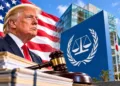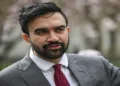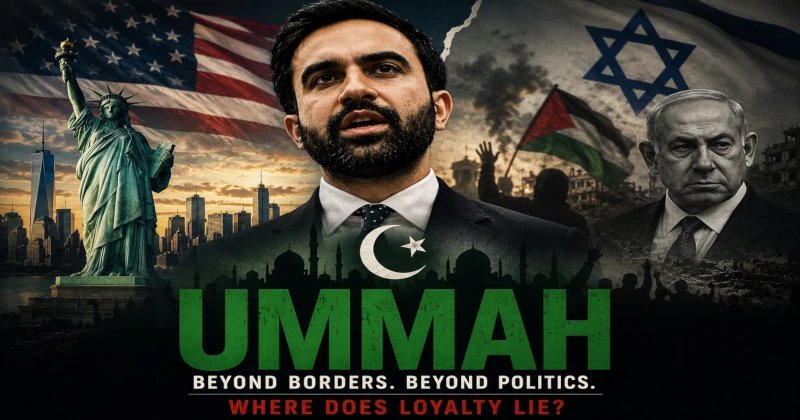
Zohran Mamdani, a representative of New York, one of the world’s most influential metropolises, finds himself at the centre of global political criticism once again. This time, the controversy stems from his public demand to enforce the arrest warrant issued by the International Criminal Court (ICC) against Israeli Prime Minister Benjamin Netanyahu.
Mamdani stated that while New York City lacks the legal authority to execute such an arrest, the US federal government should honour the ICC warrant and take action. He further declared that “Benjamin Netanyahu is not welcome in New York City.”
When a representative from a city like New York uses such language, the political implications naturally become significant. This has reignited the debate surrounding Mamdani’s ideological politics. This stance has previously embroiled him in controversies regarding issues such as India, Prime Minister Narendra Modi, the Ram Mandir and the Gaza war. Critics characterise this as an extension of “Ummah-based identity politics,” wherein he harbours hostility toward Israelis, Hindus, and other non-Muslims.
A Statement Amidst Rising Antisemitic Incidents
Mamdani’s statement comes at a time of growing concern regarding antisemitic incidents in the United States. According to the Anti-Defamation League (ADL), 6,274 antisemitic incidents were recorded in the US in 2025; the report for 2026 is yet to be released. Available data indicates that the number of violent attacks against Israelis has reached its highest level in decades. Just a day prior, a New York resident named Raul Morales (51) attacked two individuals, one Asian and one Jewish, with a knife and a screwdriver in the Upper West Side while shouting “Allahu Akbar.” In this regard, New York has been a key focal point for these events.
For this reason, Jewish organisations have also reacted strongly to Mamdani’s statement. Israel’s Ambassador to the United Nations, Danny Danon, stated that the Mayor of New York has a duty to serve the city’s residents, not to issue political statements that further polarise society. He argues that Mamdani’s statement amounts to delivering a political verdict before the judicial process has even concluded; declaring someone a “war criminal” before a court case has ended runs counter to fundamental principles of justice.
Categorically rejecting these allegations, Israel maintains that it is waging a war of self-defence following the terrorist attack carried out by Hamas on October 7, 2023, and that its military operations target Hamas, not civilians.
Interestingly, Mamdani himself has acknowledged that the New York City administration lacks the authority to execute an ICC arrest warrant. In a video message, he stated that the city’s legal department had reviewed all options and concluded that the municipal administration could not take such action independently. Nevertheless, he called upon the federal government to intervene. Earlier, during his election campaign, Mamdani had publicly stated that if a legal avenue existed, he would attempt to have Netanyahu arrested through the New York Police Department.
America’s Distinct Constitutional Position
The most significant aspect of this entire controversy is America’s constitutional position. The United States is not a member of the International Criminal Court (ICC); therefore, ICC orders are not automatically binding on the US. For this reason, President Donald Trump has already clarified that Netanyahu will not be arrested in the US under any circumstances. He has characterised the ICC’s actions as political and biased. Consequently, Mamdani’s appeal appears to have no immediate legal impact; instead, it is being viewed primarily as a political message.
Mamdani’s History of Anti-India Statements
It is worth noting that Mamdani had previously publicly referred to Indian Prime Minister Narendra Modi as a “war criminal” and held him responsible for the 2002 Gujarat riots, even though the Supreme Court of India had already exonerated Prime Minister Modi in the matter. Mamdani also claimed that “no Muslims are left in Gujarat,” an entirely false statement. According to the official 2011 census, the Muslim community constitutes approximately 9.67 per cent of Gujarat’s total population; this translates to a Muslim population of roughly 5.847 million (58.47 lakh), representing about one-tenth of the state’s total population.
Mamdani described the inauguration of the Ram Mandir in Ayodhya as a “celebration of the mosque’s demolition” and a symbol of “Hindutva fascism.” This statement contradicted the Supreme Court’s verdict and the faith of millions of Hindus. In January 2024, he also participated in protests held in New York against the Ram Mandir’s consecration ceremony. Derogatory slogans against Hindus were allegedly raised during these rallies. Based on these statements, it is evident that Mamdani is engaging in identity politics centred on Islamic identity regarding select issues, all while operating under the guise of left-liberal politics.
Association with Radical Groups
Zohran Mamdani’s controversies often garner attention due to his associations with organisations and individuals facing serious allegations. He recently met Imam Siraj Wahhaj, who has been accused of having ties to the conspirators behind the 1993 World Trade Centre bombing. Zohran Mamdani has also been linked to organisations like the Indian American Muslim Council (IAMC). This organisation engages in anti-India propaganda, fosters an atmosphere of fear and mistrust by accusing Hindu groups of “Hindutva terrorism” and runs anti-Hindu campaigns.
Ideological Allegations Against Mahmood Mamdani
Critics of Zohran Mamdani believe that the roots of his controversial views lie in his family background. His father, Professor Mahmood Mamdani, a writer of Ugandan origin, has also faced serious ideological allegations. In his books and lectures, he has attempted to provide an ideological basis for Islamic extremism and violence. In one book, he portrayed the creation of Pakistan as a “necessity for religious unity” while attempting to depict the roles of Jinnah and certain Islamic leaders in a relatively benign light.
Mahmood Mamdani has also stated that Islam does not recognise the concept of “nationalism,” but rather the concept of the “Ummah”, the global Muslim community, which cannot be divided by borders. Critics and some Indian intellectuals believe that this idea indirectly provides an ideological foundation for extremist concepts like “Ghazwa-e-Hind.” In essence, Mahmood Mamdani has attempted to justify Islamic violence and terror in his writings ideologically; this influence is also evident in his son Zohran Mamdani’s politics, where opposition to Israel, India and Hindus is legitimised in the name of progressivism.
Critics also argue that Mamdani’s rise in the US exemplifies the ideology of “Islamo-Marxism,” which is gaining influence within Western politics and academic institutions. According to them, this ideology is manifesting as an alliance between “woke” leftism and Islamist identity politics, a trend evident in pro-Palestine protests across cities like New York, Berlin, Paris and London.
In this context, it is also alleged that radical Islam has expanded its ideological acceptance in Western society by cloaking itself in the guise of Marxist, socialist and progressive politics, despite being, in reality, an illiberal and regressive ideology. Some critics further claim that a strategic alliance between global Islamist groups and practical Marxism could pose a long-term challenge to the West.
Furthermore, allegations have been raised that a significant portion of Mamdani’s election campaign was funded by the Council on American-Islamic Relations (CAIR), an organisation described as a supporter of the Muslim Brotherhood. This reinforces the argument that the Islamo-Marxist ideology has co-opted the leftist agenda, a phenomenon whose effects are beginning to be observed in India as well.
The Politics of ‘Ummah’
This is precisely where the most significant ideological debate regarding Mamdani’s politics arises. Critics argue that he prioritises political issues concerning the global Muslim community over local administrative matters. It is in this context that the term “politics of Ummah” is employed; in Islamic tradition, “Ummah” refers to the worldwide Muslim community.
Under this concept, an individual prioritises support for Islam and the Muslim community, regardless of the magnitude of the dispute. No matter how grave a crime a follower of Islam may commit, the imperative under the “Ummah” framework is to stand by them when among non-Muslims. According to critics, this very tendency is evident in Mamdani’s current political style.