New Delhi: On 15 August 1969, India was still finding its feet as a young republic, a powerful organisation was born out of a fishing village in Thiruvananthapuram that would go on to redefine the nation’s place among the stars. The Indian Space Research Organisation (ISRO) emerged from the Indian National Committee for Space Research (INCOSPAR), which had been set up in 1962 under the visionary physicist Dr Vikram Sarabhai. Today, that same organisation stands at the threshold of a new era, one in which private Indian companies are building and launching their own rockets and the state is no longer the sole custodian of India’s space.
Dr Sarabhai’s Vision and First Launch
Dr Sarabhai’s founding vision for the Indian space programme was strikingly different from the space race narrative of the Cold War superpowers. He was clear that India had no interest in competing with the moon missions of the United States and the Soviet Union merely for prestige. Instead, he believed space technology must be harnessed to solve the everyday problems of ordinary Indians such as irrigation, communication, education and disaster management. This philosophy shaped everything that followed.
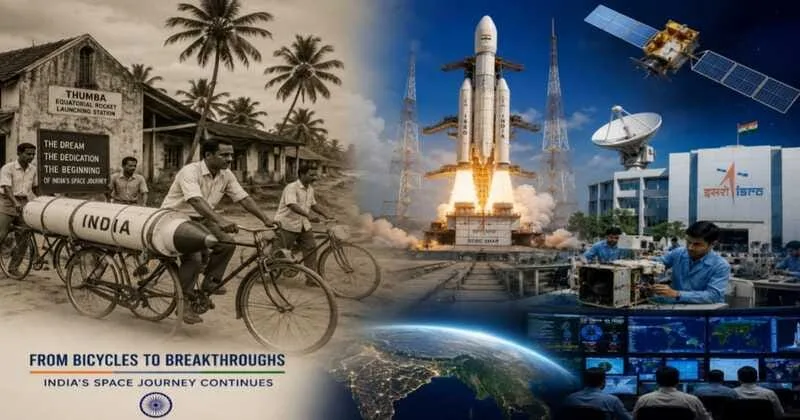
The Thumba Equatorial Rocket Launching Station, established in 1963 near Thiruvananthapuram, became the cradle of Indian rocketry. The stories from that period are now part of scientific folklore: how components for India’s first rocket experiments were transported on bicycles and bullock carts because the country lacked even basic infrastructure for space research. It was from these humble beginnings that a young scientist named A.P.J. Abdul Kalam, who would later become President of India, began his journey working alongside Sarabhai.
India’s first satellite, Aryabhata, was launched on 19 April 1975, but it had to be launched using a Soviet rocket, since India did not yet possess its own launch capability. That dependency became the driving force behind decades of indigenous effort, where the Satellite Launch Vehicle (SLV) programme of the 1970s and 80s, followed by the Augmented Satellite Launch Vehicle (ASLV), the workhorse Polar Satellite Launch Vehicle (PSLV) and eventually the Geosynchronous Satellite Launch Vehicle (GSLV) family, including the powerful GSLV Mk-III (now called LVM3).
By the time Chandrayaan-1 was launched in 2008, ISRO had already proven that it could achieve extraordinary results on shoestring budgets with a reputation for frugal engineering that would later earn global admiration when the Mars Orbiter Mission, Mangalyaan, succeeded in its very first attempt in 2014 at a cost lower than that of many Hollywood space films. Chandrayaan-3’s historic soft landing near the Moon’s south pole in July 2023 cemented India’s place as the fourth nation to achieve a lunar landing and the first to do so near the lunar south pole, a region of immense scientific value due to its permanently shadowed craters believed to contain water ice.
Opening the Gates: The 2020 Reforms
For over five decades, the Indian space programme remained almost entirely a government affair, run through ISRO’s network of centres, the Vikram Sarabhai Space Centre for launch vehicles, the U R Rao Satellite Centre for satellite design and the Space Applications Centre for payloads and sensors. Private industry existed only as a contractor supplying components, never as an independent player building or operating space assets of its own.
This changed decisively in 2020, when the Government of India announced sweeping space sector reforms as part of its broader Atmanirbhar Bharat push. The government created the Indian National Space Promotion and Authorisation Centre (IN-SPACe) as a single-window, autonomous nodal agency empowered to authorise, promote and regulate the space activities of non-government entities, from building launch vehicles and satellites to operating ground infrastructure. Private companies were also permitted to use ISRO’s own testing and launch facilities on reasonable terms, lowering the enormous capital barrier that had historically kept new entrants out of the sector.
Alongside IN-SPACe, the government set up New Space India Limited (NSIL) as the commercial and production arm of the Department of Space, tasked with transferring ISRO-developed technologies to industry and aggregating demand for launch services. The Indian Space Association (ISpA), launched in October 2021 as the apex industry body, gave private players a collective voice in policy dialogue with the government, explicitly framing its mission around the goal of an Atmanirbhar and technologically self-reliant India.
In 2024, the government went further, liberalising foreign direct investment norms for the space sector and dividing it into distinct sub-sectors for satellite manufacturing and operation, launch vehicles and ground infrastructure, each with tailored FDI ceilings. This was designed to attract global capital into Indian space start-ups while ensuring strategic and security-sensitive activities remained tightly regulated.
The Private Sector Takes Flight
The results of these reforms are now visible in the sky, quite literally. In November 2022, Hyderabad-based start-up Skyroot Aerospace, founded in 2018 by former ISRO engineers Pawan Kumar Chandana and Naga Bharath Daka, created history with the launch of Vikram-S, India’s first privately developed rocket. Named in tribute to Dr Vikram Sarabhai himself, the suborbital rocket lifted off from the Satish Dhawan Space Centre in Sriharikota under Mission Prarambh, meaning “the beginning.” It was a modest craft by international standards, just six metres long and 545 kilograms, but its symbolic weight was immense for the first time: a rocket built entirely outside government walls had touched the edge of space.
That beginning matured into something far more consequential this July. On 18 July 2026, Skyroot’s orbital rocket Vikram-1 lifted off from Sriharikota on Mission Aagaman (“Arrival”), successfully placing its payload into a 450-kilometre orbit roughly fifteen minutes after launch. The achievement made India only the third country in the world, after the United States and China, to demonstrate private orbital launch capability.
Standing 22 metres tall and capable of carrying payloads of up to 350 kilograms, Vikram-1 carried customer satellites and in-orbit experiments, and its success has been described by industry observers as marking the dawn of a genuinely new chapter for Indian spaceflight. Skyroot itself became the first Indian space company to cross a billion-dollar valuation earlier this year, reflecting the scale of investor confidence the sector has begun to attract.
Skyroot is not alone. Chennai-based Agnikul Cosmos, Bengaluru’s Pixxel building indigenous earth-observation satellite constellations, and dozens of other start-ups are now part of an ecosystem that IN-SPACe reports has grown to include more than 1,200 registered start-ups and over 6,400 users on its digital platform, with hundreds of applications received for satellite development and deep-space exploration activities. A dedicated venture capital fund has also been structured to support these companies through their growth stages, with investments ranging up to several crore rupees depending on a start-up’s maturity and demonstrated impact on India’s space capabilities.
The government ambitions go well beyond enabling a handful of successful start-ups. Speaking on National Space Day in August 2025, Prime Minister Narendra Modi urged the Indian private sector and start-up community to work towards a target of fifty rocket launches a year, asserting that the government possessed both the intent and the policy will to enable the next generation of reforms required to get there. He also announced that the first PSLV rocket built entirely by the private sector would soon take flight, a milestone that would mark private industry’s entry into building ISRO’s own proven launch vehicle, not merely new start-up rockets. The Prime Minister pointed to how space technology was already easing the lives of ordinary citizens, from satellite-based crop insurance assessments and safety alerts for fishermen to disaster management and the geospatial backbone of the PM Gati Shakti infrastructure planning platform.
Atmanirbharta Beyond the Launch Pad
The idea of Atmanirbhar Bharat in the space sector is not confined to rockets alone. It also runs through India’s collaborative missions with the world’s leading space agencies, conducted from a position of technological confidence rather than dependence. The NISAR satellite, jointly developed with NASA and launched on 30 July 2025 from Sriharikota, is a case in point: a mission built on an equal partnership rather than one-way technology transfer, reflecting how far Indian capability has come since the days when even a satellite like Aryabhata needed a foreign rocket to reach orbit.
India’s growing technological maturity was further underscored in January 2025, when ISRO successfully carried out an in-orbit satellite docking experiment, making India the fourth country in the world to demonstrate this complex capability, essential for future space station operations. The government has since approved the development of a five-module Bharatiya Antariksh Station, with the first module targeted for launch by 2028, alongside a roadmap that includes Chandrayaan-4, the Venus Orbiter Mission, the Gaganyaan human spaceflight programme and a reusable Next Generation Launch Vehicle, all building towards the government’s Space Vision 2047, which envisions an Indian astronaut on the Moon by 2040.
Public sector undertakings such as BHEL, HAL and BEL continue to play a supporting role in manufacturing critical components and infrastructure, ensuring that the ecosystem’s self-reliance extends across the supply chain and not merely to the marquee start-ups making headlines.
The distance between the bullock carts of Thumba in the 1960s and the orbital rocket that lifted off from Sriharikota this July captures, in a single image, the arc of India’s space journey. What Dr Vikram Sarabhai began as a state-led mission to serve the needs of a developing nation has, under the Atmanirbhar Bharat framework, evolved into a vibrant public-private partnership capable of competing in the global commercial space economy. ISRO remains the backbone and the mentor of this ecosystem, but it is no longer working alone. With policy reforms, regulatory facilitation through IN-SPACe, capital support and a clear national vision extending to 2047, India’s space story is entering a phase where self-reliance is no longer an aspiration but a demonstrated, launch-tested reality.