The European Union (EU) has granted several concessions to Pakistan in terms of market access since 2014 under what is called GSP+. As such, the EU now accounts for 28 per cent of its total exports, making this preferential market access a lifeline for its economy. This Generalised Scheme of Preferences Plus (GSP+) is due for review in the near future, and at stake are exports worth $7.5 billion and tariff concessions worth $730 million.
The grant of this status resulted in a 108 per cent increase in Pakistani textile exports to the EU due to concessional tariffs. In October 2023, the EU Parliament extended the GSP+ status for another four years until 2027 for Pakistan. Now, the time for review and scrutiny of Pakistan’s record for possible renewal or termination of GSP+ is drawing near.
The upcoming GSP+ monitoring mission will scrutinise Pakistan’s record on 27 international conventions. Maintaining this status is considered critical for Pakistan to keep export costs low. Loss of the GSP+ status can deal a serious economic blow to Pakistan, but there is a very real chance of this happening.
Record of Adherence to Global Conventions
Overall, GSP+ has been a big carrot that Pakistan has been munching on with gay abandon, but the time for the proverbial stick will arrive soon. The GSP+ arrangement has increased trade and created additional jobs in Pakistan, but the government now needs to improve its record on governance and human rights significantly. Since this looks like a tough task, Pakistan losing its GSP+ status, which it has enjoyed for the past 12 years, is under serious threat.
So far, Pakistan’s compliance record with GSP+ conditions has been dismal, and two general elections since this status was granted have been highly controversial, particularly those held in February 2024. The nation’s human rights record and that pertaining to personal freedoms, over the last few years, have nosedived.
The government of Prime Minister Shehbaz Sharif has to comply with the revised GSP+ framework that takes effect on January 1, 2027. This is easier said than done, as indicated in an EU report released a couple of days ago, on July 16.
Enforced Disappearances: A Major Stumbling Block
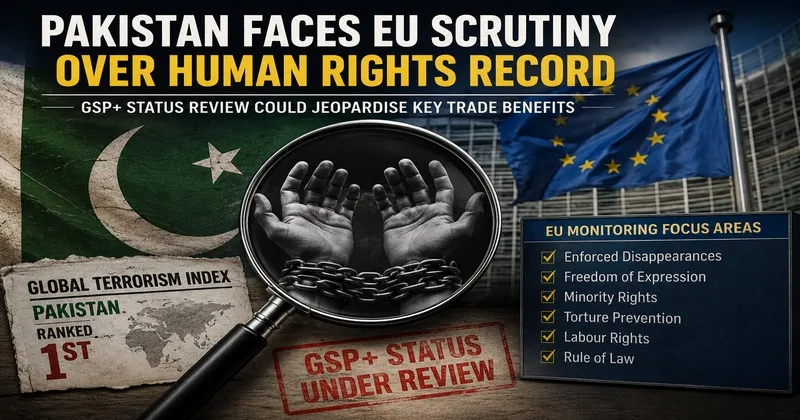
Regarding the EU’s monitoring of Pakistan, it has listed 13 key areas on top of which is Enforced Disappearances, something its security forces have been doing for countless years, mainly in Balochistan. Dr Mahrang Baloch’s recent sentencing in a trial, which is perceived as less than fair by most European nations, has brought the focus sharply on this issue. Her nomination for the Nobel Peace Prize twice in the last two years means there is intense scrutiny of the Pakistani state’s behaviour towards her.
Then comes the issue of “Freedom of association and the right to collective bargaining”. Here too, Pakistan’s record in Balochistan vis-à-vis Baloch Yekjehti Committee (BYC) has been very bad, and most EU nations are unwilling to condone highhandedness on this score. Several demonstrations by BYC activists have amplified Pakistan’s dismal record of human rights as far as enforced disappearances goes.
Violation of Rights of Minorities Under Scanner
Torture prevention; death penalty; freedom of expression and belief and minority rights; violence against women, transgender persons, and minorities; right to information; labour inspectorates; child and forced labour; combating climate change and environmental degradation; fight against corruption; drug control and reporting have also been flagged among the 13 priority areas which the Pakistan government must improve its record on, that too significantly. The repeated abductions of minor Christian girls over the past few years, and those of girls of other minorities like Hindus and Sikhs, have made powerful EU nations like the Netherlands very unhappy.
Some days ago, there were detailed discussions in the EU Parliament regarding Pakistan’s failure to fulfil guarantees in 27 agreed areas, particularly these 13 named above, which have now been brought into sharper focus. In 2023, when Pakistan’s GSP+ status was extended, the issue of impunity in cases of enforced disappearances was highlighted, though it acknowledged “continuous progress” on the rights of women and children, the protection of transgender people, environmental conservation and good governance.
For the past few years, the increasing violence in Khyber Pakhtunkhwa province of Pakistan and its summary expulsion of thousands of Afghans have also been considered gross human rights violations by the EU Parliament. At this juncture, Pakistan fails on most yardsticks which the EU applies in the grant of GSP+ status.
Top Position in Global Terrorism Index
In the Global Terrorism Index, Pakistan is at the very top as a nation most impacted by terrorism globally, followed by Burkina Faso at number two. The surge of violence in Balochistan, Khyber Pakhtunkhwa and in Pakistan-Occupied Jammu & Kashmir (POJK) has been responsible for this pole position. Even nations like Syria, Iraq and Afghanistan, once afflicted by terrorist violence, have seen relative improvements as conditions in Pakistan have only worsened.
On the Freedom in the World index, Pakistan has a very low score of 32 out of 100 and further decline is only a matter of time. It actually ranks worse than Guinea-Bissau, rated ‘Partly Free’, scores one point higher. Pakistan, practically a hybrid regime of civilian faces masquerading as politicians in power but real control in the hands of the Army, has fallen into the category of `Authoritarian Regimes’.
Very Low Ranking on Rule of Law Index
As a country struggling across all major social and political indicators, it cannot perform well on another very important yardstick, the rule of law. On the Rule of Law Index, Pakistan ranks a dismal 130th out of 143 nations globally. All indicators point to the fact that it is slipping further and its ranking is slipping further.
The latest report on GSP+ status has taken note of and appreciated some progress by Pakistan; the EU wants Islamabad to do more to keep this access to its markets. Under the EU’s new trade rules, which come into effect in January 2027, Pakistan will be more strictly monitored. Not only that, it must reapply for GSP-Plus, submit a written plan of action, and win Brussels’ approval by the end of 2028.