It has been 44 years since Kerala formally began observing the Malayalam month of Karkidakam as Ramayana Masam (the Month of the Ramayana). What was once associated with hardship and scarcity, often referred to as Panja Karkidakam (the month of famine) or Kallakkarkidakam, was transformed into a sacred period marked by devotion, reflection, and the recitation of the Adhyatma Ramayanam. Behind this remarkable cultural transformation lay a quiet yet profound social movement that reshaped the spiritual consciousness of Keralam.
The incessant rains of Karkidakam, once symbolic of gloom, are today accompanied by the devotional chanting of the Adhyatma Ramayanam. Across Keralam, and wherever Malayalis live, the month has become synonymous with Ramayana recitations. Amid the roar of the monsoon, the melodious verses of Thunchath Ezhuthachan once again echo in homes, temples, and public spaces.
This transformation was not accidental. It was the result of the dedicated efforts of a group of social reformers who consciously worked to guide Keralam from an era when calls were raised in the 1930s to burn the Ramayana, to a society that now celebrates an entire month in its honour. At a time when ideological slogans distorted the universal vision of Sree Narayana Guru, “One Caste, One Religion, One God for Humanity”, and when some even advocated destroying the Ramayana, Mahabharata, and temples, many feared that Keralam’s cultural soul would fade away. Yet, today, the state observes Ramayana Masam with deep spiritual fervour.
The roots of Ramayana Masam trace back to a historic conference held in Ernakulam on April 4–5, 1982. The Vishala Hindu Sammelanam, regarded as a milestone in Keralam’s social history, brought together spiritual leaders and thinkers such as Swami Chinmayananda, Swami Vishwesha Tirtha, Dr Karan Singh, and RSS Sarkaryavah Rajju Bhaiya. Lakhs of people gathered under the banner proclaiming, “Hindukkal Nam Onnane” (“We Hindus are One”).
One of the defining moments of the conference was the “ Mangalapooja” (ceremonial worship) led by Paravoor Sreedharan Thanthri of the Sree Narayana tradition. Eminent traditional priests such as Surya Kalady Surya Bhattathiripad and Peruvanam K.P.C. Anujan Bhattathiripad voluntarily joined as assistants, symbolising a rare unity among diverse Hindu traditions. Many consider this a memorable milestone in Keralam’s journey from ideological conflict toward spiritual harmony.
Following the conference, the organisers decided to continue functioning as a permanent organisation. At a meeting held on June 6, 1982, at the Dakshina Bharat Hindi Prachar Sabha Hall in Ernakulam under the chairmanship of A.R. Srinivasan, a historic resolution was passed to observe the Malayalam month of Karkidakam as Ramayana Masam. The meeting also resolved to jointly celebrate the birth anniversaries of Sree Narayana Guru, Chattampi Swamikal, and Mahatma Ayyankali as the “Acharya Trayam.”
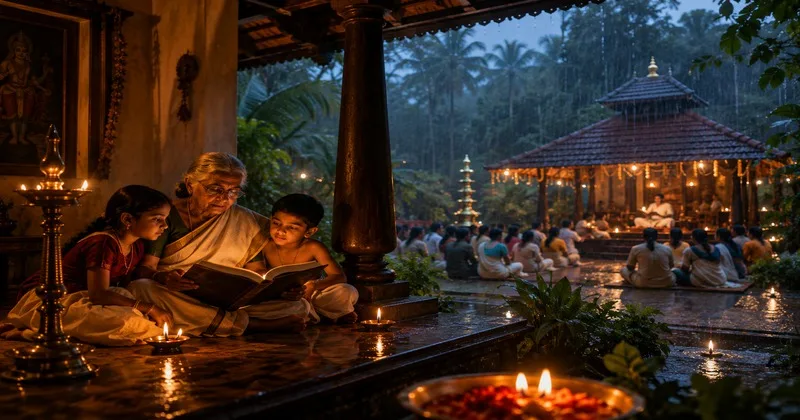
What had once been a quiet household tradition of grandmothers reading the Ramayana by the light of an oil lamp gradually expanded into a statewide cultural movement. Public Ramayana recitations began in temples, community halls, and cultural centres across Keralam. Seminars, scholarly discussions, lectures, and literary gatherings explored not merely the reading of the Ramayana but its philosophy, ethics, and contemporary relevance. Society embraced the observance while adapting traditional practices to changing times.
The transition, however, was far from easy. The observance of Ramayana Masam faced strong opposition from the Communist Party and the Progressive Arts and Literary Association (Purogamana Kala Sahitya Sangham). Some argued that “Ravanayanam” rather than “Ramayanam” should be celebrated, while others criticised Bhagwan Rama, Sita, and the epic itself through speeches and writings. Leaders ranging from Thirunalloor Karunakaran to E.M.S. Namboodiripad publicly opposed the initiative, supported by the organisational strength of the CPI(M). Keralam’s intellectual sphere witnessed prolonged debates and ideological exchanges.
Speaking at a cultural conference organised by the district committee of the Progressive Arts and Literary Association at the Kerala University Students’ Centre in Thiruvananthapuram on July 25, 1982, Thirunalloor Karunakaran criticised the concept of Rama Rajya, citing the story of Shambuka from the Ramayana. E.M.S. Namboodiripad, in his book Marxism and Malayalam Literature, argued that the Ramayana and Mahabharata had reinforced religious barriers that hindered social progress.
Supporters of Ramayana Masam responded with sustained intellectual engagement. Under the leadership of thinkers such as P. Parameswaran and P. Madhavji, they defended the cultural and philosophical significance of the epics. According to this account, the debate ultimately shifted public opinion in favour of the movement.
Ramayana Masam gradually evolved beyond ritual recitation into a broader cultural engagement with the Ramayana’s ethical teachings and social relevance. Within a year, even E.M.S. Namboodiripad reportedly softened his position, acknowledging that classics such as the Ramayana belonged to the shared cultural heritage of the Indian people and suggesting that some earlier Marxist criticism had been overly simplistic.
Reflecting on the movement, P. Parameswaran, Director of Bharatheeya Vichara Kendram, explained that while Ramayana recitation during Karkidakam had long existed in Keralam, Ramayana Masam gave it a larger social dimension. The objective, he said, was not merely reading the text but encouraging informed discussions on the Ramayana, its characters, and its relevance to contemporary society.
Today, Ramayana discussions are held everywhere, from temples to universities. Newspapers and television channels extensively cover Ramayana Masam programmes. According to this narrative, the transformation of Karkidakam into Ramayana Masam was the result of a conscious cultural effort and became an important step in reshaping Keralam’s social landscape.
Recalling those formative years, P. Parameswaran said that the Vishala Hindu Sammelanam in Kochi was part of a nationwide series of large Hindu gatherings. Leaders, including Dr Karan Singh, M.K.K. Nair, P. Madhavji, and K. Bhaskar Rao, played key roles in organising the event. At a time when some groups had called for burning the Ramayana and Mahabharata, the organisers viewed the movement as an attempt to safeguard India’s cultural heritage. It was in this context that the proposal to celebrate Ramayana Masam was adopted.
Parameswaran further observed that although Ramayana recitation had traditionally taken place in homes, it lacked broader public engagement. Ramayana Masam therefore, sought to promote seminars, lectures, and discussions explaining the epic’s enduring significance.
He also expressed concern that today the observance has often become limited to recitation alone. While homes and temples continue to organise Ramayana readings, programmes explaining its philosophical and ethical relevance have become fewer. He argued that the Ramayana remains increasingly relevant in modern times, offering enduring ideals of righteous governance, ideal family relationships, brotherhood, and moral conduct. Valmiki, he noted, presents Lord Rama as the model human being, and the epic’s timeless values can help address contemporary moral decline if understood in their true spirit.