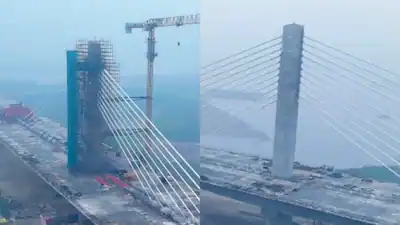
Prayagraj is set to receive one of Uttar Pradesh’s most significant infrastructure upgrades with the upcoming Phaphamau six-lane bridge over the river Ganga, a project aimed at decongesting the city’s busiest river crossing and improving regional connectivity. Recent drone footage of the site, widely shared on social media, has offered a glimpse into the scale of construction, showing pillars rising from the riverbed and long stretches of completed approach roads.
The visuals have renewed public attention on the project, which is being touted as Uttar Pradesh’s longest six-lane cable-supported bridge and a critical solution to the city’s growing traffic woes.
The Phaphamau six-lane bridge is being built to replace and supplement the existing two-lane Chandrashekhar Azad Setu, also known as the old Phaphamau bridge. Designed decades ago to handle around 15,000 passenger car units (PCUs) per day, the old bridge today carries traffic volumes exceeding 40,000 PCUs daily.
This mismatch has resulted in chronic congestion, frequent traffic jams and restrictions on the movement of heavy and commercial vehicles during peak hours. Officials say the new bridge, with significantly higher capacity, will ease pressure on the old structure and ensure smoother traffic flow across the Ganga.
The new bridge is a vital link in Prayagraj’s expanding road network. It will connect major highways including NH-96, NH-24B and the Asian Highway-1 (AH-1), improving connectivity between Prayagraj, Lucknow, Pratapgarh and several adjoining districts.
Once operational, the six-lane corridor is expected to reduce bottlenecks for both regional commuters and long-distance travellers, cutting travel time and improving logistics movement across eastern Uttar Pradesh.
Spanning nearly 9.9 kilometres including approach roads, the Phaphamau project is among the largest river bridge developments in the state. The main bridge itself measures approximately 3.84 kilometres, while the remaining length consists of high-capacity approach sections designed to handle heavy vehicular load.
A standout feature of the project is its extradosed bridge design. The main structure includes an 860-metre extradosed section, making it the second-longest bridge of this kind in India and the first six-lane extradosed bridge in Uttar Pradesh. Extradosed bridges combine elements of cable-stayed and box girder bridges, offering greater strength, flexibility and cost efficiency.
The remaining sections of the bridge use a precast segmental construction technique. The project involves the construction of 67 pillars, the majority of which have already been completed, as reflected in recent drone visuals.
The Phaphamau six-lane bridge is being built at an estimated cost of Rs 1,948 crore. The project is being executed by the National Highways Authority of India (NHAI) under the Engineering, Procurement and Construction (EPC) model, which places responsibility for design, construction quality and timely delivery with the executing agency.
Officials say this model ensures better coordination, adherence to safety norms and technical standards, especially for large-scale infrastructure over a major river like the Ganga.
The foundation stone for the bridge was laid in 2020 by Union Minister for Road Transport and Highways Nitin Gadkari, with construction commencing in February 2021. The project was initially slated for completion by February 2024, ahead of the Maha Kumbh 2025.
However, repeated challenges, including high water levels and flooding in the Ganga, along with other construction-related constraints, led to multiple deadline extensions. The completion date was first pushed to February 2025, then to July 2026, and has now been revised to September 2026.
To manage traffic during the Maha Kumbh 2025, authorities had constructed a temporary steel pontoon bridge at the site. This temporary arrangement has since been dismantled.
Once completed, the Phaphamau six-lane bridge is expected to dramatically reduce congestion on the old two-lane crossing and ensure smoother movement for private vehicles, commercial transport and goods carriers. It will also strengthen Prayagraj’s connectivity with key national highways and neighbouring regions.