FASTag: Indian highways are rewriting travelling experience
September 14, 2026
  • Read Ecopy
  • Circulation
  • Advertise
  • Careers
  • About Us
  • Contact Us
Android AppiPhone AppArattai
Organiser
  • ‌
  • Bharat
    • Assam
    • Bihar
    • Chhattisgarh
    • Jharkhand
    • Maharashtra
    • View All States
  • World
    • Asia
    • Europe
    • North America
    • South America
    • Africa
    • Australia
  • Editorial
  • International
  • Opinion
  • RSS @ 100
  • More
    • World Hindu Congress 2026
    • Op Sindoor
    • Analysis
    • Sports
    • Defence
    • Politics
    • Business
    • Economy
    • Culture
    • Special Report
    • Sci & Tech
    • Entertainment
    • G20
    • Azadi Ka Amrit Mahotsav
    • Vocal4Local
    • Web Stories
    • Education
    • Employment
    • Books
    • Interviews
    • Travel
    • Law
    • Health
    • Obituary
  • Subscribe
    • Subscribe Print Edition
    • Subscribe Ecopy
    • Read Ecopy
  • ‌
  • Bharat
    • Assam
    • Bihar
    • Chhattisgarh
    • Jharkhand
    • Maharashtra
    • View All States
  • World
    • Asia
    • Europe
    • North America
    • South America
    • Africa
    • Australia
  • Editorial
  • International
  • Opinion
  • RSS @ 100
  • More
    • World Hindu Congress 2026
    • Op Sindoor
    • Analysis
    • Sports
    • Defence
    • Politics
    • Business
    • Economy
    • Culture
    • Special Report
    • Sci & Tech
    • Entertainment
    • G20
    • Azadi Ka Amrit Mahotsav
    • Vocal4Local
    • Web Stories
    • Education
    • Employment
    • Books
    • Interviews
    • Travel
    • Law
    • Health
    • Obituary
  • Subscribe
    • Subscribe Print Edition
    • Subscribe Ecopy
    • Read Ecopy
Organiser
  • Home
  • Bharat
  • World
  • Operation Sindoor
  • Editorial
  • Analysis
  • Opinion
  • Culture
  • Defence
  • International Edition
  • RSS @ 100
  • Magazine
  • Read Ecopy
Home Bharat

From Queues to Seamless Corridors: Indian highways are rewriting the commuter travelling experience

The Indian National Highway network is expanding at a record pace, and the focus is steadily shifting from building roads to improving the everyday travel experience. Through digital tolling reforms, commuter-friendly pricing and barrier-free innovations. Highway journeys are becoming faster, fairer and more predictable for millions of users

Vivek KumarVivek Kumar
Jan 30, 2026, 05:30 pm IST
inBharat
Follow on Google News
Representative Image

Representative Image

Facebook
Twitter
WhatsAppTelegramEmail

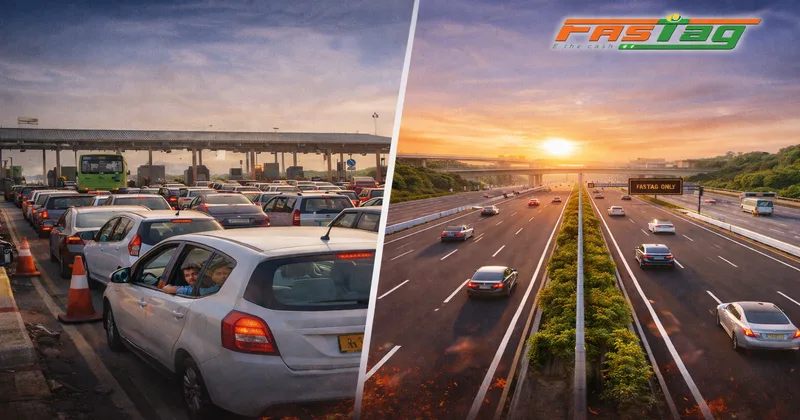
Toll booths have been the most irritating halt that one associates with an Indian highway experience. Long lines, disputes over cash, regular stops and unpredictable travel times were accepted as essential companions on a road journey. With the phenomenal development of the National Highway network in India such spots came under greater observation.

Away from the slogans of politics or announcements in leading news publications, a new change has also been taking place: reforms and technology, focused on the commuter.

Driven by the tremendous increase in National Highways, the Ministry of Road Transport and Highways (MoRTH) and the National Highways Authority of India (NHAI) have realised that it is not only about increasing infrastructure but also about improving efficiency, affordability, and ease of access and movement. During the previous decade, tolling systems began with manual cash and cash boxes and reached digital systems and services at Toll Plaza with limited human interface and involvement. In 2025, this shifted to a more people-friendly approach that included not only reducing highway congestion.

FASTag: From Compliance Tool to Commuter Relief

The purpose behind launching the FASTag system was to reduce congestion and make things more transparent. Over the years, it has become a universal phenomenon, with approximately 98 per cent of vehicles now utilising the system when approaching toll booths. To date, the issue of repeated tolls is a concern for commuters travelling between satellite towns and cities.

The launch of the FASTag Annual Pass on August 15, 2025 has been an important paradigm shift in this respect. The Annual Pass will cost Rs 3,000 and will provide 200 toll transactions or one year of validity, whichever is earlier, at 1,159 toll plazas across the country. The effect of this on frequent commuters is an end to the fluctuating monthly expenditure.

Also Read: India-EU Free Trade deal will take Assam tea from Dibrugarh to Europe with zero tariff: Home Minister Amit Shah

The effect has been accepted by commuters travelling between places such as Unnao and Lucknow, or Yamuna Nagar and Chandigarh, who have noticed significant declines in per-trip toll costs, as well as time savings at tolls. What’s most noteworthy is the factor of economy, along with certainty.  Then, by factoring in recharging as well as variable tolling costs, frequent highway users have been able to budget their trips with certainty.

The figures underline the demand for such rationalisation. More than 40 lakh Annual Passes were sold in a few months, covering nearly one-fifth of private car users. This uptake suggests that when pricing structures reflect commuters’ lived realities, digital adoption follows naturally.

While FASTag dominates toll payments, MoRTH has also refined its approach to digital inclusion; earlier non-FASTag users had to pay double the toll, a policy that has pushed compliance. It drew criticism for becoming punitive. The revised framework reduces it to 1.25 times the toll rate for UPI payments, thereby making alternatives more affordable digitally without disproportionately penalising users.

The results have been measurable. Between mid-November and early December 2025, the toll plazas reported more than 15 lakh UPI transactions valued at Rs 19.44 crore. During this period, cash collection contracted by about 25 per cent, easing congestion and bringing greater transparency.

This calibrated approach reflects a broader governance philosophy, using incentives and convenience to change behaviour rather than relying solely on penalties. For commuters, the benefit is straightforward quicker scans, fewer arguments and smoother passage through toll plazas.

Barrier-Free Tolling: Ending the Stop-and-Go Era

The most consequential reform in the pipeline is moving towards barrier-free tolling through MLFF systems. For drivers of heavy vehicles, the processes of stopping and re-starting at a toll booth have long represented fuel loss, mechanical strain and cumulative delays on long drives.

While India first MLFF tolling system has already been awarded for implementation at the Choryasi Fee Plaza on National Highway 48 in Gujarat, commencing its operation in 2026, five more such projects have been awarded in parallel, marking the beginning of a decisive shift towards modern tolling infrastructure.

Under MLFF, vehicles will pass through the toll zones at highway speeds and the toll will be deducted automatically based on vehicle identification technologies. No barrier, no queue, and no forced deceleration. International experience suggests that such systems significantly reduce travel time and fuel consumption, particularly for freight movement. For India, where logistics costs are linked with economic competitiveness, the implications go beyond commuter comfort.

Fairness During Construction: Paying Less for Less

The expansion of highways always results in temporary effects such as diversions, speed reductions, and uneven road surfaces. MoRTH has amended tolling regulations regarding equity during the expansion period. If a two-lane highway with paved shoulders is being upgraded into a four- or six-lane highway, tolls are only charged at 50 percent during the expansion period.

This principle of proportional payment promotes accountability. Users do not pay the normal charges for the partially provided infrastructural service. These actions, although less noticeable than the provision of new roads, boost community confidence in the system.

Strengthening the FASTag Ecosystem

Apart from the pricing and payment method issues, other system-focused changes primarily aim to fill gaps and enhance user-friendliness. Efforts such as “One Vehicle, One FASTag” can limit misuses and ties between FASTag and the VAHAN system are working toward reducing any malpractices regarding motor vehicle classes. There are fines for loose FASTag to improve plaza functioning.

Redressing grievances is also of paramount importance. There are various mechanisms, such as the 1033 helpline, bank support systems, email assistance, and the “RajmargYatra App,” where users can complain about issues or two. In an environment of millions of daily transactions, these mechanisms are invaluable for maintaining people’s confidence in the system.

Good Governance Story Hidden in Plain Sight

The common thread running through these reforms is a gradual process of change rather than a revolutionary declaration or a bold vision of a future highway system. Rather than addressing a particular pain point in highway usage through a specific change, such as UPI rewards for payments or free tolls at highway barriers in some States, a mindset of governance improvement through broader usage feedback seems to be at work here.

Such projects might rarely be featured on prime-time television, but they affect people on a daily basis. Smaller queues, predictable costs, less fuel waste, and less-stressful trips overall improve ease of living, as policymakers talk about.

While India is increasing its road network, the next level of development is about experience. The transformation in tolls is proof that development and ease of access need not be in conflict, either. When development policies are catered to in accordance with actual grounds and experiences, even commuting can be made easy, and this itself is an achievement.

Topics: Ministry of Road Transport and HighwaysFASTagNational Highways Authority of India
Share
Tweet
SendShareSend
✮ Subscribe Organiser YouTube Channel. ✮
✮ Join Organiser's WhatsApp channel for Nationalist views beyond the news. ✮
Previous News

Bangladesh records 522 communal attacks in a year, 61 non-Muslims killed, Minority Council warns of rising violence

Next News

NIA raids 20 locations across Kerala in crackdown on PFI–SDPI underground network

Related News

Centre bans pre-ride tipping prompts on cab apps (AI-generated Image)

No Tip Before Trip: Centre cracks down on Pre-Ride tipping prompts on Uber, Ola, and Rapido

Lucknow-Kanpur Expressway (This is an AI generated image)

Uttar Pradesh: Yogi government achieves another infrastructure milestone as Lucknow-Kanpur expressway opens

Prime Minister Narendra Modi and Minister of Road Transport and Highways Nitin Gadkari (Image Source: X)

From Rs 15,000 crore to Rs 3 lakh crore: How India’s highway infrastructure witnessed a massive tech transformation

A representative image

Prayagraj Sangam ropeway project takes off after years of delay, construction begins at Arail

A representative image

India to implement satellite and AI-based tolling system nationwide by the end of 2026

Union Minister for Road Transport and Highways Nitin Gadkari (Right)

India set for highway overhaul as Union Minister Nitin Gadkari unveils nationwide shift to MLFF electronic tolling

Load More

Latest News

Fact Check: Viral Video Falsely Claims PM Modi Said He Would End Poverty ‘In One Go’

FACT CHECK: Did PM Modi say he would end poverty in Bharat in one go? Viral video is clipped

At just 19, Mohammad Nabeel built an online Al-Qaeda network in UP

Al-Qaeda plot in UP: 19-year-old Mohammad Nabeel arrested over plan to recruit youths for Jihad

A representative image

Bankers Books Evidence Act 2026 to replace 1891 law from October 1: Here’s what will change?

SSC CGL exam Schedule (This is an AI generated image)

SSC CGL Tier 1 exams from September 30 to October 30; Check schedule and admit card details, vacancies

New Delhi, Sep 12 (ANI): Prime Minister Narendra Modi holds a bilateral meeting with Chinese President Xi Jinping on the sidelines of the BRICS Summit 2026, in New Delhi on Saturday. External Affairs Minister S. Jaishankar, NSA Ajit Doval and Principal Secretaries to the PM, Pramod Kumar Mishra and Shaktikanta Das also present. (@MEAIndia X/ANI Photo)

BRICS 2026: Why Putin, Xi and Pezeshkian meetings stand out in PM Modi’s diplomacy

Odisha Chief Minister Mohan Charan Majhi addresses the media at Bhubaneswar airport after returning from his UAE visit on September 13, 2026.

Odisha secures Rs 2.43 lakh crore investment proposals during CM Majhi’s five-day UAE outreach programme

Bhagwan Ganesh

Ganesh Chaturthi: Rationale behind worshipping Bhagwan Ganesh

RSS Akhil Bharatiya Sah-Bauddhik Shikshan Pramukh Deepak Vispute addressing the gathering

‘Nation First’ should be the guiding principle for every individual, regardless of their Field: Deepak Vispute

‘India was not poor; it was made poor’: The truth re-emerges through Jema Ferrer’s perspective

Six years after talent manager Disha Salian was found dead, her father Satish Salian on September 11 recorded a detailed statement with the Central Bureau of Investigation (CBI), naming Shiv Sena (UBT) leader Aaditya Thackeray, actors Dino Morea and Sooraj Pancholi, and others.

Disha Salian Murder Case: Father names Aaditya Thackeray in CBI statement; Lawyer claims gang rape, murder cover-up

Load More
  • Privacy
  • Terms
  • Cookie Policy
  • Refund and Cancellation
  • Delivery and Shipping

© Bharat Prakashan (Delhi) Limited.
Tech-enabled by Ananthapuri Technologies

  • Home
  • Search Organiser
  • Bharat
    • Assam
    • Bihar
    • Chhattisgarh
    • Jharkhand
    • Maharashtra
    • View All States
  • World
    • Asia
    • Africa
    • North America
    • South America
    • Europe
    • Australia
  • Editorial
  • Operation Sindoor
  • Opinion
  • Analysis
  • Defence
  • Culture
  • Sports
  • Business
  • RSS @ 100
  • Entertainment
  • More ..
    • Sci & Tech
    • Vocal4Local
    • Special Report
    • Education
    • Employment
    • Books
    • Interviews
    • Travel
    • Health
    • Politics
    • Law
    • Economy
    • Obituary
  • Subscribe Magazine
  • Read Ecopy
  • Advertise
  • Circulation
  • Careers
  • About Us
  • Contact Us
  • Policies & Terms
    • Privacy Policy
    • Cookie Policy
    • Refund and Cancellation
    • Terms of Use

© Bharat Prakashan (Delhi) Limited.
Tech-enabled by Ananthapuri Technologies