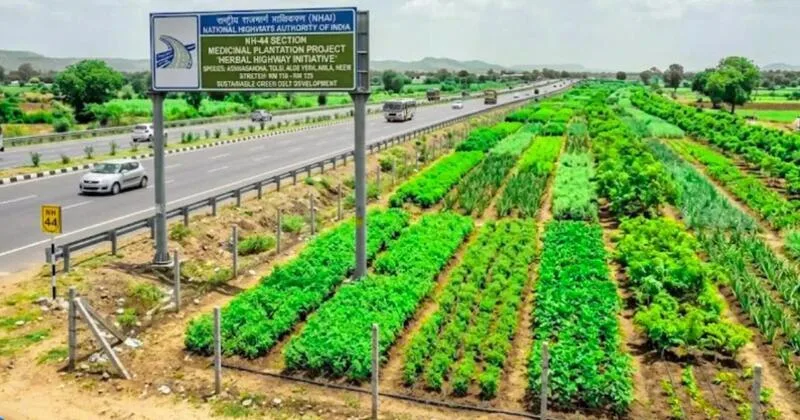
The Arogya Van is a newest green initiative from the National Highways Authority of India (NHAI). Announced in April 2026, this initiative is not another tree-planting drive. It is a deliberate, thoughtful attempt to fuse ancient Indian medicinal wisdom with modern road infrastructure, and the result could reshape the way millions of highway travellers experience their daily commute.
What Exactly Is Arogya Van?
The name says it all, ‘Arogya’ means health in Sanskrit and ‘Van’ means forest. So ‘Arogya Van’ simply means a forest of health. NHAI has identified hundreds of vacant land that lie unused along national highways, strips of ground near interchanges, toll plazas, cloverleaf junctions and wayside rest areas. Rather than leaving them barren or filling them with generic avenue trees, NHAI has decided to plant medicinal trees that are deeply rooted in India’s traditional knowledge systems.
In the first phase, NHAI has drawn up a concrete action plan covering 17 land parcels spread across 62.8 hectares. On these parcels, around 67,462 medicinal trees will be planted across 11 states: Madhya Pradesh, Haryana, Delhi-NCR, Andhra Pradesh, Gujarat, Karnataka, Odisha, Tamil Nadu, Rajasthan, Maharashtra and Chhattisgarh. To put it in perspective, 62.8 hectares is roughly the size of 88 football fields. And this is only the beginning. NHAI has already identified another 188 hectares of vacant land for future plantation, timed with the monsoon season to improve the chances of saplings surviving and thriving.
Which Trees Are Being Planted and Why?
NHAI has identified 36 tree species with well-established medicinal properties. The selection is not arbitrary; every tree has been chosen based on how well it suits the local climate and soil conditions of the region it will be planted in. This zone-wise matching, known as agro climatic suitability, which improves survival rates and long-term health of the plantation.
The list reads like a household almanack of Indian home remedies. Neem (Azadirachta indica) is used for skin ailments, immunity and as a natural pesticide. Amla (Indian gooseberry) is one of the richest natural sources of Vitamin C and a cornerstone of Chyawanprash. Jamun (Indian blackberry) is known for its benefits in managing blood sugar. Imli (tamarind) is used in digestion and as an ingredient in traditional medicine. Maulsari and Gular are also part of the list, both having deep roots in Ayurvedic and folk healing traditions. All together, these trees represent thousands of years of accumulated indigenous knowledge about the healing gifts of nature.
The Ecological Angle
One of the most important but least talked-about aspects of Arogya Van is its ecological dimension. Highways are long, continuous stretches of land that can either fragment natural habitats or, if managed well, serve as green corridors connecting different ecosystems. NHAI initiative recognises this potential.
Medicinal trees attract a far wider variety of wildlife than plain avenue trees. Bees and butterflies are critical pollinators without whom crops and wildflowers cannot reproduce. These are naturally drawn to the flowers of Neem, Jamun and Amla. Birds flock to the fruit-bearing trees. Microfauna, the tiny organisms in soil and leaf litter, keep the earth healthy and flourish under a canopy of diverse native species. In short, each Arogya Van site is designed to become a small, thriving ecosystem, not just a decorative roadside feature. This is what sets Arogya Van apart from conventional roadside greening drives. The goal is not just to make highways look green; it is to make them ecologically alive.
Highways as Classrooms: The Awareness Mission
NHAI has a smart strategy for maximising the public impact of Arogya Van. The plantation sites are being prioritised near toll plazas, wayside amenities and interchange places where travellers stop, rest or slow down. A harried driver on an expressway will not have time to notice a roadside tree. But the same driver pausing at a toll booth or stopping at a rest area, just might read a signboard identifying the Amla tree nearby and learn something about its medicinal value.
In this sense, NHAI envisions each Arogya Van patch as a living classroom what the official documents describe as a living repository of traditional medicinal knowledge. For millions of urban Indians increasingly disconnected from traditional plant knowledge, a highway rest stop could become an unexpected but memorable lesson in Ayurveda and folk medicine.
Rooted in a Larger Green Mission
Arogya Van does not stand alone. It is the latest in a series of impressive green initiatives that NHAI and the Ministry of Road Transport and Highways (MoRTH) have been rolling out over the past decade. Understanding these gives us the full picture of how India is trying to make its expanding road network an ecological asset rather than a liability.
The Green Highways Policy 2015 was the foundation on which all subsequent efforts rest. Under this policy, NHAI has so far planted over 4 crore trees along national highways, a remarkable number that reflects years of sustained effort. Closer to the present, in 2024-25, NHAI planted around 67 lakh trees against a target of 60 lakh, exceeding its own ambitious goals.
The Miyawaki plantation initiative is another standout. Inspired by a Japanese technique of growing dense, native mini-forests, NHAI has piloted Miyawaki plantations near Delhi-NCR, with over 4 lakh trees planted across eight locations, including stretches along the Dwarka Expressway, Delhi-Mumbai Expressway and Eastern Peripheral Expressway. These forests grow ten times faster than conventional plantations, provide thick sound and dust barriers, and dramatically improve local air quality, a huge benefit for highway-adjacent communities.
Then there are wildlife corridors, specially designed underpasses and overpasses built where highways cut through sensitive ecological zones, allowing animals to cross safely without coming into conflict with traffic. NHAI is developing these across the country. On the 1,350-km Delhi-Mumbai Expressway alone, five wildlife crossings are being readied, which will allow animals to move freely between forests on both sides of the road without risk.
Eco-friendly bamboo crash barriers have replaced steel barriers on many stretches, reducing the carbon footprint of road safety infrastructure. The Delhi-Mumbai Expressway features over 2,000 rainwater harvesting structures, turning the highway itself into a water conservation instrument. Bioengineering solutions, such as vetiver grass, jute geotextiles and coir mats, are increasingly used to stabilise slopes and prevent soil erosion on hill highways. And in a nod to the Indian tradition of women-led self-help groups, many plantation maintenance contracts along highways are managed by such local groups, combining conservation with rural livelihoods.
Prime Minister Narendra Modi’s Ek Ped Maa Ke Naam (One Tree in Mother’s Name) campaign has also seen strong participation from NHAI and MoRTH, with thousands of employees planting trees at highway sites across the country as a mark of personal commitment to environmental responsibility.
The Ayurveda Connection: Culture Meets Conservation
The most culturally resonant aspect of Arogya Van is its explicit alignment with India’s drive to revive and mainstream Ayurveda and other traditional systems of medicine. The Government of India, under Prime Minister Modi, has made promotion of Ayurveda, Yoga, Unani, Siddha and Homoeopathy (AYUSH) as a national priority. The Ministry of AYUSH has been working to document, conserve and popularise India’s rich herbal and medicinal plant heritage.
Arogya Van plugs directly into this larger mission. Many of the medicinal tree species that will be planted, Amla, Neem, Jamun, Haritaki, are key ingredients in classical Ayurvedic formulations. Their conservation is not just an environmental task but a cultural and pharmaceutical one. As forests continue to shrink and wild populations of medicinal plants decline, highway plantations that create new, protected populations of these species could genuinely contribute to long-term medicinal plant conservation.
What does this mean for the Common Citizen?
For the average Indian who uses national highways, whether as a daily commuter, a long-distance truck driver, a family on a road trip or a student travelling between cities, Arogya Van promises something more than a greener drive. It promises a more meaningful one.
The roadside, which has long been considered as no man’s land of dust, litter and occasional shrubs, could transform into a space of ecological richness and cultural memory. This is the quietly radical idea at the heart of Arogya Van that infrastructure need not be neutral. A road can carry vehicles and also carry culture. A highway can connect cities and also connect people to their heritage. A tree planted by the roadside can filter dust and also revive the wisdom of generations.
Green Roads, Deep Roots
The Indian national highway network spans over 1.46 lakh kilometres, the second-largest in the world after the United States. The land alongside this network, largely unused and undervalued, is a vast untapped resource. NHAI Arogya Van initiative shows what can be done when imagination, ecological thinking and cultural pride come together in public policy.
Sixty-seven thousand trees may seem like a small number against the scale of Indian ecological challenges. But every Neem sapling planted today is a shade tree and a medicine chest for the future. Every Amla grove along a highway rest stop is a tiny, living reminder of a civilisation that understood long ago that the forest is the pharmacy. In planting Arogya Van, NHAI is not just greening India’s highways. It is rooting them literally and symbolically in something ancient, enduring and deeply Indian.