On the night of June 5, 2026, the phones went quiet across the valleys of the territory Islamabad calls Azad or “Free” Jammu and Kashmir. Calls to relatives in Bradford and Birmingham stalled and dropped; mobile networks fell away, and the internet followed. By the time global internet monitoring group confirmed the outage, whole districts had gone dark, and the darkness would hold for the better part of a week. In Muzaffarabad and Rawalakot, shutters came down over shopfronts and the buses stopped running. Paramilitary vehicles moved through streets that a day earlier had belonged to traders and school children.
The word Azad has been doing quiet work for nearly eight decades. And the strangest witness against it is Pakistan’s own Constitution. Article 257 does not make Azad Jammu and Kashmir a province; it says only that the relationship between Pakistan and the state shall be settled in accordance with the wishes of its people, should they one day decide to accede. Few states hold a territory for generations while their founding document concedes that sovereignty over it remains unsettled. The provision reads less like a claim than a quiet admission: that this land is occupied, not sovereign.
To understand how a place ends up governed by a word rather than a Constitution, you have to go back to the autumn of 1947. Jammu and Kashmir was going to Bharat. Pakistan knew it, and so it struck first, seizing by force what it could not win by its ruler’s consent. Operation Gulmarg, planned with the backing of the Pakistani army and carried out through Pashtun raiders and regular soldiers, sent armed columns through the Muzaffarabad sector in late October. Town after town fell, and non-Muslim families were driven from the surrounding countryside into whatever garrisons still held. Maharaja Hari Singh signed the Instrument of Accession to India on October 26, 1947 and requested Indian Armed Forces to clear the state of aggressing raiders and Pakistani soldiers. Indian troops were airlifted into Srinagar the next morning and rest remains history.
However, the war on ground lasted for weeks, and the cruelest chapter was still to come. On November 25, after a siege that had held since October, Mirpur fell. What followed is remembered as the Mirpur Massacre. Thousands of Hindu and Sikh residents, along with the refugees who had fled to the town for safety, were killed or abducted; women took their own lives rather than be captured; and the survivors were herded into a camp at Alibeg, from which the Red Cross would rescue only a fraction the following spring. The tallies of the dead run into the tens of thousands, the demographic verdict altered. Mirpur district had been about a fifth Hindu and Sikh; within a few years almost none were left, and across the whole of what Pakistan now called Azad Kashmir the census of 1951 counted fewer than a thousand non-Muslims, down from more than a hundred thousand before the war. Kotli and Rajouri had their own killings and their own long journey towards Jammu. The fighting settled into a ceasefire brokered by the United Nations on January 1, 1949, leaving Pakistan in occupation of roughly a third of the princely state.
Three more wars, in 1965, 1971 and 1999, left the map where it was. In 1994, Bharat’s Parliament unanimously declared that the whole of Jammu and Kashmir was an integral part of the union of India and called on Pakistan to vacate the areas it occupied by aggression. That position has not changed since 1947, and it is the lens through which New Delhi has read everything Pakistan has done in the territory since.
Behind The Facade Of Self-Rule
What Pakistan built on the land it held has the shape of self-government and almost none of its substance, and that gap is the first place the word “free” begins to fail. There is a President, a Prime Minister, a legislative Assembly in Muzaffarabad, all of them operating inside limits that keep decisive authority in Islamabad and Rawalpindi. One feature of that arrangement would light the fuse in 2026: twelve of the Assembly’s fifty-three seats reserved not for people who live in the occupied territory at all, but for refugees who resettled across Pakistan’s provinces after 1947, and who elect their representatives from hundreds of miles away. In a house this size, twelve seats are enough to influence everyday outcomes. Islamabad defends them as a place kept for the displaced, and as proof it has never abandoned their cause. To their critics they are something plainer: because the voting happens outside the region, in thinly populated constituencies scattered through Punjab and beyond, they let Rawalpindi swing the Muzaffarabad assembly at will and seat whichever administration it prefers, while the people who actually live there look on. A freedom whose government can be assembled from outside its own borders is a freedom in name only.
There is a President, a Prime Minister, a legislative Assembly in Muzaffarabad, all of them operating inside limits that keep decisive authority in Islamabad and Rawalpindi
Further North, in Gilgit-Baltistan, the word wears thinner still. For decades Pakistan ran the region simply as the “Northern Areas,” with no provincial status, no constitutional protections, and no representation in the National Assembly to match the provinces, despite its strategic weight and the region’s own repeated demands for rights and a voice. It is a Shia-majority land where communities have long warned of engineered demographic change, political marginalisation, and the erosion of the sectarian balance. Here the promise of freedom was never even offered. The territory was simply held. Then, in the middle of the last decade, came the Chinese. The China-Pakistan Economic Corridor, announced in 2015 and swelling past sixty billion dollars, made occupied Gilgit-Baltistan its gateway and the Karakoram Highway its spine. Its boosters promised roads, power and prosperity. What arrived was extraction and exploitation. The skilled and supervisory jobs went to Chinese nationals and to workers brought in from Punjab and Khyber Pakhtunkhwa, leaving locals the unskilled scraps or nothing at all.
When COVID-19 arrived in 2020, it found this machinery already hollow. Shortages of medical supplies, thin healthcare, relief unevenly shared, and the doctors and activists who said so out loud often met administrative or legal pressure rather than answers, while rights groups flagged unequal access to aid and the treatment of minorities. A territory rich enough to power a country could not reliably equip its own hospitals.
The Week ‘Azad’ Went Dark
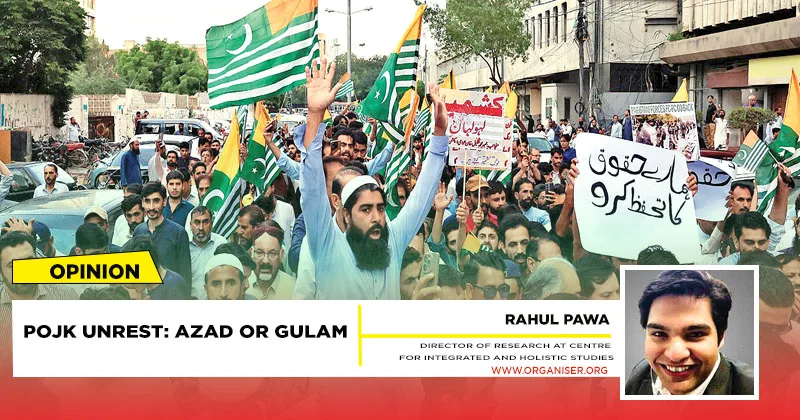
This was the ground on which 2026 caught fire. The spark was the price of electricity in a region threaded with hydropower dams, and the price of bread in a mountain territory that eats wheat trucked up from Punjab, where the subsidised flour had grown scarce and dear. Anger that had been building since 2023 hardened around those twelve seats. Out of it grew the Jammu Kashmir Joint Awami Action Committee, the JAAC, a leaderless coalition of shopkeepers, transporters, lawyers and students, held together by a charter of economic and civic demands rather than any ideology. Talks between the JAAC and a Pakistani federal delegation collapsed in late May. On June 5, the Pakistani authorities proscribed the committee under the region’s anti-terrorism law and pulled the plug on the networks. Two days later, the territory’s Supreme Court ruled that the twelve seats were constitutionally protected and could not be abolished without a formal amendment, closing the legal door the movement had been trying to walk through and forcing the argument back into the streets.
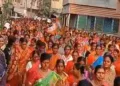
It was in Rawalakot, in Poonch district, that the argument turned lethal. Over June 7 and 8, clashes left the town’s roads strewn with barricades and its clinics filling with the injured. Pakistani figures put the dead at eleven, both protesters and police, with around seventy hurt; other counts ran higher, towards two dozen or more, and Bharat’s foreign ministry spoke of more than twenty killed. The committee’s leadership called it a massacre. With the region sealed off, independent verification was close to impossible, which, critics noted, was rather the point of sealing it. The crackdown widened from there. Police arrested scores of activists in the first days, more than a hundred by NGO counts, though the committee and diaspora networks put the figure far higher and alleged that detainees were being moved into prisons deep inside mainland Pakistan. The organisation’s central office in Muzaffarabad was raided and sealed. A journalist from the region was picked up under electronic-crimes laws for covering the unrest on his own channel. International community called the Pakistani response unlawful and disproportionate, and warned that branding a grassroots movement “terrorist” while cutting it off from the world set a dangerous precedent, that too weeks before scheduled regional elections.
With the territory dark, the story surfaced abroad. In London, Bradford, Manchester and Birmingham, home to one of the largest Kashmiri diasporas in the world, thousands marched, gathering outside Pakistani missions to demand detainees to be released and the restoration of the networks. In Westminster, dozens of MPs signed a parliamentary motion voicing concern over the blackout, the arrests and the restrictions on Assembly. What had looked, from Islamabad, like a containable local disturbance swiftly became an international embarrassment, carried outward by the very people the blackout had been meant to silence. Bharat’s foreign ministry condemned the crackdown in the sharpest terms, highlighting Pakistan of burying its failures under fake news and doctored videos, and pressed the world to hold Islamabad to account.
Seventy-eight years after a line of control cut the erstwhile state in two, Pakistan still occupies a territory it has never folded into its Constitution, never served, and never claimed outright as its own
For New Delhi, none of this was new ground. It was the vindication of an argument Bharat has pressed for decades: that its sovereignty runs to the whole of the princely state, that Pakistan’s writ in the territory it holds is occupation dressed in the language of freedom, and that the people living under it are administered, not represented. For decades Pakistan justified its presence in the vocabulary of freedom, and in the summer of 2026, the people it governed took that vocabulary at its word and turned it back on it, which is what makes the word so hard to hold.
Seventy-eight years after a line of control cut the erstwhile state in two, Pakistan still occupies a territory it has never folded into its Constitution, never served, and never claimed outright as its own. The Assembly, the President, the prime minister in Muzaffarabad, the whole furniture of self-government stands in place, and behind it the real authority still runs to Rawalpindi. “Azad” was always the load-bearing word, and in the summer of 2026, the people it was meant to describe stopped pretending it held. Whether a place can be called free while its own people are still waiting to learn what that word means is the question they forced into the open. For Pakistan, the writing on the wall is plain. The territory it occupied with the raiders of 1947 was never its to keep, and the people it has held under a borrowed word are done waiting to be free.