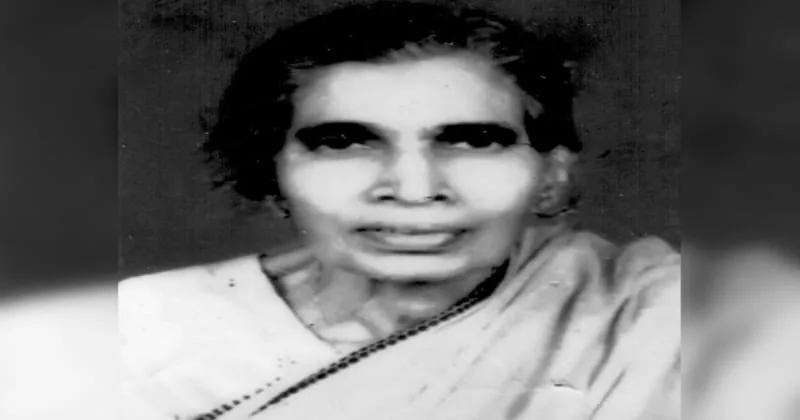
While Srinivasa Ramanujan astonished the world with his mathematical genius, another remarkable Indian scholar quietly transformed the history of mathematics. T A Sarasvati Amma did not discover new theorems, she uncovered forgotten ones, proving that India’s mathematical tradition had reached extraordinary heights centuries before many celebrated European developments.
Who is next after the Ramanujan?
In the mid-20th century, Western academic cartels claimed that advanced mathematics was a European construct, brought to a colonized India via British education. Tekkath Amayankottukurussi Kalathil Sarasvati Amma responded by spending decades… pic.twitter.com/nqCxuOKCXo
— Parimal (@Fintech03) July 6, 2026
For much of the colonial era, a powerful narrative dominated academia: advanced mathematics, particularly geometry, calculus, and infinite series, was portrayed as a uniquely European achievement. India, despite its rich intellectual traditions, was often depicted as a civilization of philosophy and spirituality rather than rigorous scientific inquiry. It was against this backdrop that Tekkath Amayankottukurussi Kalathil Sarasvati Amma (1918–2000) devoted her life to challenging long-held assumptions, not through rhetoric, but through meticulous scholarship.
Rather than debating theories, she immersed herself in centuries-old Sanskrit manuscripts, painstakingly translating mathematical texts that had remained inaccessible to most modern scholars. Her work would become one of the most influential contributions to the history of Indian mathematics.
A Scholar from Kerala
Born in Kerala, Sarasvati Amma developed expertise in both Sanskrit and mathematics, an unusual combination that uniquely equipped her to study ancient scientific literature. During the 1950s and 1960s, while associated with the University of Madras and working alongside distinguished Sanskrit scholars including Dr V Raghavan, she turned her attention to India’s mathematical heritage.
Instead of relying on secondary sources, she searched for original evidence. She travelled through Kerala, consulting palm-leaf manuscripts preserved by traditional scholarly families. Many of these texts had never been critically studied by modern historians of mathematics. These manuscripts contained sophisticated discussions on astronomy, geometry, trigonometry, and mathematical techniques written in highly technical Sanskrit and Malayalam traditions.
Years of Patient Research
Long before computers, digital archives, or online databases, Sarasvati Amma undertook painstaking manual research. She carefully examined seminal works such as the Yuktibhasa, Tantrasangraha, and Karaṇapaddhati, along with several other mathematical and astronomical treatises associated with the Kerala School. Through painstaking translation and analysis of these ancient Sanskrit and Malayalam manuscripts, she reconstructed the sophisticated mathematical ideas they contained, bringing to light centuries-old advancements in geometry, trigonometry, infinite series, and astronomical calculations. Her objective was simple: understand exactly what these texts said mathematically and compare them with later developments elsewhere. This required not only linguistic expertise but also the ability to interpret complex mathematical reasoning embedded within ancient terminology.
Rediscovering the Kerala School of Mathematics
One of Sarasvati Amma’s most significant contributions was drawing wider scholarly attention to the achievements of the Kerala School of Mathematics and Astronomy, which flourished between the 14th and 16th centuries.
The Kerala School of Mathematics was led by renowned scholars such as Madhava of Sangamagrama, Parameshvara, Nilakantha Somayaji, and Jyesthadeva. Together, they developed remarkably advanced mathematical techniques, including infinite series, trigonometric expansions, precise astronomical calculations, and sophisticated geometrical constructions. Their work also introduced methods that many historians recognize as important precursors to concepts later associated with calculus, highlighting the remarkable depth and originality of medieval India’s mathematical tradition.
Modern historians generally agree that the Kerala School developed remarkable mathematical results independently. However, the extent of their influence on later European mathematics remains an active area of historical debate.
In 1979, Sarasvati Amma published what became her best-known work: Geometry in Ancient and Medieval India- The book systematically examined geometric knowledge across Indian mathematical traditions, from the Sulba Sutras to medieval Kerala.
Unlike nationalist assertions unsupported by evidence, Sarasvati Amma grounded every conclusion in primary sources. She translated original passages, reconstructed proofs, and compared them with mathematical developments elsewhere. The work earned respect among historians because it emphasized documentation rather than speculation.
Among the most striking findings discussed by Sarasvati Amma and other historians is the work of Madhava on infinite series. The Kerala mathematicians derived infinite series expansions for mathematical constants and trigonometric functions centuries before similar results appeared in Europe.
Sarasvati Amma did not argue that every mathematical discovery originated in India. Nor did she attempt to diminish European mathematicians such as Isaac Newton or Leibniz, whose formulation of differential and integral calculus transformed modern science. Instead, her research demonstrated that the history of mathematics is richer and more geographically diverse than previously acknowledged. She insisted that India’s contributions deserved recognition because the documentary evidence existed, not because of national pride alone.
Despite producing one of the most important studies on Indian mathematics, Sarasvati Amma remained largely outside the public spotlight. She spent much of her career teaching, researching, and writing. After retirement, she returned to Kerala and continued living a simple life devoted to scholarship. She passed away in 2000, known mainly within academic circles, while many of the discoveries she had helped bring to light continued to influence global research into the history of mathematics.