The famous song “Hai Preet Jahan Ki Reet Sada” (Where Love is Always the Custom), from film actor Manoj Kumar’s patriotic movie ‘Purab Aur Paschim’, continues to instil a sense of pride and self-confidence in the heart of every Indian to this day. This song also serves as a reminder of India’s scientific and intellectual heritage, a legacy that provided direction to global civilisation. The following lines from the song remain just as relevant today:
“When my India gave the zero,
Only then did the world learn to count;
It was India that first taught
The language of the stars to the world.
Had India not given the decimal system,
Reaching the Moon would have been impossible;
Estimating the distance
Between the Earth and the Moon would have been impossible…”
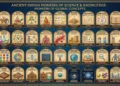
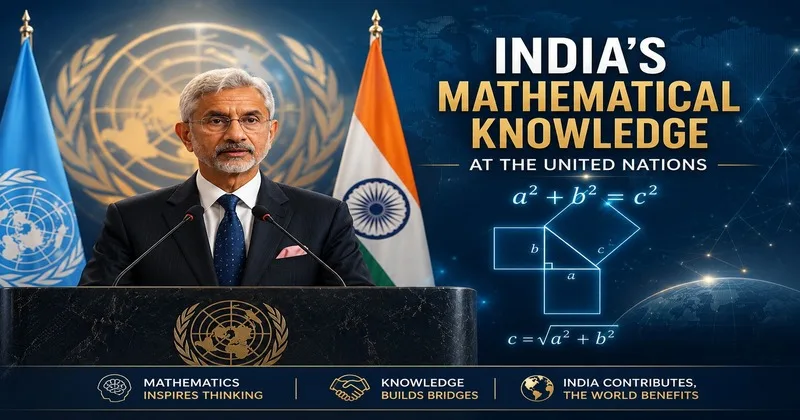
Indeed, a scene that recently unfolded at the United Nations (UN) reaffirmed the historical veracity of these lines on a global stage. During the inauguration of the “Global Diffusion of Mathematics” exhibition, India’s External Affairs Minister, S. Jaishankar, reminded the entire world that many fundamental concepts of mathematics, science, and logical reasoning originated from India’s ancient knowledge traditions. He explicitly stated that the history of science and mathematics is not confined to any single geographical region; rather, it represents a shared intellectual journey of human civilisation, a journey in which India has played a pivotal role.
Mathematical Consciousness Evolving Since the Vedic Era
The history of mathematics in India dates back to the Vedic era. The ‘Rigveda’, ‘Yajurveda’ and ‘Atharvaveda’ contain numerous references to numbers, calculations and geometric concepts. The ‘Shulba Sutras’ are regarded as the most ancient foundations of Indian geometry. The mathematical principles formulated by sages such as Maharishi Baudhayana, Apastamba and Katyayana, originally devised for the construction of sacrificial altars, later became an integral part of the global heritage of mathematics.
The fundamental principle of what the world today knows as the “Pythagorean Theorem” was, in fact, already present in Baudhayana’s ‘Sutras’. This fact clearly demonstrates that mathematical thought in India was highly advanced and systematic. Indian sages did not view mathematics merely as the science of numbers; rather, they utilised it as a medium to comprehend nature and the universe.
Zero: India’s Discovery That Transformed the World
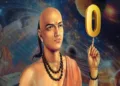
If one were to speak of the greatest contribution of Indian mathematics, it is undoubtedly “Zero.” The entire world of modern computer science, space research, artificial intelligence and digital technology is founded upon the concepts of zero and one. Had zero not been discovered, the modern system of calculation would have been utterly impossible.
The Indian mathematician Aryabhata and subsequently Brahmagupta systematised the concept of zero on scientific grounds. In 628 CE, in his treatise ‘Brahmasphutasiddhanta’, Brahmagupta elucidated the rules for performing calculations involving zero. He explained the results obtained when adding, subtracting or multiplying any number by zero. This marked an intellectual revolution that subsequently laid the foundation for modern mathematics and computing.
India’s decimal system also stands as an unparalleled contribution to the world. Developed through the combination of the digits 1 through 9 and zero, this system was so scientific and elegant that the entire world eventually adopted it. Today, it is known as the “Hindu-Arabic Numeral System.”
Aryabhata: The Great Scientist of Astronomy and Mathematics
Aryabhata, the great mathematician of the 5th century, gave a new direction to both mathematics and astronomy. His renowned masterpiece, the ‘Aryabhatiya’, showcases a remarkable synthesis of algebra, trigonometry, and astronomical calculations. He presented the value of Pi (π) with extraordinary precision:
π ≈ 3.1416
Performing such a precise calculation at that time was, in itself, an astonishing achievement. Aryabhata also posited that the Earth rotates on its own axis, a concept contrary to the prevailing belief in many parts of the world at that time, where the Earth was considered to be stationary. Furthermore, trigonometric concepts such as ‘Jya’ (sine) and ‘Kojya’ (cosine) were developed in India, eventually reaching Europe through Arabic and Latin translations.
Bhaskaracharya and the Early Concepts of Calculus
Bhaskara II- the great 12th-century mathematician, popularly known as Bhaskaracharya, presented mathematics in an exceptionally simple and engaging style. His renowned treatise, ‘Lilavati’, was not merely a mathematical text but a remarkable endeavour to make knowledge accessible and intuitive. Within its pages, mathematical problems are elucidated through the medium of poetry and riddles.
Bhaskaracharya alluded to concepts such as gravity several centuries before Isaac Newton did. His works also reveal early glimpses of calculus. Subsequently, Madhavacharya, a mathematician from the Kerala School, conducted pioneering work on infinite series, which is regarded as a precursor to modern calculus.
Pingala and the Binary System: The Indian Roots of the Digital Age
The foundational concept of the binary system, upon which the entire digital world rests today, can be traced back to India, specifically to Acharya Pingala’s ‘Chhanda Sutra’. By combining ‘laghu’ (short) and ‘guru’ (long) syllables, he devised a computational system that is considered the earliest form of modern binary logic (represented as 0 and 1).
It is for this very reason that External Affairs Minister S. Jaishankar, while addressing the United Nations, linked this ancient system to the very roots of modern Artificial Intelligence and digital technology. This serves not merely as a testament to the glories of the past but also as proof of India’s enduring intellectual relevance in the contemporary technological era.
Vedic Mathematics: Speed, Simplicity and Scientific Rigour
Vedic Mathematics holds a place of distinct significance within the Indian intellectual tradition. As revived and expounded by Jagadguru Bharati Krishna Tirthaji, Vedic Mathematics comprises 16 ‘Sutras’ (aphorisms) and 13 ‘Upasutras’ (sub-aphorisms), which facilitate the simplification of complex calculations. Sutras such as ‘Ekadikena Purvena’ and ‘Nikhilam Navatashcharamam Dashatah’ render mental calculation both rapid and highly efficient. Indeed, Vedic Mathematics is currently being taught in numerous countries across the globe as an effective technique for rapid mental computation. It stands as a compelling testament to both the scientific rigour and the practical utility of the Indian mathematical tradition.
The Light of Knowledge: From India to the World
India’s mathematical achievements were not confined solely within its own borders. From ancient universities such as Nalanda and Takshashila, this knowledge reached the Arab world. Within Baghdad’s “House of Wisdom,” Indian texts were translated into Arabic. Subsequently, this very knowledge reached Europe via Toledo, Spain and laid the foundation for the modern scientific revolution.
By adopting Indian numerals and the decimal system, Europe gave new momentum to modern mathematics. This historical process clearly demonstrates that India’s contribution to global scientific development has been profound and decisive.
India’s Message at the United Nations
The “Global Diffusion of Mathematics” exhibition held at the United Nations served not only as a showcase of India’s glory but also as a call to view history through a balanced lens. S. Jaishankar explicitly stated that for centuries, credit for scientific achievements remained concentrated within limited regions, whereas the reality is that knowledge constitutes the shared heritage of all humanity.
India’s Permanent Representative to the United Nations, P. Harish, remarked that this exhibition traces the journey of concepts such as zero, the decimal system, algebra, trigonometry, and infinity, ideas that were initially conceived in India and subsequently spread across the entire world.
India’s Renewed Relevance in the AI and Quantum Era
Today, the world is entering a new era of artificial intelligence, quantum computing, and data science. In such times, India’s ancient mathematical heritage has become even more relevant. From the concept of zero to the binary system and from algebra to calculus, the Indian knowledge tradition provided not merely mathematical formulas, but also a vision of logic, analysis and scientific inquiry that gave direction to modern civilisation.
This exhibition at the United Nations serves as a reminder to the world that India has been a pioneer not only in spiritual consciousness but also in science, mathematics and intellectual development. Indeed, it serves as a reaffirmation of the historical truth that India did not merely bestow knowledge upon the world, but also illuminated a new path for humanity to think, evolve and move forward.