A report published in late March by the European Conservatives and Reformists (ECR) Group in the European Parliament argues that Europe is witnessing the consolidation of “parallel societies” in several urban areas, driven by decades of mass immigration, cultural segregation and the expansion of Islamist influence.
Titled ‘Immigration, Islamisation, and the Rise of Parallel Societies: Focus on Urban Areas of Islamist Entrenchment and State Withdrawal’, the study was authored by New Direction – Foundation for European Conservatism and examines what it describes as the growing phenomenon of “no-go zones” across parts of the European Union.
According to the report, the scale of the issue is far larger than any single-country study can adequately capture.
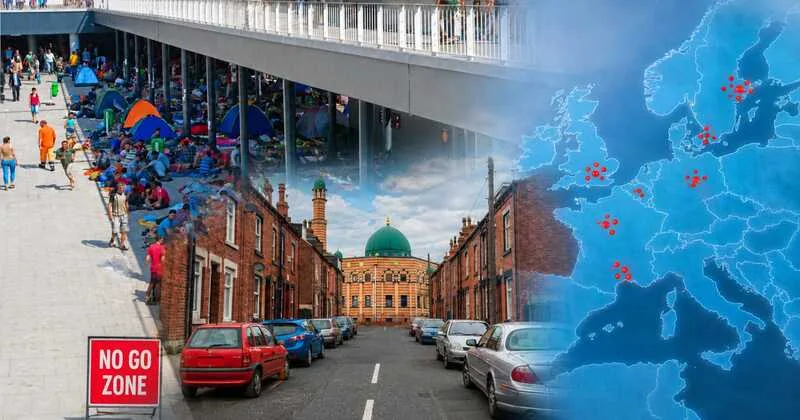
The authors estimate that between 900 and 1,000 neighbourhoods across Europe now display the defining characteristics of no-go zones. These areas range from large metropolitan suburbs to districts in medium-sized and smaller cities, indicating what the report characterises as an expanding territorial trend rather than isolated urban pockets.
Given the breadth of the issue, the report limits its detailed assessment to seven European Union member states where no-go zones are described as being most frequently reported, France, Germany, Italy, Spain, Belgium, Sweden and the Netherlands. It presents these countries as case studies to illustrate broader developments that, according to its findings, have emerged across the continent.
Immigration patterns and demographic change
The report links the emergence of these neighbourhoods to immigration patterns that accelerated from the 1970s onwards. It states that more than 40 per cent of residents living in the areas examined are foreign-born. It further argues that Muslim populations are significantly overrepresented within these districts compared with wider European averages.
According to the study, Muslims account for an average of 29 per cent of residents in the designated no-go zones, substantially higher than the European Union-wide average of 4.9 per cent and also above the average recorded in comparable urban neighbourhoods outside these zones.
🇻🇦✝️ "Now we are witnessing an invasion. There are no refugees. No, this is an invasion of mass Islamization of Europe," says Bishop Athanasius Schneider.
He says that mass immigration is essentially the destruction of Europe's historical culture and Christianity. pic.twitter.com/XG33dJ5vUH
— Visegrád 24 (@visegrad24) July 1, 2026
The report also analyses recent migration trends. Between January 2024 and March 2025, it notes that 11 of the 15 leading countries of origin for asylum seekers in the European Union were Muslim-majority states. It further points out that the three largest nationality groups granted EU citizenship during 2023 were Syrians, Moroccans and Albanians, all originating from Muslim-majority countries.
Crime, violence and terror recruitment
The study identifies crime, violence and terrorist recruitment as defining features of many of the neighbourhoods it categorises as no-go zones. Belgium is presented as one of its principal examples. The report notes that although Brussels accounts for roughly 10 per cent of Belgium’s population, the city recorded 44 per cent of all robberies committed nationwide during 2022.
Particular attention is given to the Brussels municipality of Molenbeek, which the report describes as one of Europe’s most well-known no-go zones. Molenbeek has repeatedly appeared in investigations into Islamist terrorism. The report highlights that several perpetrators connected with the November 2015 Paris terrorist attacks, the March 2016 Brussels Airport and Metro bombings and the 2014 attack on the Jewish Museum of Belgium either grew up in or spent considerable time in the district.
It also identifies Molenbeek as an important recruitment hub for ISIS, noting that Belgium produced the highest number of Western Islamic State fighters per capita. Journalist Matthew Levitt described Molenbeek in 2016, following the Paris attacks, as “another world, another culture, festering in the heart of the West.” The report cites this characterisation while arguing that similar environments exist elsewhere in Europe.
France receives similar attention. The report states that several neighbourhoods in Seine-Saint-Denis, including Drancy, Clichy-sous-Bois, Aulnay-sous-Bois and Stains, have repeatedly surfaced in investigations into French jihadist networks. Samy Amimour, one of the terrorists involved in the Bataclan attack during the November 2015 Paris attacks, was born in Drancy. Other jihadist cells, including the Cannes-Torcy network, also drew members from these suburbs. According to the report, such neighbourhoods provide conditions in which extremist recruitment can take root more easily.
Parallel legal systems across Europe
Beyond security concerns, the report argues that some immigrant-dense neighbourhoods are developing alternative social and legal frameworks that operate independently of national institutions. It identifies the United Kingdom as the clearest illustration, pointing to the existence of Sharia Councils that adjudicate matters relating to marriage, divorce, inheritance and child custody.
Among them, the Islamic Sharia Council in London, established in 1982, is highlighted as handling more than 1,000 cases annually. While these councils present themselves as operating within British law, the report argues that investigations have documented practices including pressure on women to return to abusive husbands, refusals to grant divorces without a husband’s consent and unequal treatment in matters involving child custody and property division. It concludes that these institutions prioritise patriarchal religious norms over civil rights despite functioning outside the formal judicial system.
State withdrawal, grooming gangs and institutional failure
The report argues that the consequences of these parallel societies extend beyond questions of integration and increasingly affect policing, criminal justice and public administration. It cites the United Kingdom as an example, linking parts of the organised sexual exploitation of white girls by predominantly Pakistani Muslim grooming gangs to towns including Rotherham, Rochdale and Oldham. According to the report, many of these crimes occurred in neighbourhoods it classifies as no-go zones, where authorities failed to intervene effectively despite repeated warning signs.
The rapid and uncontrolled influx of millions from failed Islamic states with deeply incompatible values — is not “enrichment.”
We have seen the results in Europe: rape gangs, no-go zones, skyrocketing crime, parallel Sharia societies, rising antisemitism, and a growing jihadist… pic.twitter.com/kveQDy5ZF3
— Liza Rosen (@LizaRosen0000) June 13, 2026
The study attributes this failure to what it describes as institutional reluctance driven by political correctness. It argues that cultural segregation, weak policing and official inaction enabled criminal networks to operate over extended periods. In the report’s assessment, this reluctance allowed offenders to act with relative impunity while victims remained inadequately protected, creating what it characterises as state complicity through inaction rather than direct participation.
The report presents these developments as evidence of a broader pattern in which public institutions gradually lose authority within certain neighbourhoods. It argues that as confidence in state institutions declines, informal community structures increasingly shape social behaviour, dispute resolution and everyday life.
Sharia patrols and changing public spaces
Germany is presented as another example of the tensions identified in the report. It revisits the 2014 case of self-described “Sharia patrols” in Wuppertal, where groups of Muslim men wearing distinctive orange vests attempted to discourage gambling, alcohol consumption and other activities they regarded as inconsistent with Islamic teachings.
The report notes that a local court initially found no criminal offence in the wearing of the uniforms, although that ruling was subsequently overturned by Germany’s federal judiciary. It further states that the individuals involved ultimately received symbolic fines for wearing illegal uniforms rather than for attempting to enforce religious rules through vigilante behaviour. The report presents this outcome as illustrating the difficulty European authorities have faced in responding to informal attempts to impose religious norms outside the framework of national law.
It argues that such incidents are not isolated examples but form part of a wider trend in which informal social pressure increasingly influences conduct within particular neighbourhoods. According to the report, this influence extends beyond religious observance and affects everyday interactions, especially those involving women.
The study also cites an incident involving former Member of the European Parliament Belinda de Lucy. In a TalkTV interview broadcast on 12 July 2025, she recounted being confronted near her home in west London while walking to collect her daughters from school. According to her account, two men dressed in Islamic clothing blocked her path, shouted at her and criticised her attire, which consisted of a large T-shirt and knee-length shorts. Describing the encounter, she said, “What is happening? This is my home!”
De Lucy also criticised the police response, stating that the attending officer repeatedly emphasised that he was Muslim and that the proposed course of action was to speak with the local imam and congregation. The report includes this account as an example of what it considers an inadequate institutional response to allegations of religious intimidation.
Gender norms, religious texts and urban transformation
The report argues that changes in neighbourhood culture are particularly visible in the experiences of women. It cites testimonies describing women being insulted, intimidated or socially excluded for failing to conform to conservative Islamic dress expectations. According to the report, what begins as an individual religious practice can, in certain localities, become a community expectation enforced through collective social pressure rather than by state authorities.
To explain the religious framework it believes underpins these developments, the report cites passages from Islamic sources. It refers to Quran 2:228, in the translation by Dr Mustafa Khattab, which states that men have “a degree” of responsibility above women, and to Quran 4:34 in the Sahih International translation, which describes men as being in charge of women and includes instructions regarding marital disputes.
„Paris & London sind nicht wiederzuerkennen.“
🇺🇸 Trump zieht eine realistische Bilanz zu Westeuropas Migrationspolitik. 🚨
Er warnt vor dem Verlust kultureller Identität und sieht die historischen Hauptstädte durch den unkontrollierten Zugang gefährdet.
Ein klares Statement. 👇🏻 pic.twitter.com/IhJseL8pmJ— Der Prophet (@AldousHuxIey) July 5, 2026
It also cites narrations from Sahih al-Bukhari stating that women constitute the majority of the inhabitants of Hell and describing women’s testimony as equivalent to half that of a man’s in certain legal contexts. The report presents these references as part of its discussion of gender roles, while noting that they are religious texts interpreted in different ways across Muslim communities.
The study further argues that visible cultural changes have emerged in several European cities. In Sevran, located in France’s Seine-Saint-Denis department, it cites reports that women have been informally excluded from cafes and restaurants. It describes accounts of women facing intimidation or exclusion when they do not conform to local expectations regarding Islamic dress.
Grenoble is presented as another case illustrating debates over religious accommodation in public life. The report recounts how Mayor Eric Piolle proposed changes to municipal swimming pool regulations that would have permitted female-only swimming sessions and allowed burkinis. According to the report, the proposal generated national controversy before France’s highest administrative court ultimately rejected the measures, reaffirming the principle that public institutions should remain free from religious particularism.
Europe at a crossroads
The report concludes that Europe is confronting a profound challenge involving identity, integration and national cohesion. It argues that a growing section of the population in some European countries no longer identifies with the historical values, cultural traditions or national identity of their country of citizenship. According to the authors, this has contributed to the emergence of parallel societies that increasingly function according to their own social norms and communal structures rather than those of the wider state.
Framing the issue as one of long-term political significance, the report contends that Europe faces a choice between reinforcing integration within existing constitutional and legal frameworks or allowing these parallel structures to become more deeply entrenched. It argues that immigration policy, urban governance, policing and cultural integration will remain central to this debate as European governments grapple with the long-term consequences identified in the study.