China's Indus dam exposes Pakistan's double standards
July 24, 2026
  • Read Ecopy
  • Circulation
  • Advertise
  • Careers
  • About Us
  • Contact Us
Android AppiPhone AppArattai
Organiser
  • ‌
  • Bharat
    • Assam
    • Bihar
    • Chhattisgarh
    • Jharkhand
    • Maharashtra
    • View All States
  • World
    • Asia
    • Europe
    • North America
    • South America
    • Africa
    • Australia
  • Editorial
  • International
  • Opinion
  • RSS @ 100
  • More
    • Op Sindoor
    • Analysis
    • Sports
    • Defence
    • Politics
    • Business
    • Economy
    • Culture
    • Special Report
    • Sci & Tech
    • Entertainment
    • G20
    • Azadi Ka Amrit Mahotsav
    • Vocal4Local
    • Web Stories
    • Education
    • Employment
    • Books
    • Interviews
    • Travel
    • Law
    • Health
    • Obituary
  • Subscribe
    • Subscribe Print Edition
    • Subscribe Ecopy
    • Read Ecopy
  • ‌
  • Bharat
    • Assam
    • Bihar
    • Chhattisgarh
    • Jharkhand
    • Maharashtra
    • View All States
  • World
    • Asia
    • Europe
    • North America
    • South America
    • Africa
    • Australia
  • Editorial
  • International
  • Opinion
  • RSS @ 100
  • More
    • Op Sindoor
    • Analysis
    • Sports
    • Defence
    • Politics
    • Business
    • Economy
    • Culture
    • Special Report
    • Sci & Tech
    • Entertainment
    • G20
    • Azadi Ka Amrit Mahotsav
    • Vocal4Local
    • Web Stories
    • Education
    • Employment
    • Books
    • Interviews
    • Travel
    • Law
    • Health
    • Obituary
  • Subscribe
    • Subscribe Print Edition
    • Subscribe Ecopy
    • Read Ecopy
Organiser
  • Home
  • Bharat
  • World
  • Operation Sindoor
  • Editorial
  • Analysis
  • Opinion
  • Culture
  • Defence
  • International Edition
  • RSS @ 100
  • Magazine
  • Read Ecopy
Home Bharat

Selective Outrage? China’s Indus Dam exposes Pakistan’s double standards on water security

China's upstream dam on the Indus has drawn little reaction from Pakistan, in stark contrast to Islamabad's repeated objections to Indian projects on the same river system

Dr Vishnu AravindDr Vishnu Aravind
Jul 4, 2026, 09:00 am IST
in Bharat, World, China, South Asia, Asia
Follow on Google News
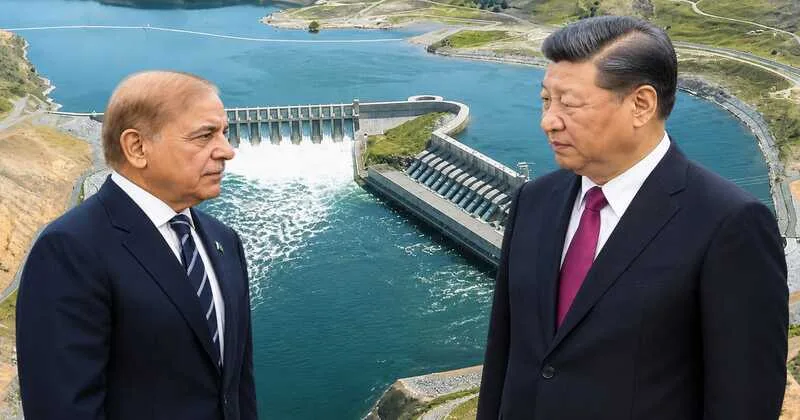
Xi builds, Sharif stays silent. The Indus tells the real story

Xi builds, Sharif stays silent. The Indus tells the real story

FacebookTwitterWhatsAppTelegramEmail

The geopolitics of South Asian water security has once again highlighted contrasting responses to upstream river developments. While Pakistan has consistently accused India of violating the spirit of the 1960 Indus Waters Treaty over hydropower projects on the western rivers, its response to a Chinese dam on the upper reaches of the Indus has remained conspicuously restrained.

China has constructed a medium-scale dam on the Sengge Zangpo, the Tibetan name for the upper reaches of the Indus River, near Demchok in western Tibet, close to the Line of Actual Control with Ladakh. Reports available for more than a decade indicate that the structure diverts and regulates sections of the river for local hydropower generation while supporting infrastructure expansion in Tibet’s Ngari prefecture. Located upstream of both India and Pakistan, the project has the potential to influence seasonal water flows further downstream.

Despite the strategic significance of the development, Pakistan has not mounted the kind of diplomatic or political campaign that routinely accompanies Indian projects on the Indus river system.

Different responses to different neighbours

Pakistan has frequently raised objections to Indian run-of-the-river hydropower projects and maintenance works on the Chenab and Jhelum rivers. Islamabad has repeatedly alleged violations of the Indus Waters Treaty, describing such projects as threats to its agriculture and water security. These concerns have been pursued through multiple international mechanisms, including the World Bank and the Permanent Court of Arbitration.

In contrast, China’s project on the Sengge Zangpo has attracted little public criticism from Pakistan. There have been no major parliamentary debates, international legal initiatives or official warnings comparable to those issued against India over similar concerns. The absence of sustained public objections stands out, given Pakistan’s dependence on the Indus River system.

The Indus originates in Tibet before flowing through Ladakh and entering Pakistan via Gilgit-Baltistan. Pakistan relies on the river for irrigation across nearly 80 per cent of its agricultural land, making uninterrupted downstream flows critical for food production and rural livelihoods. As China controls the river’s uppermost reaches without a formal water-sharing agreement with downstream countries, any upstream infrastructure carries long-term strategic implications.

Strategic interests shape water politics

The differing responses reflect broader geopolitical realities. China remains Pakistan’s principal strategic partner, its largest supplier of military equipment, a major investor through the China-Pakistan Economic Corridor (CPEC), and a consistent diplomatic supporter in international forums. Publicly challenging Beijing over water infrastructure could complicate a relationship that Islamabad considers central to its strategic and economic interests.

Pakistan has also welcomed Chinese participation in major infrastructure projects within its own territory, including support for large dam projects such as Diamer-Bhasha and Mohmand. These initiatives are viewed by Islamabad as essential for strengthening domestic water storage and power generation capacity.

Also Read: Rajasthan CID arrests Rafiq Sheikh in Pakistan-linked ISI spy funding network case spanning multiple states

India, meanwhile, continues to operate within the framework of the Indus Waters Treaty while maintaining its own concerns regarding Chinese upstream projects on other transboundary rivers, particularly the Brahmaputra, known in Tibet as the Yarlung Tsangpo. The broader Himalayan region has increasingly become an arena where upstream infrastructure projects intersect with questions of national security, energy needs and water governance.

The contrasting reactions to Chinese and Indian river projects underscore how geopolitical alliances can shape official responses to water security challenges. While Pakistan has consistently internationalised disputes concerning Indian hydropower projects, its muted reaction to infrastructure on the upper Indus in Chinese-controlled territory presents a markedly different approach.

As climate change, glacier retreat and rising water demand place additional pressure on the Indus basin, upstream interventions by any country are likely to attract greater regional attention. The developments on the Sengge Zangpo illustrate that debates over transboundary rivers are influenced not only by hydrology and treaty obligations but also by strategic partnerships and broader geopolitical considerations.

Ultimately, the contrasting responses raise questions about the consistency of Pakistan’s position on transboundary water security. If upstream interventions genuinely constitute a threat to downstream interests, the principle should apply irrespective of whether the actor is India or China. The silence over Beijing’s dam on the upper Indus, alongside persistent criticism of Indian projects under the Indus Waters Treaty framework, reinforces the perception that Pakistan’s approach to water diplomacy is shaped as much by strategic alliances as by concerns over water security.


 

Topics: China-Pakistan RelationsWater SecuritySengge Zangpo DamPakistanChinaIndus Waters TreatyIndus river
ShareTweetSendShareSend
✮ Subscribe Organiser YouTube Channel. ✮
✮ Join Organiser's WhatsApp channel for Nationalist views beyond the news. ✮
Previous News

UNESCO warns Pakistan over botched cement “restoration” at Vedic-era Taxila

Next News

Codeine cough syrup smuggling case: Gangster Act invoked against 10

Related News

Permanent Representative of India to the United Nations Parvathaneni Harish speaks at United Nations Security Council session

India rejects Pakistan at UN: Links Indus Waters Treaty to cross-border terrorism, reaffirms J&K stand

Former Politburo member Ma Xingrui

China expels Ma Xingrui in fresh politburo purge as Xi Jinping tightens grip amid mounting internal challenges

Tamil Nadu: Counterfeit currency syndicate with Malaysia, Pakistan links busted in Chennai; terror angle investigated

Fazal-ur-Rehman and Asim Munir

Pakistan: Fazal-ur-Rehman challenges Asim Munir to ‘take off uniform & fight election’; Slams for failure in Kargil war

Pakistan tops the Global Terrorism Index and faces EU scrutiny over its human rights record, risking key trade benefits

GSP+ status review: EU wants Pakistan to improve human rights record, end enforced disappearances, or lose it

Representative Image

Balochistan Declares Independence from Pakistan: Unveils flag & anthem; Claims control of 85% province & minerals

Load More

Latest News

Sant Mandal sangosthi in Ayodhya

Sants unite against ‘misinformation’ on Shri Ram Janmabhoomi; urge devotees not to be misled by rumours

Ceremonial lamp lighting at the commencement of meeting of the Rashtra Sevika Samiti’s Akhil Bharatiya Karyakarini and Pratinidhi Mandal

Rashtra Sevika Samiti’s three-day meeting begins at Samalkha; reaffirms commitment to women’s awakening

Aditya L1: India's maiden dedicated solar mission

Aditya L1: Govt highlight discoveries of India’s solar mission; Hails Chandrayan-3 as milestone for space ambitions

Security forces checking the vehicles as they intensify crackdown on terror networks in J&K

J&K: Houses of LeT operatives Aadil Thokar, Haroon Ganai demolished; 2,500 suspected OGWs detained

Permanent Representative of India to the United Nations Parvathaneni Harish speaks at United Nations Security Council session

India rejects Pakistan at UN: Links Indus Waters Treaty to cross-border terrorism, reaffirms J&K stand

Karnataka KPSC Recruitment Scam: Congress govt under fire for selling seats for Rs 80 lakh each

Union Minister Mansukh Mandaviya urged India’s 124-member contingent in Glasgow to compete with passion

Commonwealth Games 2026: Invoking blessings of Ma Durga & Mahakali, Mandaviya urges Indian squad to play without fear

Internal planning chats have raised questions over the political messaging behind Kolkata's proposed student solidarity march

Student Protest or Political Agenda? Internal chats raise questions over Kolkata’s proposed Solidarity March

Preparations underway on Bada Danda in Puri for the Bahuda Yatra

Bahuda Yatra 2026: Puri prepares for grand return of Mahaprabhu Jagannath amid tight security and devotee surge

Delhi Police claimed 480 Pakistan-linked accounts spread fake content during the NEET-UG protests

Operation Sindoor Network Now Targeting NEET-UG Protests? Delhi police blocks 480 Pakistan-linked accounts

Load More
  • Privacy
  • Terms
  • Cookie Policy
  • Refund and Cancellation
  • Delivery and Shipping

© Bharat Prakashan (Delhi) Limited.
Tech-enabled by Ananthapuri Technologies

  • Home
  • Search Organiser
  • Bharat
    • Assam
    • Bihar
    • Chhattisgarh
    • Jharkhand
    • Maharashtra
    • View All States
  • World
    • Asia
    • Africa
    • North America
    • South America
    • Europe
    • Australia
  • Editorial
  • Operation Sindoor
  • Opinion
  • Analysis
  • Defence
  • Culture
  • Sports
  • Business
  • RSS @ 100
  • Entertainment
  • More ..
    • Sci & Tech
    • Vocal4Local
    • Special Report
    • Education
    • Employment
    • Books
    • Interviews
    • Travel
    • Health
    • Politics
    • Law
    • Economy
    • Obituary
  • Subscribe Magazine
  • Read Ecopy
  • Advertise
  • Circulation
  • Careers
  • About Us
  • Contact Us
  • Policies & Terms
    • Privacy Policy
    • Cookie Policy
    • Refund and Cancellation
    • Terms of Use

© Bharat Prakashan (Delhi) Limited.
Tech-enabled by Ananthapuri Technologies