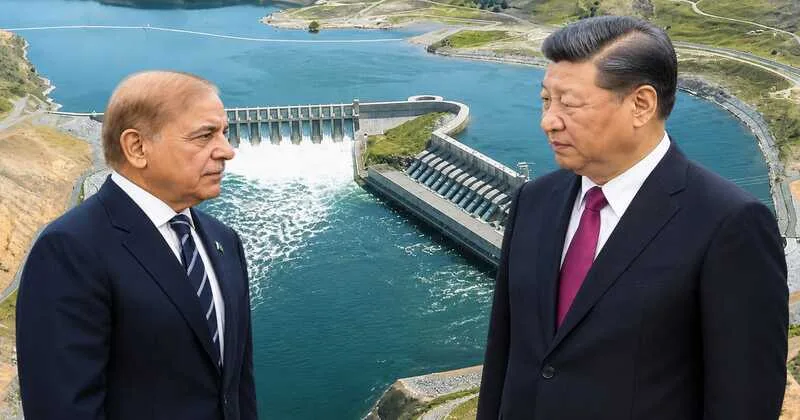
The geopolitics of South Asian water security has once again highlighted contrasting responses to upstream river developments. While Pakistan has consistently accused India of violating the spirit of the 1960 Indus Waters Treaty over hydropower projects on the western rivers, its response to a Chinese dam on the upper reaches of the Indus has remained conspicuously restrained.
China has constructed a medium-scale dam on the Sengge Zangpo, the Tibetan name for the upper reaches of the Indus River, near Demchok in western Tibet, close to the Line of Actual Control with Ladakh. Reports available for more than a decade indicate that the structure diverts and regulates sections of the river for local hydropower generation while supporting infrastructure expansion in Tibet’s Ngari prefecture. Located upstream of both India and Pakistan, the project has the potential to influence seasonal water flows further downstream.
Despite the strategic significance of the development, Pakistan has not mounted the kind of diplomatic or political campaign that routinely accompanies Indian projects on the Indus river system.
Different responses to different neighbours
Pakistan has frequently raised objections to Indian run-of-the-river hydropower projects and maintenance works on the Chenab and Jhelum rivers. Islamabad has repeatedly alleged violations of the Indus Waters Treaty, describing such projects as threats to its agriculture and water security. These concerns have been pursued through multiple international mechanisms, including the World Bank and the Permanent Court of Arbitration.
In contrast, China’s project on the Sengge Zangpo has attracted little public criticism from Pakistan. There have been no major parliamentary debates, international legal initiatives or official warnings comparable to those issued against India over similar concerns. The absence of sustained public objections stands out, given Pakistan’s dependence on the Indus River system.
The Indus originates in Tibet before flowing through Ladakh and entering Pakistan via Gilgit-Baltistan. Pakistan relies on the river for irrigation across nearly 80 per cent of its agricultural land, making uninterrupted downstream flows critical for food production and rural livelihoods. As China controls the river’s uppermost reaches without a formal water-sharing agreement with downstream countries, any upstream infrastructure carries long-term strategic implications.
Strategic interests shape water politics
The differing responses reflect broader geopolitical realities. China remains Pakistan’s principal strategic partner, its largest supplier of military equipment, a major investor through the China-Pakistan Economic Corridor (CPEC), and a consistent diplomatic supporter in international forums. Publicly challenging Beijing over water infrastructure could complicate a relationship that Islamabad considers central to its strategic and economic interests.
Pakistan has also welcomed Chinese participation in major infrastructure projects within its own territory, including support for large dam projects such as Diamer-Bhasha and Mohmand. These initiatives are viewed by Islamabad as essential for strengthening domestic water storage and power generation capacity.
India, meanwhile, continues to operate within the framework of the Indus Waters Treaty while maintaining its own concerns regarding Chinese upstream projects on other transboundary rivers, particularly the Brahmaputra, known in Tibet as the Yarlung Tsangpo. The broader Himalayan region has increasingly become an arena where upstream infrastructure projects intersect with questions of national security, energy needs and water governance.
The contrasting reactions to Chinese and Indian river projects underscore how geopolitical alliances can shape official responses to water security challenges. While Pakistan has consistently internationalised disputes concerning Indian hydropower projects, its muted reaction to infrastructure on the upper Indus in Chinese-controlled territory presents a markedly different approach.
As climate change, glacier retreat and rising water demand place additional pressure on the Indus basin, upstream interventions by any country are likely to attract greater regional attention. The developments on the Sengge Zangpo illustrate that debates over transboundary rivers are influenced not only by hydrology and treaty obligations but also by strategic partnerships and broader geopolitical considerations.
Ultimately, the contrasting responses raise questions about the consistency of Pakistan’s position on transboundary water security. If upstream interventions genuinely constitute a threat to downstream interests, the principle should apply irrespective of whether the actor is India or China. The silence over Beijing’s dam on the upper Indus, alongside persistent criticism of Indian projects under the Indus Waters Treaty framework, reinforces the perception that Pakistan’s approach to water diplomacy is shaped as much by strategic alliances as by concerns over water security.