PM Modi's effort to translate Gandhi’s antyodaya into practice
August 28, 2026
  • Read Ecopy
  • Circulation
  • Advertise
  • Careers
  • About Us
  • Contact Us
Android AppiPhone AppArattai
Organiser
  • ‌
  • Bharat
    • Assam
    • Bihar
    • Chhattisgarh
    • Jharkhand
    • Maharashtra
    • View All States
  • World
    • Asia
    • Europe
    • North America
    • South America
    • Africa
    • Australia
  • Editorial
  • International
  • Opinion
  • RSS @ 100
  • More
    • Op Sindoor
    • Analysis
    • Sports
    • Defence
    • Politics
    • Business
    • Economy
    • Culture
    • Special Report
    • Sci & Tech
    • Entertainment
    • G20
    • Azadi Ka Amrit Mahotsav
    • Vocal4Local
    • Web Stories
    • Education
    • Employment
    • Books
    • Interviews
    • Travel
    • Law
    • Health
    • Obituary
  • Subscribe
    • Subscribe Print Edition
    • Subscribe Ecopy
    • Read Ecopy
  • ‌
  • Bharat
    • Assam
    • Bihar
    • Chhattisgarh
    • Jharkhand
    • Maharashtra
    • View All States
  • World
    • Asia
    • Europe
    • North America
    • South America
    • Africa
    • Australia
  • Editorial
  • International
  • Opinion
  • RSS @ 100
  • More
    • Op Sindoor
    • Analysis
    • Sports
    • Defence
    • Politics
    • Business
    • Economy
    • Culture
    • Special Report
    • Sci & Tech
    • Entertainment
    • G20
    • Azadi Ka Amrit Mahotsav
    • Vocal4Local
    • Web Stories
    • Education
    • Employment
    • Books
    • Interviews
    • Travel
    • Law
    • Health
    • Obituary
  • Subscribe
    • Subscribe Print Edition
    • Subscribe Ecopy
    • Read Ecopy
Organiser
  • Home
  • Bharat
  • World
  • Operation Sindoor
  • Editorial
  • Analysis
  • Opinion
  • Culture
  • Defence
  • International Edition
  • RSS @ 100
  • Magazine
  • Read Ecopy
Home Bharat

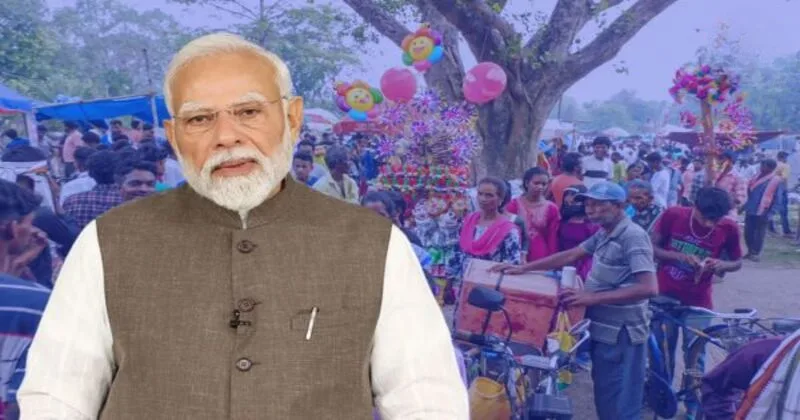
Prime Minister Narendra Modi: A sincere effort to translate Gandhi’s philosophy of antyodaya into practice

According to the World Bank’s 2025 Poverty and Equity Brief, extreme poverty in India declined from 16.2 per cent in 2011–12 to 2.3 per cent in 2022–23 and approximately 171 million people moved out of extreme poverty

Dr Manmohan PrakashDr Manmohan Prakash
Jun 28, 2026, 08:30 am IST
inBharat, Analysis
Follow on Google News
Facebook
Twitter
WhatsAppTelegramEmail

Mahatma Gandhi had offered a profoundly important principle for governance and policymaking in independent India: “Whenever you are in doubt, recall the face of the poorest and weakest person you have seen and ask yourself whether the step you are about to take will be of any use to him.” This thought was not merely a moral message but represented the fundamental philosophy of democratic governance. Development becomes meaningful only when its benefits begin with the most deprived person in society and ultimately reach the entire community.

Over the past nearly twelve years, under the leadership of Prime Minister Narendra Modi, the Government of India has implemented several policies and schemes aimed at ensuring that development reaches the last person in society. From this perspective, the true evaluation of the Modi government’s success should be based on its social impact, improvement in living standards, and equal access to opportunities.

As we know, after 2014, the guiding principle of governance became “Sabka Saath, Sabka Vikas, Sabka Vishwas, Sabka Prayas” (Together with All, Development for All, Trust of All, Efforts by All). The essence of this approach was to ensure that development did not remain limited to select groups but reached the broader population with inclusive participation. Under this vision, efforts were made to place the poor, rural communities, disadvantaged sections, and citizens deprived of basic facilities at the center of policymaking. As a result, while earlier Congress governments emphasized the slogan of poverty eradication, the BJP government claims to have enabled a large number of poor people to rise above the poverty line.

In this context, poverty alleviation statistics are noteworthy. According to the World Bank’s 2025 Poverty and Equity Brief, extreme poverty in India declined from 16.2 per cent in 2011–12 to 2.3 per cent in 2022–23 and approximately 171 million people moved out of extreme poverty. When measured using the lower-middle-income poverty line, an estimated 378 million people are considered to have risen out of poverty. This transformation is viewed not merely as an increase in income but also as an indicator of expanded access to basic services and social security mechanisms. This, in itself, represents a significant achievement.

Among the most important initiatives in the direction of Antyodaya has been financial inclusion. A large number of citizens who had remained outside the formal banking system were connected through bank accounts, direct benefit transfersband digital payment systems. This made it possible to deliver government support more directly and transparently to beneficiaries while reducing intermediary layers between governance and citizens.

Gandhiji placed special emphasis on the dignity of village life and ordinary citizens. In line with this vision, priority was given to essential facilities such as housing, sanitation, electricity and drinking water. Through the Pradhan Mantri Awas Yojana, permanent housing was promoted; through the Swachh Bharat Mission, sanitation was transformed into a mass movement; and initiatives such as Har Ghar Jal sought to expand access to life’s basic necessities. The objective of these schemes was not merely to provide facilities but also to lay the foundation for a dignified life.

Women’s empowerment was also linked with the philosophy of Antyodaya. Efforts were made to provide clean cooking fuel through the Ujjwala Scheme, encourage self-help groups and increase women’s economic participation. These initiatives aimed to strengthen women’s health, reduce labor burdens and enhance their social participation.

In the field of health security, initiatives such as Ayushman Bharat have been regarded as significant for poor families. For a long time, illness and treatment expenses pushed many households toward financial distress. To reduce this challenge, efforts were made to strengthen access to healthcare services and financial protection mechanisms.

With respect to rural India and farmers, initiatives such as PM-Kisan Samman Nidhi, irrigation expansion, promotion of natural farming, and increased technological adoption in agriculture were introduced. These measures sought to make agriculture more productive, sustainable and income-generating. At the same time, rural India was increasingly viewed not merely as a recipient of assistance but as an active participant in the mainstream of national development.

Also Read: India’s exports hit record high in May 2026 despite global uncertainties; Trade deficit narrows

Poverty eradication cannot be achieved solely through the distribution of aid; it requires the creation of opportunities. Accordingly, emphasis was placed on policies promoting skill development, startups, self-employment, and micro and small enterprises. Efforts to connect youth with employment and entrepreneurship were also extensions of this broader vision.

The COVID-19 pandemic became a real test of the social security system. During this period, efforts were made to provide food assistance, healthcare services and essential support on a large scale. This demonstrated how important a strong welfare infrastructure becomes during times of crisis.

However, the performance of any government should be evaluated with a balanced perspective. Challenges such as the quality of employment, income inequality, standards of education and healthcare, regional disparities and long-term economic opportunities still persist. Therefore, the goal of Antyodaya cannot yet be considered fully achieved. In reality, it remains a continuous process that requires sustained improvement and active social participation.

Overall, under the leadership of Prime Minister Narendra Modi, governance in recent years appears to have moved toward making development broader and more inclusive. With the goal of building a strong, self-reliant and developed nation, there has been a sincere and meaningful effort in policy formulation and implementation to ensure that development reaches the last person in society.State government should also make policies keeping in mind the  centre vision.

Topics: IndiaPrime Minister Narendra ModiMahatma GandhiAntyodayaFEATUTEDPoverty World Bank
Share
Tweet
SendShareSend
✮ Subscribe Organiser YouTube Channel. ✮
✮ Join Organiser's WhatsApp channel for Nationalist views beyond the news. ✮
Previous News

Odisha: CM Majhi unveils major MSME drive, launches women entrepreneurship platform and new industrial clusters

Next News

West Bengal UCC Bill Explained: What Uniform Civil Code covers, Why Govt is bringing it, What it means for state

Related News

Book Review | Finding Zero: A Mathematician’s Odyssey to Uncover the Origins of Numbers

Nepal Floods: India airlifts 37.5 tonne relief aid; Hundreds of Indians missing, Embassy opens emergency helpline

Anchoring the Village: Inside MoRD's Multi-Scheme Strategy to Keep Rural India at Home(AI Generated Image)

How India’s rural development architecture is rewriting the migration story

From Village Schools to Colonial Classrooms: The Systematic Disruption of India’s Traditional Education(AI Generated Image)

How British colonialism & Macaulay’s minute systematically dismantled Indian indigenous education system!

27th India-Russia Inter-Governmental Commission (IRIGC-TEC) in Moscow alongside Russian First Deputy Prime Minister Denis Manturov

EAM Jaishankar flags steep trade imbalance with Russia; Hails national payment, early FTA as key to USD 100bn trade

NSA Ajit Doval met Chinese Vice President Han Zheng

NSA Ajit Doval in China: Meets Vice President Han Zheng; Affirms border peace & stability as pivotal to bilateral ties

Load More

Latest News

BJP Telangana state president N Ramachander Rao under house on August 27, 2016

Telangana BJP chief detained, Rao targets Rahul Gandhi over Congress plot to paralyse education, hand lands to mafia

Nagaland Janjati Vikas Samiti: Spreading knowledge, preserving indigenous heritage & empowering tribal youth

Dr Mohan Bhagwat’s US Visit: AHEAD Forum account back on X after facing backlash from Hindus globally

Maoist Dump Recovered in Malkangiri District, Odisha

Maoist dumps unearthed in Malkangiri & Kanker search operations; Arms, IEDs and communication tools recovered

Nepal Floods: Sewa International and Hindu Swayamsevak Sangh launch relief operations

Amrita Devi: Protector of Sacred Khejri Trees

Amrita Devi Balidan Diwas: Protector of sacred Khejri trees

Book Review | Finding Zero: A Mathematician’s Odyssey to Uncover the Origins of Numbers

Raksha Bandhan and Anti-Partition Movement: Bond of Fraternity

US religious freedom panel, headed by a Pakistani, peddles lies about RSS ahead of Sarsanghachalak’s US visit

Tradition Meets Technology: Adani Computer Lab Opens at Ayodhya Gurukul

Ayodhya Gurukul’s Digital Leap: Adani Foundation sets up modern computer lab

Load More
  • Privacy
  • Terms
  • Cookie Policy
  • Refund and Cancellation
  • Delivery and Shipping

© Bharat Prakashan (Delhi) Limited.
Tech-enabled by Ananthapuri Technologies

  • Home
  • Search Organiser
  • Bharat
    • Assam
    • Bihar
    • Chhattisgarh
    • Jharkhand
    • Maharashtra
    • View All States
  • World
    • Asia
    • Africa
    • North America
    • South America
    • Europe
    • Australia
  • Editorial
  • Operation Sindoor
  • Opinion
  • Analysis
  • Defence
  • Culture
  • Sports
  • Business
  • RSS @ 100
  • Entertainment
  • More ..
    • Sci & Tech
    • Vocal4Local
    • Special Report
    • Education
    • Employment
    • Books
    • Interviews
    • Travel
    • Health
    • Politics
    • Law
    • Economy
    • Obituary
  • Subscribe Magazine
  • Read Ecopy
  • Advertise
  • Circulation
  • Careers
  • About Us
  • Contact Us
  • Policies & Terms
    • Privacy Policy
    • Cookie Policy
    • Refund and Cancellation
    • Terms of Use

© Bharat Prakashan (Delhi) Limited.
Tech-enabled by Ananthapuri Technologies