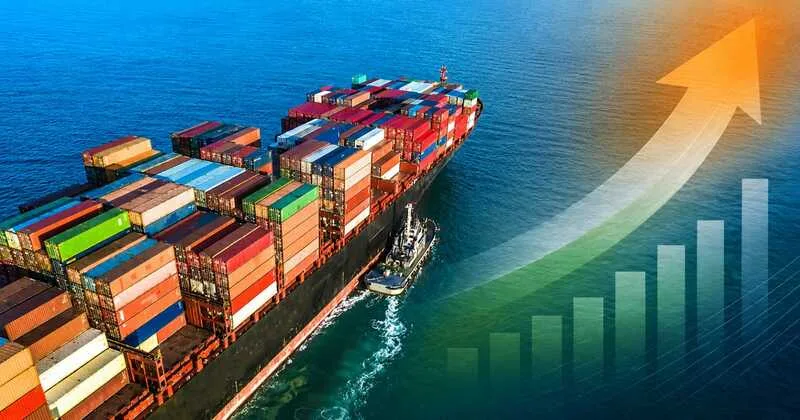
India’s export sector demonstrated remarkable resilience in May 2026, achieving the highest monthly merchandise export level in the country’s history despite continuing uncertainties in the global economy. The strong performance highlights the growing competitiveness of Indian manufacturing and industry and reinforces India’s position as an increasingly important player in global trade.
According to government data released on Monday, India’s merchandise exports rose to $45.2 billion in May 2026, up from $43.56 billion in April, marking a significant increase over the same period last year. Strong demand for Indian products from markets across Asia, Africa and Europe played a crucial role in driving export growth.
Among the biggest contributors to this expansion were Singapore, Tanzania, Sri Lanka, South Africa and Italy, where Indian exports registered double-digit and, in some cases, triple-digit growth rates. The performance underscores India’s success in strengthening its presence not only in traditional markets but also in emerging destinations.
Key sectors powering export growth included petroleum products, engineering goods, electronics, pharmaceuticals, chemicals, gems and jewellery. Particularly noteworthy was the strong showing of engineering and electronics exports, which reflects India’s emergence as a global manufacturing hub and a reliable supplier in high-value sectors.
Trade with major partners such as the United States, the United Arab Emirates and China also remained positive. Although growth moderated in certain markets, overall global demand for Indian products continued to remain strong.
Trade deficit narrows as exports offset rising imports
India’s merchandise trade deficit narrowed marginally in May as export growth helped offset part of the rising import bill. The merchandise trade deficit fell to $28.21 billion in May from $28.38 billion in April, remaining below economists’ forecast of $28.72 billion, according to a Reuters poll.
Imports increased to $73.41 billion in May, compared with a six-month high of $71.94 billion in April. Higher imports were driven primarily by crude oil, gold and electronics.
India’s overall trade performance also remained strong during the month. According to official data, the country’s total exports, including merchandise and services, rose to USD 81.96 billion in May 2026 from USD 70.76 billion in May 2025. Overall imports increased to USD 92.47 billion from USD 77.55 billion during the same period.
India’s total exports, comprising merchandise and services, reached US$ 162.69 Billion during April–May 2026-27, registering a robust 14.66% growth over the corresponding period last year.
The strong export performance reflects resilient trade momentum, growing global demand for… pic.twitter.com/HngrXYtVcO
— Dept of Commerce, GoI (@DoC_GoI) June 15, 2026
Consequently, India’s overall trade deficit, which combines merchandise and services trade, widened to USD 10.51 billion in May 2026 compared with USD 6.79 billion a year earlier. The rise in both exports and imports reflects growing economic activity and robust demand, while the strong expansion in exports highlights the increasing global acceptance of Indian goods and services.
Trade data showed that crude oil and related imports surged nearly 54% year-on-year to $22.68 billion, while gold imports rose 34 per cent to $3.42 billion. These increases contributed significantly to the overall import bill and the continued trade deficit.
The figures highlight the challenge India faces in sustaining export momentum while managing import costs amid volatile energy prices, disruptions in West Asia and ongoing trade negotiations with the United States.
Trade talks with the United States gain momentum
India is simultaneously pursuing stronger trade ties with the United States. Trade Secretary Rajesh Agrawal announced that U.S. Trade Representative Jamieson Greer is scheduled to visit India on June 23-24 for further discussions on an interim trade agreement.
“Discussions with USTR will be centred around giving final touches to our interim deal,” Agrawal told reporters. He added that New Delhi would seek clarity regarding proposed U.S. tariffs under a Section 301 investigation while finalising the agreement.
India is seeking a trade deal that would provide its exports with preferential tariff access to the American market. Negotiations have been complicated by U.S. investigations into alleged overcapacity in sectors such as textiles and steel. Trade issues are also expected to feature in discussions between U.S. President Donald Trump and Prime Minister Narendra Modi on the sidelines of this week’s summit in France, although a final agreement is not expected during the meeting.
Trade Minister Piyush Goyal recently expressed optimism that the first tranche of a bilateral trade agreement could be concluded by mid-July 2026.
Commerce Secretary Rajesh Agrawal on BTA (Bilateral Trade Agreement) negotiation with US says, "United States Trade Representative is coming on the evening of 22nd June. On 23-24 June, he will be engaging with our Minister for Commerce and Industry. After that, he will be going… pic.twitter.com/o3IW0sI84P
— ANI (@ANI) June 15, 2026
Meanwhile, a developing agreement between the United States and Iran to end hostilities, lift the US blockade of Iran and reopen the Strait of Hormuz could provide additional relief to India’s economy. India imports more than 80% of its crude oil and around 60% of its cooking gas, much of it from West Asia. Lower oil prices and reduced shipping disruptions could help reduce freight, insurance and energy costs for Indian businesses.
India’s services sector also continued to perform strongly. The government estimated services exports at $36.76 billion in May, while services imports stood at $19.06 billion, resulting in a services trade surplus of $17.7 billion.
Welcoming the easing of geopolitical tensions, Ashwin Chandran, Chairman of the Confederation of Indian Textile Industry, described the US-Iran announcement as “a shot in the arm” for India’s textile and apparel sector, saying it would ease supply-chain cost pressures and support the country’s export ambitions.
With record merchandise exports, expanding global market access and ongoing trade negotiations, India’s foreign trade sector appears well-positioned for further growth in the coming months.