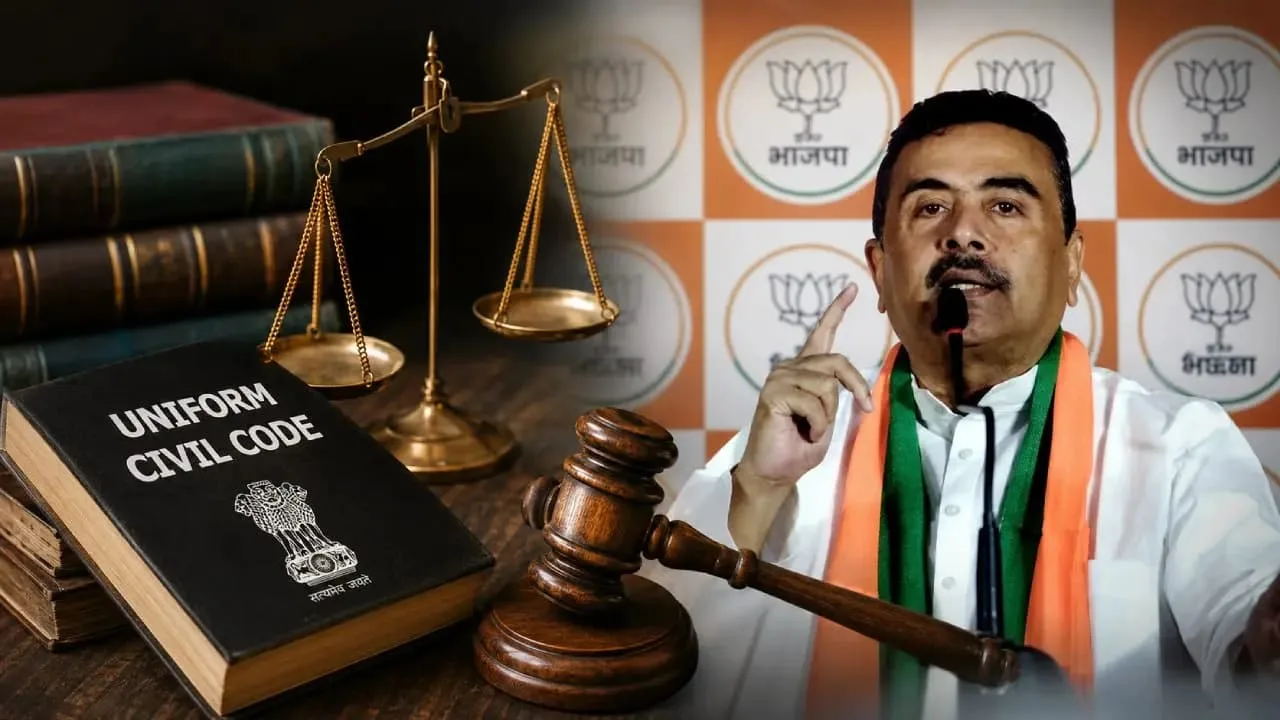
The West Bengal government is preparing to introduce one of its most important legislative proposals since coming to power. On Monday, the state Assembly is expected to take up the Uniform Civil Code (UCC) Bill, a move that fulfils a major promise made by the Bharatiya Janata Party (BJP) during the Assembly elections.
The proposed legislation is expected to bring all citizens under a common set of civil laws governing marriage, divorce, inheritance, property rights, adoption and certain family-related matters, regardless of religion.
If passed, West Bengal would join a growing list of BJP-ruled states that have moved towards implementing a Uniform Civil Code. The development is being closely watched because of Bengal’s unique demographic composition and its long history of political and social debates surrounding identity, religion and governance.
A key BJP poll promise
The BJP had promised to introduce a Uniform Civil Code within six months of forming the government in West Bengal. The commitment featured prominently in the party’s election manifesto and was presented as a major governance reform aimed at ensuring equality before the law.
According to party sources, the decision to table the Bill was finalised during a recent Business Advisory Committee (BAC) meeting of the Assembly, with Monday fixed as the date for its introduction.
For the BJP government led by Chief Minister Suvendu Adhikari, the UCC represents more than just another legislative proposal. It is one of the party’s core ideological commitments and has been advocated by the BJP at the national level for decades.
What is Uniform Civil Code?
The Uniform Civil Code refers to the idea of having one common civil law applicable to all citizens, irrespective of religion.
At present, several personal matters in India such as marriage, divorce, succession, inheritance and adoption are governed by religion-specific personal laws. Hindus, Muslims, Christians, Parsis and other communities often follow different legal frameworks in these areas.
Supporters of the UCC argue that a common legal framework promotes equality before the law and ensures that citizens are treated similarly regardless of their religious identity.
The concept finds mention in Article 44 of the Constitution, which is part of the Directive Principles of State Policy. It states that the State shall endeavour to secure a Uniform Civil Code for citizens throughout the territory of India.
However, because Directive Principles are not legally enforceable, successive governments have debated how and when such a code should be implemented.
What is expected in the West Bengal UCC bill?
While the final text of the Bill is yet to be made public, government and party sources indicate that the proposed legislation will focus on four major areas: marriage, gender equality, live-in relationships and divorce.
Uniform Marriage Rules: One of the key proposals is expected to be the introduction of a uniform minimum legal age for marriage across all communities.
The legislation is also likely to make marriage registration mandatory for everyone, regardless of faith. Supporters argue that compulsory registration creates legal documentation, protects spouses and helps prevent disputes related to marital status.
The move would mean that all marriages would be formally recorded under a common legal framework rather than being governed solely by religious customs.
Ban On Polygamy: The proposed UCC is expected to prohibit polygamy and establish a single standard applicable to all citizens.
Advocates of the reform argue that a common rule on marriage would promote equal treatment under the law and strengthen legal protections for women.
The issue has often been at the centre of discussions surrounding the Uniform Civil Code, with supporters claiming that different personal laws create unequal legal standards.
Equal Rights For Women: A major focus of the proposed legislation is expected to be gender equality.
According to the framework discussed by BJP leaders, women would receive equal legal rights in matters related to inheritance, property ownership and succession.
Many say such provisions could help remove legal disparities that arise under different personal law systems and strengthen women’s access to property and financial security.
The BJP has repeatedly projected the UCC as a measure intended to enhance legal protections for women across communities.
Registration Of Live-In Relationships: One of the most debated provisions is expected to be mandatory registration of live-in relationships.
According to the proposed framework, couples living together without marriage may be required to register their relationship with a designated authority. Registration may also be required when such relationships end.
Supporters argue that registration can help establish legal accountability and provide clarity in cases involving maintenance, inheritance, custody disputes or allegations of abandonment.
Common Divorce Framework: The legislation is also expected to introduce a single legal framework for divorce proceedings.
Instead of religion-specific procedures governing the dissolution of marriage, a uniform process would apply to all citizens.
The proposal is expected to provide equal legal remedies and rights to both spouses regardless of their religious background.
Supporters say this would simplify legal procedures and reduce inconsistencies that currently exist between different personal law systems.
Why is West Bengal’s UCC debate different?
The proposed legislation carries particular significance in West Bengal because of the state’s social and demographic profile.
Several districts in the state, including Malda, Murshidabad and parts of North Dinajpur, have substantial minority populations. As a result, any legislation affecting personal laws is likely to have significant political and social implications.
Many believe debates around the Bill may be more intense in Bengal than in some other states because issues related to religion and identity have historically played an important role in the state’s electoral politics.
The government, however, maintains that the Bill is focused on legal equality and administrative uniformity rather than religion.
BJP’s Argument
The BJP has consistently argued that the Uniform Civil Code is necessary to ensure equal treatment of all citizens.
Party leaders say different personal laws create unequal legal standards based on religion and that a common code would strengthen constitutional principles of equality.
Reports from within the party also claim that sections of women from minority communities have expressed support for the proposed legislation, arguing that stronger legal rights in matters such as marriage, inheritance and divorce could benefit them.
These claims, however, have not been independently verified.
The party further argues that legal uniformity is essential for a modern legal system and that citizens should have access to the same rights and protections regardless of faith.
One of the central criticisms historically associated with the UCC debate is that personal laws form an important part of community identity and religious traditions.
Some also believe that implementing a Uniform Civil Code requires careful consultation with different communities to ensure that concerns related to tradition, customs and minority rights are adequately addressed.
The debate is therefore likely to extend beyond legal issues and enter broader discussions about constitutional rights, secularism and cultural autonomy.
Part of a larger national trend
West Bengal is not the first BJP-ruled state to move towards a Uniform Civil Code.
Uttarakhand became the first state to implement a UCC framework. Other BJP-governed states, including Assam, Madhya Pradesh, Maharashtra and Gujarat, have also taken steps towards introducing similar legislation.
The Bengal Bill is therefore being viewed as part of a broader national push by the BJP to advance one of its long-standing policy goals.
The development also comes amid renewed national discussions on personal laws, gender justice and legal reforms.
The Bill is expected to be introduced in the Assembly on Monday. Following its introduction, legislators are likely to debate its provisions before any vote is taken.
The final impact of the legislation will depend on the exact language of the Bill, the amendments proposed during debates and the legal framework ultimately approved by the Assembly.
Regardless of the outcome, the introduction of the Uniform Civil Code Bill is set to become one of the most consequential political and legislative developments of the first BJP government in West Bengal.
The debate is expected to shape discussions not only on law and governance but also on identity, equality, gender rights and the future relationship between personal laws and the Indian legal system.