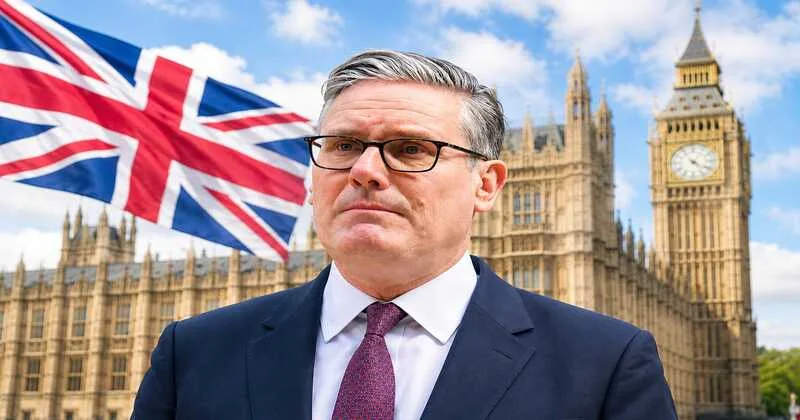
British Prime Minister Keir Starmer’s resignation on June 22, 2026, marks more than the end of another premiership. Coming after mounting pressure from within the Labour Party, disappointing electoral performances and growing internal divisions, Starmer’s departure makes him the sixth British Prime Minister in just ten years to leave office before completing a full political cycle. He joins a growing list that includes David Cameron, Theresa May, Boris Johnson, Liz Truss and Rishi Sunak.
For a country that presents the Westminster model as one of the world’s most stable democratic systems, the frequency of leadership collapses raises uncomfortable questions. The crisis is no longer merely about individual leaders. It is increasingly about whether Britain’s political institutions, constitutional arrangements and governing elite remain capable of addressing the country’s long-term decline.
The British political system has long been celebrated for continuity, convention and stability. Unlike many democracies, Britain functions without a single written constitution. Its governance rests upon parliamentary sovereignty, political conventions, party discipline and institutional traditions that evolved over centuries. The Westminster model has often been presented as a benchmark for democratic governance across the world.
Yet the reality of the past decade tells a different story. Six Prime Ministers have come and gone within ten years. Governments have changed, parties have alternated, policies have shifted, but many of Britain’s underlying problems have remained stubbornly unresolved. The repeated removal of leaders has created an impression of political dynamism while masking a deeper institutional stagnation.
Revolving-door leadership and institutional fragility
The departure of Starmer continues a pattern that has become increasingly familiar in British politics. David Cameron resigned after the Brexit referendum. Theresa May was forced out amid Brexit deadlock. Boris Johnson fell under the weight of scandal and internal rebellion. Liz Truss survived only weeks in office after triggering market turmoil. Rishi Sunak departed following Conservative electoral defeat. Now Starmer has become the latest casualty of political instability.
The Westminster system is often praised for its ability to replace leaders without triggering constitutional crises. Yet the repeated removal of Prime Ministers raises a fundamental question that if leadership changes so frequently while national problems persist, is the system genuinely solving problems or merely replacing faces?.
Watch live: My statement. https://t.co/MX7ga3FRGq
— Keir Starmer (@Keir_Starmer) June 22, 2026
The constitutional flexibility that once appeared to be a strength increasingly resembles a mechanism for elite self-correction rather than democratic accountability. Prime Ministers are frequently removed by party calculations rather than direct public verdicts. Leadership transitions occur smoothly, but governance outcomes remain disappointing.
Britain’s political class continues to celebrate institutional resilience even as public confidence weakens. The result is a paradox that institutions survive, but trust in their effectiveness steadily declines.
A nation in relative decline
The political instability would be less significant if Britain were thriving. Instead, it coincides with mounting evidence of national decline.
Middle-income British families were, in 2023, 20 percent poorer than their German counterparts and 9 percent poorer than their French counterparts. For low-income households, the gap reached 27 percent when compared with both Germany and France.
Britain today records the highest degree of inequality in Europe. Productivity growth since 2008 has been only half that achieved by the 25 richest OECD economies. The country has the highest incarceration rate in Western Europe and has even acquired the unflattering distinction of being Europe’s pothole capital.
These statistics challenge the traditional image of Britain as a model advanced economy. They also raise questions about the effectiveness of governance under successive governments.
The political establishment continues to debate leadership personalities while deeper structural weaknesses remain unresolved. Changing Prime Ministers has not reversed stagnant productivity, reduced inequality or improved public services. The crisis therefore appears institutional rather than individual.
The long shadow of post-imperial adjustment
Britain’s difficulties did not emerge overnight. The country’s post-war period between 1945 and 1973 is often remembered as a golden age. Unemployment remained low. Inflation was relatively stable. Real incomes rose. Inequality and child poverty declined. Life expectancy improved. Workers and women gained greater rights. Prime Minister Harold MacMillan famously declared in 1957 that most people had “never had it so good.” Yet beneath this prosperity, Britain was already confronting profound changes.
Decolonisation gradually reduced imperial influence. The 1973 oil crisis exposed economic vulnerabilities. The Winter of Discontent in 1978-79 revealed growing tensions between labour, government and society. The crisis contributed to Labour’s electoral defeat and opened the door for Margaret Thatcher’s transformative reforms.
🚨 NEW: The UK will shortly have its seventh Prime Minister in 10 years after Keir Starmer's resignation pic.twitter.com/WLUTXYAwgS
— Politics UK (@PolitlcsUK) June 22, 2026
The Thatcher era fundamentally altered Britain’s economic model. Manufacturing declined while finance and services expanded. State intervention was reduced. Markets were liberalised. London emerged as a global financial centre.
Yet the benefits were unevenly distributed. Economic growth failed to eliminate inequality. Unemployment and child poverty increased. Productivity gaps with European competitors widened. Financial deregulation generated wealth but concentrated many gains among already prosperous sectors.
Subsequent governments largely accepted the foundations of this model. Rather than undertaking major structural reforms, they frequently applied limited adjustments to an increasingly fragile system. The global financial crisis of 2008 exposed those vulnerabilities dramatically.
The age of misery and the failure of political consensus
The years following 2008 represent one of the most difficult periods in modern British history. From 2010 to 2015, the Conservative-Liberal Democrat coalition implemented extensive austerity measures. Public spending was cut while several European competitors pursued more expansionary responses to economic weakness.
The consequences continue to shape British politics. Brexit deepened divisions. The COVID-19 pandemic imposed additional economic and social pressures. Inflation surged. Living standards stagnated. Public services struggled under growing demand.
The cumulative effect was a prolonged period of uncertainty that exposed weaknesses in Britain’s governing institutions.
The Brexit referendum itself illustrated the limitations of Westminster politics. A decision of enormous constitutional significance was reduced to a binary political contest. Subsequent governments spent years attempting to manage the consequences. Rather than restoring national confidence, Brexit intensified divisions over Britain’s place in the world. The promise of national renewal proved elusive.
Instead, Britain found itself caught between competing visions of its future while many underlying economic challenges remained unresolved.
The repeated collapse of Prime Ministers during this period reflected more than political misfortune. It revealed the inability of successive governments to establish a durable national consensus.
The Oxbridge establishment and elite continuity
One of the most striking features of British democracy is the remarkable continuity of its governing elite. Forty-five of Britain’s 58 Prime Ministers have studied at Oxford or Cambridge. The influence of Oxbridge extends far beyond politics into bureaucracy, diplomacy, journalism, academia and intelligence services.
This interconnected network helped govern Britain throughout much of the twentieth century. During World War II, academics contributed significantly to intelligence operations, military planning and national strategy. Their expertise became closely intertwined with the British state. Yet over time, this integration produced its own problems.
🇬🇧 Reasons for the resignation of the last six British Prime Ministers (2010–2026)
1. 🇬🇧 David Camero (2010 – 2016)
🔹 Resigned after the Brexit referendum result favored "Leave".2. 🇬🇧 Theresa May (2016 –2019)
🔹 Resigned after repeated failures to secure parliamentary… pic.twitter.com/muoop1bMas— The Index Mint (@TheIndexMint) June 22, 2026
Political leaders, civil servants, journalists and intellectuals increasingly emerged from similar educational and social backgrounds. Institutions that were supposed to scrutinise one another often shared common assumptions and perspectives.
The result was not necessarily corruption or conspiracy. Rather, it was the development of a governing culture characterised by consensus, caution and institutional self-preservation.
Tony Blair, David Cameron, Theresa May, Boris Johnson, Liz Truss, Rishi Sunak and Keir Starmer all emerged from this broader elite ecosystem. Their ideological differences were real, but they operated within many of the same institutional frameworks and assumptions.
This continuity helps explain why leadership changes often produce less transformation than expected. Prime Ministers fall, yet the broader governing culture remains remarkably resilient.
The Westminster myth meets twenty-first century reality
British democracy has traditionally relied on gradual adaptation rather than radical transformation. This approach served the country well during many periods of its history.
Today, however, Britain faces challenges that may require more than incremental adjustments.
A revealing observation from 1877 continues to resonate. Lord Salisbury described English policy as one of floating lazily downstream while occasionally using a boat-hook to avoid collisions.
More than a century later, the description appears strikingly relevant. Successive governments have often responded to crises through short-term management rather than long-term restructuring. Whether confronting economic stagnation, Brexit, public service pressures or political fragmentation, leaders have frequently preferred tactical responses over fundamental reform.
The result is a country where institutions remain intact but outcomes continue to disappoint. The Westminster system was designed for stability, compromise and continuity. Yet those same characteristics can become obstacles when a nation requires deeper renewal.
Qui a dit que les Anglais étaient froids? Starmer en larmes aujourd’hui. Thatcher lors de sa chute, et plus tard à l’heure du souvenir.
Commentaire élogieux de ce diplomate britannique: «Mais elle était une guerrière!» pic.twitter.com/QJpNwMfEdU
— Darius Rochebin (@DariusRochebin) June 22, 2026
Keir Starmer’s resignation therefore should not be viewed merely as another leadership change. It is part of a broader pattern exposing tensions within Britain’s constitutional and political order.
The country’s democratic institutions continue to function. Elections occur regularly. Governments change peacefully. Parliament remains sovereign.
But procedural stability is not the same as national effectiveness. The central question confronting Britain today is not whether its institutions can survive. They almost certainly can. The more important question is whether those institutions can still generate the leadership, vision and reform necessary to reverse decades of relative decline.
Six Prime Ministers have fallen in ten years. Yet inequality remains high. Productivity remains weak. Public confidence remains fragile. Economic performance continues to lag behind major European competitors.
The crisis facing Britain is therefore not simply a crisis of leadership. It is increasingly a crisis of democratic performance.