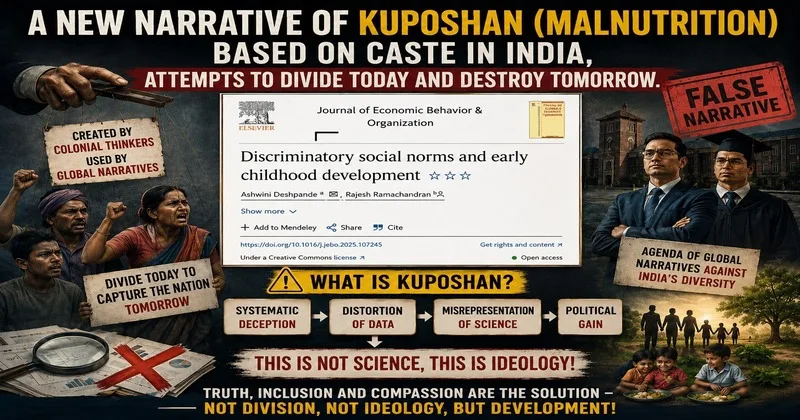
Malnutrition is a grave social and health-related issue in India. It is also an undeniable fact that economic inequality, lack of education, inadequate healthcare services and social backwardness adversely affect child development. However, a recently published study, which attempts to attribute the higher prevalence of ‘stunting’ among children from Scheduled Castes primarily to caste-based discrimination, raises several serious questions.
This research suggests that the rate of stunting among children from so-called “upper castes” is negligible, whereas it is significantly higher among the Scheduled Castes. The problem arises when such findings begin to be presented as a universal social truth.
In reality, once a specific mindset is formed, the direction of one’s research and thought processes inevitably aligns with it. Often, in such instances, an individual becomes so blinded by this preconceived notion that they are unwilling to look beyond the narrative they have already constructed in their own minds. This study appears to be a case in point; it draws upon data and analysis provided by the Centre for Economic Data and Analysis (CEDA) at Ashoka University. The research has been published in the ‘Journal of Economic Behavior and Organization’, crediting Ashwini Deshpande (CEDA) and Rajesh Ramachandran (Monash University) as the authors who completed the study.
The data presented in this research attempt to establish, with great emphasis, the claim that children in India who suffer from stunting do so primarily because of their low-caste status, a condition from which children of upper castes are supposedly exempt. In other words, according to this study, if individuals belonging to India’s Scheduled Castes and Tribes are stunted or of short stature, the primary culprit is their failure to receive nutritious food, a deprivation directly attributed to the fact that they were born into a specific caste. Conversely, children born into upper-caste households are rarely stunted, as they typically have access to excellent nutrition.
Regarding the actual facts in this context, the renowned sociologist André Béteille has offered a clear perspective in his book, “Caste, Class and Power”. He writes, “The reality of Indian society is extremely complex; it cannot be understood through a unidimensional perspective alone” (University of California Press, 1965, p. 23). This very observation applies equally to the research in question here. Framing any health issue solely through the lens of caste amounts to a denial of the inherent complexities of the social sciences. Consequently, this conclusion appears not only scientifically incomplete but also seems to represent an attempt to construct an ideological narrative by grossly oversimplifying the intricate realities of Indian society.
Height Is Not Determined Solely by Diet
In any society, health, stature, nutrition and physical development are influenced by a multitude of factors; human height, specifically, does not depend solely on nutrition. Genetics, family history, geographical conditions, lifestyle, access to healthcare services, hormonal makeup, economic status, and dietary quality all of these elements play a role in shaping a human life. Given this reality, attempting to explain “stunting” based exclusively on caste appears to be driven more by ideological bias than by scientific objectivity. Modern medical science clearly states that heredity (genetics), hormones, environment, family history and regional biological variations also play significant roles. The renowned biologist Francis Galton wrote in his book “Hereditary Genius” that “the influence of heredity on human physical characteristics is extremely profound” (Macmillan, 1869, p. 12).
Similarly, Keith L. Moore, author of “The Developing Human”, writes: “Height is influenced by both heredity and nutrition; neither factor alone can fully explain human growth.” In other words, from a scientific perspective, it is incorrect to attribute height solely to nutrition. Were this the case, all children from affluent families would be tall, and all children from impoverished families would be short- whereas the reality is quite different (Elsevier Publication, 10th Edition, p. 145).
Are All People from the General Category Tall?
If the findings of research were to be accepted as absolute truth, then the majority of people belonging to the Brahmin, Kshatriya, Vaishya and other General Category communities in India should, on average, be tall. However, this does not reflect reality. In fact, a significant number of individuals with below-average stature can be observed among various Brahmin communities in North India, many Rajput groups in Rajasthan, the Baniya communities of Bihar and Eastern Uttar Pradesh and numerous General Category families across Central India. If they supposedly received “superior nutrition,” then why did they not grow tall?
The answer is clear: the human physique is not determined solely by diet. The influence of genetics is of paramount importance. If parents are short in stature, their children’s average height may also be relatively shorter, regardless of whether they receive adequate nutrition. The World Health Organisation (WHO) and numerous medical studies acknowledge that height is not determined solely by nutrition; rather, genetic makeup plays a significant role in it.
Modern medical science indicates that children’s height and physical development are influenced by the following key factors: heredity, hormonal influences, regional and ethnic diversity, lifestyle, and overall health. Of these, it is estimated that 60 to 80 per cent of human height is determined by genetic factors. In many families, average height, whether short or tall, has remained consistent across generations. This phenomenon is observed not only in India but across the globe. Similarly, deficiencies in growth hormones, thyroid hormones and other biological factors can also impact a child’s height.
Variations in average height observed in Northeast India, South India, the Himalayan regions and tribal communities are often attributable to natural and genetic causes. Conversely, factors such as recurrent infections, environmental pollution, lack of sleep, mental stress and limited access to healthcare services can also hinder a child’s growth. Under these circumstances, singling out caste as the sole decisive factor amounts to disregarding the complex scientific realities involved.
To understand this in greater depth, we can look at the research study of the renowned anthropologist D.N. Majumdar; in his book, “Races and Cultures of India”, he writes: “India’s ethnic and biological diversity is so extensive that no single physical characteristic can be permanently linked to any specific social class” (Asia Publishing House, 1958, p. 88). Naturally, this fact clarifies that, in India, physical constitution is not solely correlated with social class.
The Research’s Greatest Weakness: Mistaking Correlation for Causation
The fundamental flaw in this research is that it presents a statistical correlation as direct causation. If children belonging to the Scheduled Castes in a particular region are found to have shorter stature, the reasons for this could be manifold, as has already been noted above. In other words, attributing health-related issues solely to caste amounts to overlooking the broader factors that drive development.
Upper Caste = Prosperity: A Dangerous Oversimplification
This research indirectly conveys the message that individuals belonging to the General Category are in a superior economic position; however, the social reality of India is far more complex than this. In this context, one may refer to the caste-based survey conducted in Bihar, the findings of which were released in 2023. According to this survey, approximately 25.09 per cent of families within the General Category (Unreserved) are poor. Out of a total of over 27.6 million families, the prominent groups within the General Category facing poverty include the Bhumihars (27.58 per cent), Brahmins (25.32 per cent), Kayasthas (13.38 per cent) and Rajputs (24.89 per cent).
Approximately one-quarter of all families within the General Category are currently living below the poverty line. It is also pertinent to note here that the Bihar government has defined “poor” families as those with a monthly income of less than Rs 6,000. At the same time, it is also noteworthy that, in terms of population percentage, the General Category constitutes 15.52 per cent of Bihar’s total population- a figure that, in absolute terms, is many times greater than that of the Scheduled Tribes.
Looking at the statistics, out of Bihar’s total population of 13.07 crore, the Scheduled Tribe (ST) population stands at 1.68% (approximately 2,199,361 people). Therefore, it must be acknowledged that, even today, crores of families belonging to the General Category are grappling with poverty, unemployment, and malnutrition. In rural areas, numerous families belonging to the Brahmin, Rajput, Baniya, Kayastha and other communities are economically extremely vulnerable. Their children, too, lack regular access to adequate milk, fruits, protein, and nutritious food.
Does this research foster social division?
The most concerning aspect of this research is its social impact. When a study conveys the message that children from “upper castes” are inherently better-positioned, while children from “lower castes” remain stunted due to discrimination, it risks generating a new form of animosity within society. India has already been grappling with caste-based tensions. In such a context, if subjects like health and physical development are also framed through the lens of caste conflict, it will inevitably erode social trust. Fundamentally, the objective of research should be to seek solutions, not to fragment society into new categories.
If a child is born into the “General Category,” does that automatically guarantee they will be well-nourished and tall? This assumption borders on making a mockery of social and economic realities. Data from the National Sample Survey Organisation (NSSO), along with various government statistics, indicate that even within the General Category, a significant population lives precariously close to the poverty line.
M.N. Srinivas’s seminal work, “Social Change in Modern India”, offers a highly precise and pragmatic perspective in this regard. In this book, Srinivas writes: “To understand Indian society solely on the basis of caste is to ignore its economic realities” (University of California Press, 1966, p. 47).
Even today, there are millions of families within the General Category where children do not have regular access to adequate milk, protein, or nutritious food. If a child is born into the General Category, does that automatically ensure they will be well-nourished and tall? This notion is not only unscientific but also serves to negate the very real suffering endured by impoverished families within the General Category.
The Vindhya Range Hypothesis: A Selective Use of History
In this research, the Vindhya Range is presented as the historical demarcation line defining the social divide between North and South India. This argument appears to be a gross oversimplification. India’s social history is, in reality, extremely complex and multi-layered. South India, too, offers numerous historical instances of caste-based divisions, untouchability and social inequality. Meanwhile, in North India as well, numerous social reform movements have periodically challenged caste-based discrimination.
In reality, drawing a mere geographical line to conclude that caste discrimination was more prevalent in the North and less so in the South actually appears, today, to be an attempt to mould history into a specific ideological framework. The fact is that numerous instances of untouchability and caste-based divisions can be found in South India as well. Conversely, North India, too, has possessed a strong tradition of social reform movements.
Is the example of “Dalit Muslims” sufficient evidence?
Research has also suggested that a similar pattern is observable among “Dalit Muslim” groups; therefore, the argument posits that the problem is rooted in caste-based exclusion. However, this line of reasoning remains incomplete. This is because the economic status, educational attainment, access to healthcare services and regional circumstances of Muslims, Adivasis and various other communities in India vary significantly. If a particular community is economically disadvantaged, it is likely to experience a higher incidence of health-related issues. It would be inappropriate to attribute this solely to the consequences of “social exclusion.”
When the historian R.C. Majumdar arrives at the conclusions of his study, he, too, observes: “The social history of India cannot be understood within a single linear framework; social processes have varied across different regions.” (The History and Culture of the Indian People, Bharatiya Vidya Bhavan, Vol. 1, p. 31).
Why Neglect Genetics?
The World Health Organisation (WHO) itself acknowledges that genetic factors play a significant role in child growth. The World Health Organisation’s report, “Child Growth Standards” (WHO Press, Geneva, 2006, p. 7), states: “Child growth is influenced by genetics, nutrition, environment and health conditions together.” This raises the question: if science itself accepts that growth is multifactorial, why do some researchers present conclusions that focus solely on caste?
Do Such Studies Fuel Social Discord?
India is already grappling with the challenges of caste-based tensions and political polarisation. In such a context, if the message is conveyed that children from “upper castes” are naturally in a superior position, while children from “lower castes” remain stunted solely due to social oppression, it risks creating a new form of psychological divide within society.
The Responsibility of Scientific Research: Objectivity, Not Ideological Agendas
The objective of any research should be an impartial examination of facts. If researchers predetermine their conclusions and subsequently interpret data to fit that narrative, the endeavour ceases to be science and transforms into ideological activism. As Dr Sarvepalli Radhakrishnan wrote in his book “Recovery of Faith” (Harper & Brothers, 1955, p. 102): “When social discourse loses its balance, it begins to fragment society rather than unite it.” The goal of research should be to identify solutions, not to exacerbate mistrust and division within society.
What is the Real Solution?
Today, we must all recognise that the solution to malnutrition in India lies not in caste-centric discourse, but rather in development-oriented policies- specifically, the holistic advancement of maternal education, access to clean water, rural healthcare services, balanced nutrition, employment opportunities, public awareness campaigns, child nutrition programs and rural development. Such comprehensive development remains the enduring imperative of our times. In this regard, one may also consult the work of renowned economist Jagdish Bhagwati, who observes: “The true foundation of development lies in the expansion of economic opportunities, not in discourses that perpetually divide society.” “India’s Tryst with Destiny”- (HarperCollins, 2012, p. 119).
Science Must Not Be Turned into an Ideological Battlefield
It must be acknowledged that social inequalities have existed in India, and numerous communities continue to face challenges to this day. However, to attribute any health issue solely to caste-based discrimination is scientifically incomplete and socially perilous. There are a multitude of factors underlying dwarfism or short stature, as previously noted, with genetics, general health, economic status, environmental conditions, nutrition, hormonal influences and family structure being the most significant contributors. Under these circumstances, framing this issue as a “upper caste versus lower caste” dichotomy constitutes an approach that serves only to divide society.
In reality, India has no need for research that constitutes a calculated conspiracy to fragment Indian society on the basis of caste, the ‘Varna’ system or any other pretext. On the contrary, what India requires today is research that fosters social cohesion, offers balanced perspectives and seeks constructive solutions, rather than conclusions that, under the guise of academic inquiry, merely fuel ideological conflict.