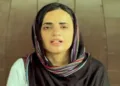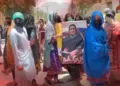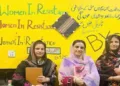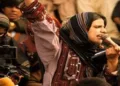
An anti-terrorism court in Quetta, the capital of Balochistan, has found Dr Mahrang Baloch, chief organiser of the Baloch Yakjehti Committee (BYC), and Sibghatullah Shahji, another group leader, have been awarded life imprisonment. They have been held as guilty in a case pertaining to the death of a security personnel during a protest in Gwadar in 2024 that turned violent.
ATC Quetta-1 Judge Muhammad Ali Mobeen had heard the case pertaining to the death of a Frontier Corps (FC) personnel. The FC personnel had died as a result of injuries received from a mob pelting stones. BYC’s Dr Mahrang Baloch, Sibghatullah Shahji and others were named in the case as accused.
Advocate Nadia Baloch rejected the ruling against her sister, describing it as a verdict delivered by a “faceless court” and questioning how the person directly accused of killing the FC official had already been acquitted, while those accused of delivering speeches were sentenced to life imprisonment. “The person accused of killing the FC official had already been acquitted, while those who delivered speeches were sentenced,” she said, according to The Balochistan Post.
Verdict Shows Pakistan’s Hatred Towards Baloch People
In a detailed statement following the ruling, the BYC described the life sentences handed to Dr Mahrang and Sibghatullah Shahji as an expression of what it called “Pakistan’s hatred towards the Baloch nation,” saying the verdict would mark the beginning of “a historic phase of resistance and struggle”.
After completing the hearing, the court announced the verdict on Monday, handing life sentences to Dr Mahrang Baloch and Sibghatullah, the former’s lawyer Israr Jattak told the media. “The judge of the ATC Quetta has awarded a life term to Mahrang Baloch and Sibghatullah Shah Ji in the murder case of FC personnel,” Jattak said.
While the exact details of the case are unclear, BYC protesters had clashed with security personnel in Gwadar on July 29, 2024, as the organisation gathered for the Baloch Rajee Muchi (Baloch National Gathering). In separate clashes at the Talar check-post and on the Marine Drive, three people had lost their lives and 10 were injured.
A day before that, as protesters made their way to Gwadar, a press note issued by the deputy commissioner of Kalat stated that participants of the BYC march had attacked a Levies checkpoint near Mastung and resorted to “extreme violence”.
“The security forces stopped the rally three kilometres outside Mastung for negotiations. However, an armed mob which was waiting for the marchers in Mastung city opened fired on personnel of the Frontier Corps (FC). Two FC personnel and four civilians were injured,” the note said.
BYC Not a Proscribed Body Under Law
Dr Mahrang Baloch and Sibghatullah have been in jail for the last two years in multiple cases. Dr Mahrang was initially arrested on March 22 last year and detained under the Balochistan Maintenance of Public Order (MPO) for 30 days. This detention was extended twice for further periods of 30 days each. Before the expiry of the third detention order, she was taken into custody in connection with another case.
Following their detention under the MPO, cases were also registered against Dr Mahrang Baloch and other BYC leaders under different sections of the Anti-Terrorism Act and the Pakistan Penal Code. While the BYC is not listed among banned organisations by the National Counter Terrorism Authority (NACTA), Dr Mahrang is included on its list of proscribed persons.
Constitutional petitions seeking the release of Mahrang and two other activists were rejected by the Balochistan High Court (BHC) in May 2025. They were later challenged in the Supreme Court.
The BYC has said the case had no legal foundation, alleging that the evidence was inadmissible and that two FIRs concerning the same death contradicted one another. According to the BYC, one FIR recorded the FC official’s death on July 27, while another placed it on July 29, a discrepancy it said undermined the foundation of the prosecution case.
“How can one person die twice?” the BYC said, arguing that when the FIRs themselves were contradictory and the evidence remained questionable, imposing life sentences amounted not to justice but to “open state and judicial repression”.
Peaceful Leaders Convicted On False Charges
The BYC compared the ruling with the execution of Hameed Baloch 45 years ago, saying that case remained a stain on the Pakistani state and that the verdict against Dr Mahrang and Sibghatullah Shahji would similarly be remembered.
It also pointed to what it described as state violence during the “Baloch Raaji Muchi,” alleging that four Baloch participants were killed, dozens injured and three permanently disabled when Pakistani forces opened fire, while no one had been held accountable for those deaths and injuries. The BYC said peaceful political leaders had instead been convicted in a case built on disputed evidence, adding that “those carrying guns are protected, while the unarmed public has been turned into criminals.”
The BYC said the ruling was not limited to Dr Mahrang and Sibghatullah Shahji, but concerned public politics in Balochistan, the struggle of families of missing persons and the right to question state policies. “This decision has proved that even remaining peaceful has been made a crime in Balochistan,” the statement said, adding that speaking for one’s people and exposing what it described as state repression had also been criminalised.
Not Justice But Predetermined Punishments
BYC leader Sammi Deen Baloch said the outcome had appeared predetermined from the day the cases were transferred to the “faceless” trial process, alleging that the prosecution repeatedly pressed the judges to expedite proceedings and hand down sentences. “That same day, we realised that what awaited us was not justice, but predetermined punishments,” she said, accusing the judiciary of joining other state institutions in efforts to silence peaceful political voices.
Ms Baloch said the judiciary, in which oppressed people had placed their hopes, had failed to act as a barrier against injustice and had instead strengthened those in power. The BYC said it would continue what it described as a democratic, political and rights-based struggle, arguing that prisons, sentences and criminal cases would not bring the movement to an end.
“Today’s decision is not the final decision,” the organisation said. “The final decision will not be made in the closed rooms of courts. The final decision will be delivered by the history of the people.”