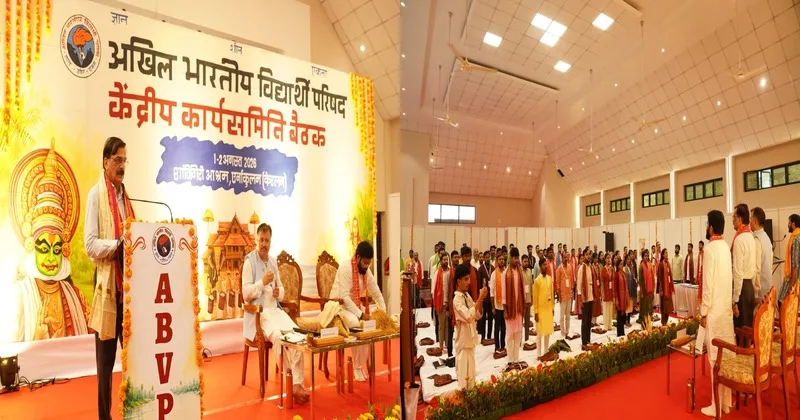
Ernakulam: The two-day Central Working Committee Meeting of the Akhil Bharatiya Vidyarthi Parishad (ABVP) commenced in Ernakulam, Keralam on August 1. The meeting was inaugurated by ABVP National President Prof Raghuraj Kishore Tiwari, National General Secretary Dr Virendra Singh Solanki, and National Organising Secretary Ashish Chauhan. Senior ABVP office-bearers and representatives from across the country are participating in the meeting. The delegates were welcomed with Keralam’s traditional Panchavadyam percussion ensemble and the vibrant Pulikali folk dance.
The Central Working Committee deliberated on a wide range of issues, including education, technology, environment, service activities, sports, arts, organisational matters, and contemporary national developments. The meeting welcomed the assent of the Hon’ble President of India to the Public Examinations (Prevention of Unfair Means) Amendment Act, 2026, describing it as a major step towards ensuring transparency, accountability, and credibility in the country’s examination system. The committee also discussed the National Pharmacy Commission Bill, 2026, on which ABVP has submitted detailed recommendations to the Ministry, advocating quality-driven, student-centric, and employment-oriented pharmacy education, along with adequate representation of academic experts in the proposed Commission.
Addressing the meeting, ABVP National President Prof. Raghuraj Kishore Tiwari said that, “Holding the Central Executive Committee Meeting in Keralam the birthplace of Jagadguru Adi Shankaracharya and a land known for its tradition of social harmony is deeply significant for ABVP. Despite numerous challenges, ABVP workers in Keralam have continued to work tirelessly for national interest and student welfare. This meeting will further strengthen the organisation’s direction and future roadmap. ABVP has always played a constructive role on issues concerning students and education. Genuine student concerns deserve meaningful solutions, but attempts to use student issues for anti-national or political agendas cannot be accepted. Student power must always be channelled towards nation-building. Over the next two days, the organisation will deliberate on education, organisational priorities, student union elections, membership expansion, national campaigns, and key contemporary issues before finalising its roadmap for the coming months.”
ABVP National General Secretary Dr Virendra Singh Solanki said, “ABVP firmly believes that students’ concerns should be addressed through dialogue, democratic processes, institutional reforms, and transparent governance not through violence, vandalism, or political agendas. ABVP has consistently demanded impartial investigations into examination irregularities, stringent action against the guilty, and comprehensive reforms in the national examination system. It is sincere and hardworking students who suffer the most due to examination malpractices. Therefore, stringent laws, effective punishment, technological safeguards, and institutional accountability are essential to eliminate examination mafias.
He further said, “The President’s assent to the Public Examinations (Prevention of Unfair Means) Amendment Act, 2026, is a landmark step in this direction. It will strengthen action against organised examination crimes and significantly enhance the transparency, security, and credibility of India’s examination system. Likewise, the National Pharmacy Commission Bill is an important initiative towards reforming pharmacy education and regulation. ABVP has submitted detailed suggestions to make the legislation more effective, student-centric, and quality-oriented. We are confident that these recommendations will be given due consideration, leading to a stronger and future-ready pharmacy education ecosystem. Guided by the vision of the National Education Policy 2020, ABVP will continue to work for quality education, transparent examinations, and equal opportunities for every student.”