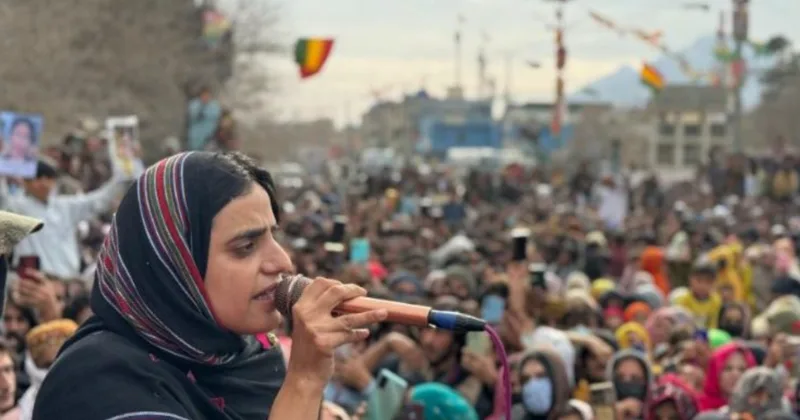
Dr Mahrang Baloch has filed a writ petition in the Supreme Court of Pakistan challenging the rejection of her bail application following her arrest. She has established herself as a human rights activist par excellence and has today become the most visible face of peaceful protests by Baloch women nationwide and internationally. She is also the central organiser of the Baloch Yakjehti Committee (BYC), a formidable group meant for mass mobilisation against atrocities by the Pakistani security forces.
The petition was submitted through lawyer Jibran Nasir, who is representing Dr Baloch in the case. The appeal follows a decision by the Balochistan High Court on February 23 rejecting her request for bail. The matter relates to a First Information Report (FIR) registered at the Counter Terrorism Department (CTD) police station in Quetta on January 6 this year. The complaint was filed by Sub-Inspector Asghar Ali, according to a report in The Balochistan Post.
According to the FIR, Dr Baloch had been placed on the Fourth Schedule under Pakistan’s Anti-Terrorism Act (ATA) 1997, a list used to monitor individuals considered security risks. Authorities allege that she failed to comply with required attendance obligations and continued to participate in public gatherings and protest sit-ins.
The FIR also alleges that she provided support to the banned armed group Baloch Liberation Army (BLA). Those allegations have not been independently verified, and Dr Baloch and her supporters have previously rejected similar accusations.
The case was registered under Sections 11-EE and 11-F(1)(2) of the Anti-Terrorism Act, which concern membership of or support for proscribed organisations. Dr Baloch was first arrested on 22 March 2025 and detained for 30 days under the Maintenance of Public Order (MPO) law. Her detention was later extended twice for further 30-day periods. She was subsequently formally arrested on 21 August 2025 in another case while still in state custody.
MPO Law Used to Suppress Dissent
The MPO law is rooted in the British colonial legal system also used following Pakistan’s independence in 1947. Tt was formally promulgated as the West Pakistan Maintenance of Public Order on December 2, 1960, during the military dictatorship of General Ayub Khan.
The MPO law makes it convenient for the political governments to circumvent due law and to clamp down on any individual or group participating in political opposition and protests. The law has established new and revised existing laws governing the preventive detention of individuals and publication control for the preservation of public order, safety of public peace, and public interest.
After the 1971 war, the law throughout Pakistan. Since its promulgation, it has been consistently applied and abused by succeeding regimes, including so-called democratic governments. In effect, these are not democratic governments but hybrid regimes where the real power is in the hands of the Army. This leads to a hollowing out of all democratic institutions, including the judiciary, which stops functioning as an independent entity, either out of fear, or to favour the powerful.
According to eminent lawyer Ahsan Pirzada, the MPO law is not human rights friendly. “The said law has been used repeatedly to snub political restlessness and public dissent towards the ruling elites,” he said. The biased application of the MPO can be seen during the mass arrests of Pakistan Peoples Party (PPP) protestors in 1997, the arrest of Mohajir Qaumi Movement-Haqiqi (MQM-H) chief Afaq Ahmed in 2012, the arrest of PTI leaders and workers in 2023, and dealing with any type of political dissent.
“Time and time again the police use the MPO simply because they do not have sufficient evidence to frame criminal charges against suspects,” Amnesty International has said.
It Violates Article 4 & 25 of Constitution
According to legal experts, the MPO Ordinance violates Articles 4 (right of individuals to be dealt with in accordance with the law, etc.) and 25 (equality of citizens) of the Constitution of Pakistan which guarantee liberty and freedom to citizens.
On June 12 last year, Dr Mahrang Baloch had also challenged her detention under MPO provisions. The Balochistan High Court later upheld that detention in a ruling issued on May 22. Actually, such cases, which represent political dissent and are inconvenient for the government to handle, are not listed for hearings for long periods. Of course, repeated adjournments are one of the most widely used tactic to keep the accused in jail indefinitely.
Dr Mahrang Baloch is one of the most prominent rights campaigners in Balochistan and has led demonstrations concerning enforced disappearances, detentions and broader civil rights issues in the region. Her legal case has drawn significant attention and criticism from activists and observers, who view the proceedings as an important test of civic freedoms and the treatment of dissent in Pakistan.
Press Clubs Used to Arrest Individuals
Throughout Pakistan, press clubs like Karachi Press Club, Quetta Press Club and a few others in Balochistan are venues where protesters address press conferences so that their issues could be amplified and covered by various news organisations. However, a new trend is emerging whereby the press clubs have started discouraging the people to use their premises and keep them waiting for days on end.
Press clubs have long been seen as one of the few spaces where marginalised voices could still be heard. However, activists and lawyers say even those spaces are becoming increasingly restricted as happened in the case of BYC activist Fauzia Baloch, her mother and two minor sisters. They were all arrested when they were standing outside the Karachi Press Club premises and picked up by the police.
They were also represented by lawyer by lawyer Jibran Nasir who is also fighting for Dr Mahrang Baloch. He said the press clubs also are becoming dangerous places for the marginalised now as they can be forcibly disappeared from there also.