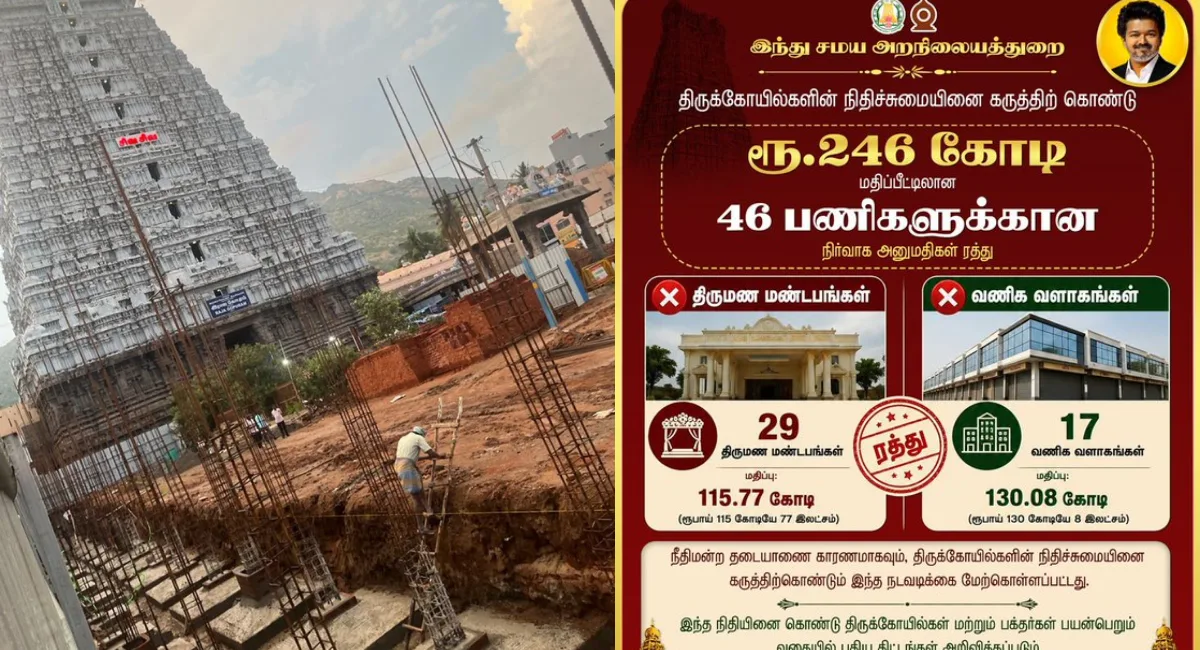
The Hindu Religious and Charitable Endowments (HR&CE) Department of Tamil Nadu has announced the cancellation of 46 temple-related infrastructure projects worth Rs. 246 crore, citing legal complications and concerns over the financial burden on temples.
In a statement issued on June 19, the department said that several projects announced during the previous administration had failed to progress beyond the planning stage due to court cases, legal hurdles and questions regarding their financial viability. Consequently, the government decided to withdraw administrative approvals granted to these projects.
திருக்கோயில்களின் நிதிச்சுமையினை கருத்திற் கொண்டு ஏற்கனவே அறிவிக்கப்பட்டு தொடங்கப்படாத ரூ.246 கோடி மதிப்பீட்டிலான திருமண மண்டபங்கள் மற்றும் வணிக வளாகங்களுக்கான நிர்வாக அனுமதிகள் ரத்து. @CMOTamilnadu @RameshOffcl @TNDIPRNEWS #CMJosephVijay #tnhrce #tndipr pic.twitter.com/Z18u37inQy
— TN HRCE (@tnhrcedept) June 19, 2026
According to the statement, the cancelled projects include 29 marriage halls estimated at Rs. 115.77 crore and 17 commercial complexes worth Rs. 130.1 crore.
Some of the notable projects include marriage halls proposed in Palani, Ottanchatram and Pudukottai, as well as a commercial complex in Thiruvannamalai.
The department stated that most of the proposed projects had remained on paper and were never executed. Legal disputes, including court orders affecting certain projects, and concerns regarding the financial burden on temples were cited as key reasons behind the decision.
It further noted that while marriage halls and commercial complexes had traditionally been conceived as revenue-generating assets for temples, questions had increasingly been raised about their feasibility and the financial liabilities they imposed on temple administrations.
The HR&CE Department also announced that the funds originally earmarked for these projects would be redirected towards initiatives aimed at improving temple infrastructure and facilities for devotees.
The government indicated that fresh schemes utilising the released funds are expected to be announced in the coming months.
The HR&CE department added that a reassessment of the financial health of temples had necessitated a review of expenditure priorities, with greater emphasis being placed on temple maintenance and devotee amenities.
The announcement has drawn praise from several temple activists and Hindu organisations.
Author and commentator Badri Seshadri welcomed the move on social media platform X, stating that it reflected a commitment by the HR&CE Department to ensure that temple funds are used exclusively for temple-related purposes and that past mistakes would be corrected. He also expressed gratitude to Chief Minister Joseph Vijay and HR&CE Minister Ramesh.
As detailed by @trramesh, two positive news (we have to see more in action): a statement that HRCE will ensure temple funds are used only for temples and past misdeeds will be corrected; followed by actual order cancelling Kalyana mandapam and shopping complex construction… https://t.co/b89QSoPMLw
— Badri Seshadri (@bseshadri) June 19, 2026
Temple activist T.R. Ramesh too welcomed the decision and described it as a significant development in the effort to protect temple resources.
I had deactivated my X account two days ago. I was not feeling elated with my daily feeding Hindus who, in general, do NOT care about their Temples and Dharma – with victory news from Court actions or about the violations of Dharma and Law by the instrumentalities of the… pic.twitter.com/bDVV17NtrX
— trramesh (@trramesh) June 19, 2026
In his statement, he said that the government had issued two Government Orders cancelling 46 projects involving commercial wedding halls and commercial complexes on temple lands that had been announced during the previous DMK government. He noted that only a handful of activists who had pursued litigation and campaigned against the projects over the past five years fully understood the significance of the decision.”
Senior Tamil Nadu BJP leader Prof. Kangasabapathi also welcomed the announcement made by the Joseph Vijay-led TVK government.
வாழ்த்துக்கள் @CMOTamilnadu நன்றி. https://t.co/29exUX4MF1
— Prof.P.Kanagasabapathi (@pkspathi) June 20, 2026
The decision comes days after the government, in the Governor’s Address, announced that the entire HR&CE Department would be revamped and that temple funds would henceforth be utilised only for temple-related purposes.
Hindu Munnani State President Kadeswara Subramaniyam also hailed the move, saying that temple funds should be used exclusively for temples and welcoming the commitment made in the Governor’s Address.
கோயில் நிதி, கோயில்களுக்கு மட்டுமே!!
“இந்து சமய அறநிலையத்துறையின் கட்டமைப்பில் மாற்றங்கள் கொண்டு வரப்படும்; கோயில் நிதி கோயில்களுக்கு மட்டுமே செலவு செய்யப்படும்” என சட்டமன்றத்தில் ஆளுநர் அர்லேகர் உரை…
தமிழக அரசின், ஆளுநர் உரையில் குறிப்பிட்ட இந்த கருத்தை இந்துமுன்னணி… pic.twitter.com/lEJxR9x2W3
— Hindu Munnani (@hindumunnani_tn) June 18, 2026
However, critics argue that while the TVK-led government has mirrored the DMK on most issues, it appears to have taken a different approach to temple administration. Despite strong opposition from Dravidar Kazhagam leader K. Veeramani, CM Joseph Vijay appointed Srirangam MLA Ramesh, a member of the Brahmin community, as Minister for HR&CE.
This decision assumes significance in the backdrop of Tamil Nadu’s long-standing debates over temple administration and the role of the HR&CE Department.
They argue that attacks on Sanatana and temples in the state have a long history, tracing back to the British colonial period. Since then, they allege, the British and subsequent Dravidian-centric parties have systematically weakened the HR&CE Department and diverted funds received from devotees.
Critics further claim that the DMK transformed the department into a tool to target Sanatana traditions, noting that former HR&CE Minister P. Sekar Babu was present when such statements were made. They also point to recent judicial observations in Tamil Nadu, where courts, while hearing a case concerning the construction of a new church on a public road in a Hindu-majority area despite local opposition, remarked that certain religious elements appeared to have become emboldened.
Against this backdrop, critics contend that the HR&CE Department plays a crucial role in Tamil Nadu’s political landscape and has, for decades, been accused of encouraging and harbouring anti-Sanatana elements through its platforms, administration and functioning.
They therefore view the TVK government’s decision as a welcome step. However, they add that whether these statements and appointments translate into meaningful reforms remains to be seen, given the department’s history and the continued influence of what they describe as divisive anti-sanatana-centric political forces.