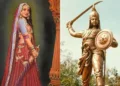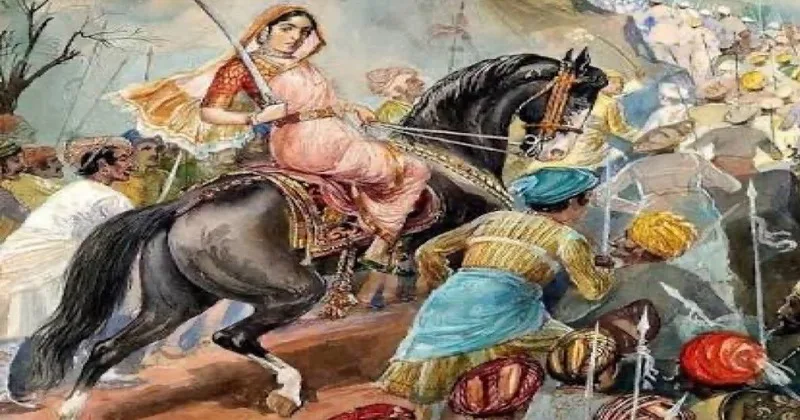
Tarabai Bhonsale occupies a rare place in Indian history, a woman who stepped into a collapsing empire, reorganised its resistance, and ensured that the vision of Swarajya did not fade even under the overwhelming pressure of the Mughal state under Aurangzeb. Often remembered in legend as a “lioness of the Deccan,” her real historical significance lies not in exaggeration, but in her extraordinary political and military leadership during one of the most turbulent phases of the Maratha struggle.
Tarabai Bhonsale – Daughter-in-Law of Shivaji Maharaj, The Queen Who Hunted the Mughals Across India
The year was 1700 CE.
The Deccan was under siege.
Aurangzeb had descended with the largest army in his empire.Forts fell. Generals died.
The young prince, Shivaji II, was only… pic.twitter.com/mgcMF6QFMV— Comman Man (@CommanMan777589) June 13, 2026
The Crisis After Shivaji’s Legacy
The late 17th-century Deccan was a land in flux. After the death of Shivaji Maharaj and the execution of his son Sambhaji, the Maratha state faced severe instability. When Rajaram I, Tarabai’s husband, died in 1700, the responsibility of protecting the young heir Shivaji II (Shahu’s rival claimant in later succession struggles) fell upon her shoulders. At this moment, the Mughal Empire under Aurangzeb had pushed deep into the Deccan, capturing forts and attempting to decisively end Maratha resistance. It is in this moment of near-collapse that Tarabai emerged as a regent, strategist, and commander.
A Queen Becomes a Commander
Unlike many royal figures confined to court politics, Tarabai directly assumed leadership of military operations. From her base in the hill forts of the Western Ghats, she reorganised the Maratha resistance.
Her leadership was defined by three key strengths that reshaped Maratha resistance during a critical phase of the conflict. Instead of relying on fort-bound defence, she emphasised mobility, with Maratha forces using rapid cavalry movements, strategic retreats, and guerrilla-style attacks to constantly unsettle the enemy. She also promoted a decentralised system of warfare, where commanders were given significant autonomy to act independently, making it extremely difficult for Mughal forces to deliver a decisive or coordinated blow.
Alongside this, her deep understanding of the Western Ghats and Deccan terrain turned the natural landscape into a strategic advantage, effectively neutralising the numerical superiority of the Mughal army. This approach marked a shift towards attritional warfare, aimed not at direct confrontation but at gradually exhausting one of the largest imperial forces of the time
The Strain on the Mughal Empire
Under Aurangzeb, Mughal forces maintained prolonged campaigns in the Deccan, but complete victory proved elusive. Maratha resistance, strengthened under Tarabai’s leadership, continued through raids, ambushes, and disruption of supply lines. Rather than direct battlefield confrontations, the conflict became one of endurance. Mughal armies, stretched across vast territory, faced constant harassment, logistical breakdowns, and the inability to secure lasting control over captured forts. While Tarabai did not “hunt across India” in a literal expansive sense, her administration did help sustain Maratha resistance across key regions of the Deccan, ensuring Mughal advances remained contested and unstable.
Governance in War Time
One of Tarabai’s most significant contributions was her ability to maintain administrative resilience even amid continuous warfare. She maintained structured fort governance systems, sustained revenue-collection networks, and preserved communication channels between dispersed Maratha commanders, enabling coordination across a highly fragmented battlefield.
At the same time, she supported the recruitment and mobilisation of local fighters, ensuring that resistance remained active and replenished despite constant pressure. This strong administrative framework prevented the Maratha state from breaking into disorder or collapsing under imperial assault. Her court at Satara thus functioned as a centre of political continuity and decision-making, even during prolonged periods of siege and instability.
Tarabai’s leadership is often associated with strategic withdrawal and surprise counterattacks. Rather than engaging in symbolic “last stands,” her forces prioritised survival and sustained resistance.
The Question of “Satara Deception”
Popular retellings sometimes describe elaborate traps such as the “Satara deception,” where the fort was abandoned strategically to mislead Mughal forces. Historically, Maratha warfare did involve tactical withdrawals and fort exchanges. However, such narratives are often amplified in later storytelling traditions. What remains consistent in historical accounts is that Satara and the surrounding regions remained contested zones, frequently changing control during this period.
Aurangzeb’s prolonged Deccan campaign ultimately drained the Mughal Empire’s resources, and although the empire succeeded in expanding its territorial reach in the region, it failed to establish lasting and stable governance. In this context, Tarabai’s leadership proved vital, as she ensured that Maratha resistance did not collapse under sustained pressure. She preserved essential leadership structures and maintained the organisational backbone of the state, allowing it to survive through one of its most vulnerable phases. Even though later political developments, particularly the rise of Shahu, altered internal Maratha power dynamics, Tarabai’s early regency remained crucial in safeguarding the continuity and resilience of the Maratha state during this critical period.
Tarabai Bhonsale’s legacy is best understood through three key dimensions that highlight her enduring impact on Maratha history. First, she demonstrated remarkable political resilience by maintaining the continuity of the Maratha state during one of its most destabilised and uncertain periods, ensuring that governance did not collapse under sustained pressure.
Second, she played a crucial role in military adaptation, supporting and shaping a system of warfare that effectively resisted one of the largest and most powerful imperial armies of medieval India. Finally, she stands as a powerful symbol of leadership, remembered as one of the most significant examples of female political authority in early modern Indian history, whose influence continues to inspire historical discourse on resistance and governance.
Tarabai Bhonsale was not simply a warrior queen of legend, but a decisive political actor in a defining historical struggle. In the long arc of Indian history, she stands as a reminder that empires are not only shaped by emperors, but also by those who refuse to let them fall.