Indian history is filled with tales of kings who expanded empires, accumulated wealth, and left behind monuments. Yet only a few rulers transformed into enduring symbols of resistance and self-respect. Maharana Pratap, the legendary ruler of Mewar, occupies that rare place in India’s civilizational memory. More than four centuries after his death, his name continues to evoke admiration, not merely because he fought a powerful empire but because he refused to surrender the sovereignty of his homeland. His life represents a unique blend of courage, sacrifice, statesmanship, and unwavering commitment to freedom.
Among the many events associated with Maharana Pratap, none has received greater attention than the Battle of Haldighati fought on 18 June 1576. For decades, many textbook narratives reduced the battle to a simplistic conclusion by focusing solely on the immediate military outcome. Such interpretations often overlook a larger historical reality. Wars are not decided merely by who occupies a battlefield at sunset. They are judged by whether political objectives are achieved.
Maharana Pratap was born in 1540 to Maharana Udai Singh II of the Sisodia dynasty. The Sisodias had long been regarded as one of the most prestigious Rajput houses in India. Their history was marked by fierce resistance against external domination and an uncompromising commitment to honour. When Maharana Pratap ascended the throne in 1572, northern India was undergoing a rapid political transformation. Emperor Akbar had expanded Mughal authority across large parts of the subcontinent. Several Rajput kingdoms had entered into alliances with the Mughal court. Mewar, however, remained a notable exception.
Akbar understood that Mewar held strategic as well as symbolic importance. Bringing the Sisodias under Mughal authority would strengthen imperial legitimacy and complete his influence over Rajasthan. Diplomatic missions were repeatedly sent to Maharana Pratap. These envoys offered accommodation, status, and security within the imperial framework. Yet Maharana Pratap refused every proposal that required acknowledgement of Mughal supremacy. His resistance was not rooted in personal hostility but in a principled belief that the sovereignty of Mewar could not be compromised.
This refusal eventually led to confrontation. The Mughal army, commanded by Raja Man Singh of Amber, marched against Mewar. Maharana Pratap gathered his forces, including Rajput warriors and Bhil allies, and prepared to defend his kingdom. The armies met in the narrow pass of Haldighati, named after the turmeric-coloured soil of the region.
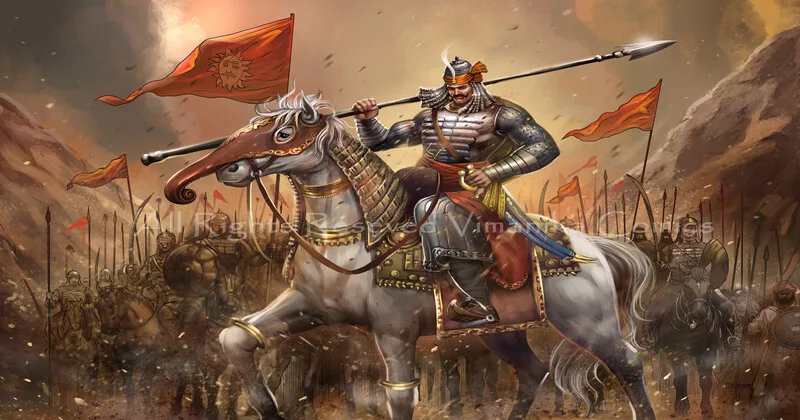
The battle quickly entered the realm of legend. Contemporary accounts and later traditions describe intense combat, extraordinary acts of bravery, and fierce determination on both sides. Maharana Pratap personally led charges against the opposing forces. His loyal horse Chetak became immortal in folklore for carrying the wounded ruler away from danger despite suffering severe injuries. Stories of courage from Haldighati continue to inspire generations of Indians.
Yet the true significance of Haldighati lies beyond heroic anecdotes. The principal objective of the Mughal campaign was to subdue Maharana Pratap and bring Mewar under imperial control. That objective was never achieved.
The years following the battle reveal why Maharana Pratap deserves to be remembered not merely as a warrior but also as a statesman. Forced to operate from the forests and hills of the Aravalli range, he faced immense hardships. Resources were scarce, territory had been lost, and the empire he opposed possessed far greater military and financial strength. Many rulers in similar circumstances would have accepted defeat and sought compromise. Maharana Pratap chose a different path.
He reorganised his administration, strengthened local alliances, and maintained the morale of his people. The support of loyal figures such as Bhama Shah proved invaluable. Bhama Shah’s financial assistance enabled the Maharana to rebuild his military capabilities and continue the resistance. Equally important was the support of the Bhil community, whose knowledge of the terrain and commitment to Mewar helped sustain the struggle.
Maharana Pratap’s leadership demonstrated a profound understanding of statecraft. He recognised that survival depended not only on battlefield victories but also on effective governance. Even during periods of exile and hardship, he worked to preserve the administrative structure of Mewar. This ability to combine military resistance with political organisation distinguished him from many contemporary rulers.
By the 1580s, circumstances began to change. The Mughal Empire faced challenges in other regions, reducing the attention devoted to Mewar. Maharana Pratap seized the opportunity. Through a series of campaigns, he gradually recovered significant portions of his kingdom. Important territories returned to Sisodia control. Although Chittor remained under Mughal occupation, much of Mewar was restored.
His legacy extends far beyond military history. Maharana Pratap became a symbol of self-respect and civilizational confidence. He represented the conviction that freedom and honour were worth defending even against overwhelming odds. For generations, poets, historians, and ordinary citizens have celebrated him as an embodiment of courage and sacrifice.
One of the greatest mistakes in understanding Maharana Pratap is viewing him solely as a courageous warrior. Courage alone does not sustain resistance against a vastly larger empire. What distinguished Maharana Pratap was his military acumen. He understood the geography of Mewar better than any Mughal commander and transformed the rugged Aravalli hills into a natural fortress.
At Haldighati, Maharana Pratap deliberately chose a narrow mountain pass where the numerical superiority of the Mughal army could be neutralised. The terrain restricted the movement of large cavalry formations and prevented the Mughals from fully deploying their strength. This was not a reckless charge against a superior force but a carefully calculated military decision designed to maximise the advantages of local geography.
The Maharana also recognised the importance of mobility. Instead of relying exclusively on conventional warfare, he adopted tactics that modern military historians often describe as an early form of guerrilla warfare. Small, highly mobile units launched sudden attacks, disrupted supply lines, gathered intelligence, and vanished into the hills before the enemy could organise an effective response. These tactics exhausted Mughal forces and ensured that Mewar’s resistance remained alive long after Haldighati.
No account of Maharana Pratap’s struggle is complete without acknowledging the Bhils. Under the leadership of Maharana Pratap, the Bhils became active participants in the defence of Mewar rather than mere auxiliaries. The relationship between Maharana Pratap and the Bhils was built on mutual trust and respect. This bond was so strong that the emblem of Mewar itself came to depict both a Rajput warrior and a Bhil, symbolising their shared struggle. In many ways, the resistance of Mewar was not simply the story of one ruler but of an entire society united in defence of its homeland.
Today, Maharana Pratap remains one of India’s most revered historical figures because he combined the qualities of a fearless warrior with those of a visionary statesman. He fought, when necessary, governed under difficult circumstances, inspired loyalty among diverse communities, and preserved the dignity of his kingdom. Haldighati was only one chapter in that extraordinary journey. The true measure of his greatness lies in the fact that Mewar survived, resisted, and endured. That is why his legacy continues to resonate across centuries, reminding Indians that courage, conviction, and perseverance can outlast even the mightiest empires.