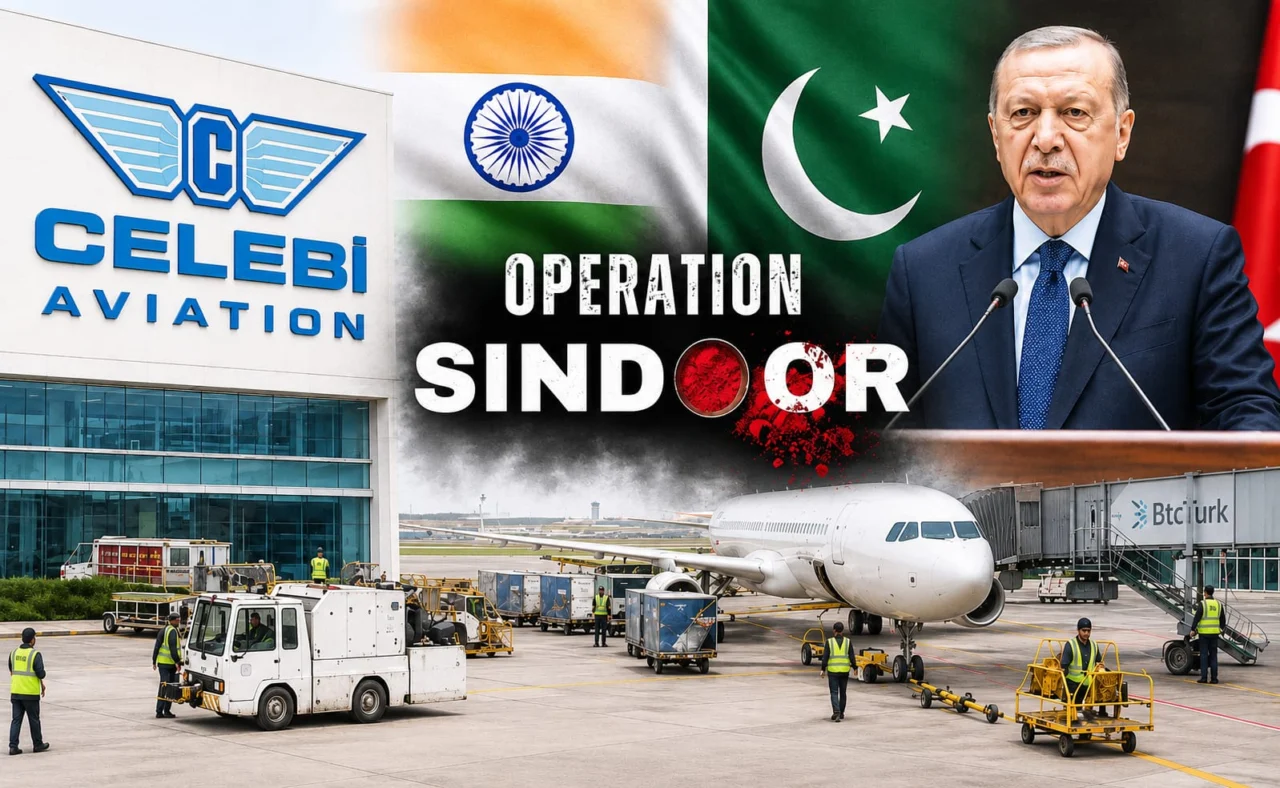
Speaking to Bloomberg HT, Celebi Aviation Chairperson Canan Celebioglu described India’s decision as one of the most painful episodes in the company’s history, saying that nearly two decades of work in the country came to an abrupt end after New Delhi acted on national security concerns amid deteriorating India-Turkey relations.
The revocation of security clearances by India’s Bureau of Civil Aviation Security (BCAS) on May 15, 2025, forced Celebi’s Indian subsidiaries to immediately cease ground-handling and cargo operations at nine major airports, including Delhi, Mumbai, Bengaluru and Hyderabad.
Celebioglu said the company’s investments, infrastructure and operational footprint in India were effectively wiped out in a single day. “All our equipment, everything we had, was seized and they removed us from there. They transferred our 10,000 employees to another company in a single day,” she told Bloomberg HT. She further claimed that the value built by the company over 17 years in India collapsed instantly. “They brought the value we had created, perhaps $400 million or $500 million, down to zero in a single day,” she said.
Fallout of Operation Sindoor and Turkey’s support for Pakistan
The action against Celebi came days after India concluded Operation Sindoor, launched in response to the April 2025 Pahalgam terror attack, in which 26 people were killed, most of them tourists.
India stated that the terrorists responsible for the attack had come from Pakistan, a charge denied by Islamabad. The situation escalated into four days of missile and drone exchanges between India and Pakistan before hostilities ceased on May 10, 2025.
During the conflict, Turkey openly backed Pakistan, criticising India’s military strikes. Reports also emerged that Pakistan had deployed Turkish-made drones during the confrontation, further straining relations between New Delhi and Ankara. The developments triggered a strong backlash in India, with calls for boycotts of Turkish businesses and tourism.
The company had argued that 65 per cent of its parent entity was owned by international institutional investors, while Can and Canan Celebioglu together held the remaining 35 per cent. At the same time, reports also surfaced regarding the involvement of Sumeyye Erdogan, daughter of Turkish President Recep Tayyip Erdogan, in the ownership structure of the company.
However, Indian authorities cited national security concerns while revoking the firm’s security clearance.
By 2025, Celebi had emerged as one of India’s largest airport ground-handling and cargo service operators. Through its Indian subsidiaries, it operated at nine major airports and reportedly handled nearly 58,000 flights annually.
Following the cancellation of clearances, airport operators terminated contracts with the company and reassigned operations to alternative service providers. Celebioglu estimated that around 10,000 workers were transferred as part of the transition.
Delhi High Court upholds government decision
Celebi subsequently challenged the government’s decision before the Delhi High Court, arguing that it had not been given prior notice or an opportunity to respond before the security clearances were withdrawn.
However, the High Court dismissed the challenge in July 2025 after examining confidential submissions made by the government.
The Court ruled in favour of the Centre, citing “compelling national security considerations.”
During the proceedings, the government argued that airport ground-handling companies occupy highly sensitive positions within aviation infrastructure. Authorities pointed out that such firms have access to aircraft systems, cargo movement networks, passenger information and restricted airport zones.
The Court accepted the government’s position and upheld the revocation of security clearances.
The episode has become one of the most visible examples of the economic consequences arising from Turkey’s diplomatic stance during the India-Pakistan conflict of 2025.
While Celebioglu emphasised the emotional impact of losing the Indian market, she acknowledged the depth of the company’s investment in the country. “Put the monetary value aside. It was a place built stitch by stitch. We contributed to the development of the sector. We worked with authorities. We invested heavily. This shocked us. It truly saddened us,” she said.
According to the company’s audited accounts, Celebi’s Indian subsidiaries generated 6.48 billion Turkish lira in revenue and 1.18 billion Turkish lira in operating profit during 2024, underlining the significance of the Indian market to its global operations.
The sharp deterioration in India-Turkey ties has persisted beyond the Celebi episode. Diplomatic relations between New Delhi and Ankara remain strained, with no visible signs of restoration.
For India, however, the Celebi case reinforced the government’s position that national security considerations take precedence in sectors linked to critical infrastructure. The Delhi High Court’s endorsement of the government’s action further strengthened that position, even as the Turkish company continues to count the cost of its abrupt exit from one of its most important overseas markets.