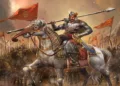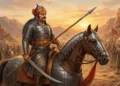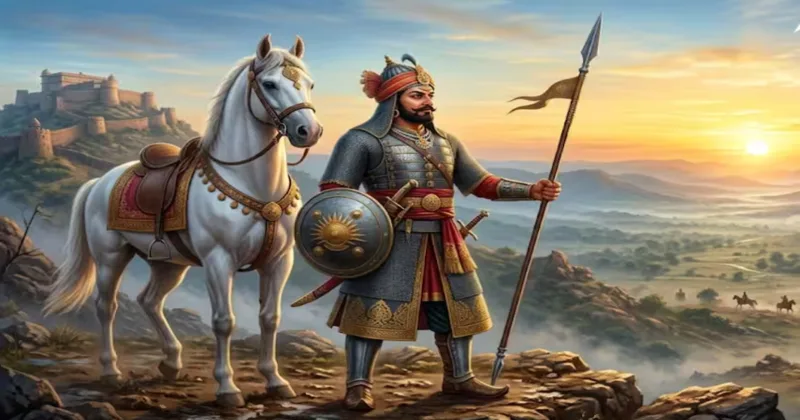
The Battle of Haldighati, fought on June 18, 1576 between Maharana Pratap of Mewar and the Mughal forces led by Raja Man Singh under Emperor Akbar, occupies a unique place in India’s historical consciousness. Few battles have garnered attention among historians, political thinkers, and the wider public. At the heart of this debate lies a seemingly straightforward question: Who won the Battle of Haldighati?
For centuries, many historical accounts, particularly those based on Mughal court chronicles, have described the battle as a Mughal victory because Maharana Pratap withdrew from the battlefield. Colonial historians, relying heavily on Persian sources, largely accepted this interpretation and presented Haldighati as another example of Mughal military superiority. Yet, history is rarely as simple as the outcome of a single day’s combat. Modern historical analysis encourages us to distinguish between a tactical success and a strategic victory.
If victory is measured not only by possession of the battlefield but by the achievement of long-term political objectives, the preservation of sovereignty, and the ability to continue the struggle, then the story of Haldighati appears very different. More than a military encounter, it was a contest over the future of Mewar and the limits of imperial expansion.
Military historians often argue that a battle should not be judged solely by who remained on the field at the end of the day. Tactical victories can become strategic failures if they do not achieve the larger political goals for which wars are fought. The Battle of Haldighati offers a classic example of this distinction. The Mughal Empire possessed one of the largest and most powerful military machines of the sixteenth century. Emperor Akbar had already secured the allegiance of many Rajput kingdoms through diplomacy, alliances, and military campaigns. His objective in Mewar was not simply to defeat Maharana Pratap in battle but to bring the kingdom under Mughal sovereignty, as had happened elsewhere in Rajasthan.
Although the Mughal army gained temporary control of the battlefield, it failed to secure the complete submission of Mewar. Maharana Pratap escaped, remained politically independent, and continued his resistance for the rest of his life. Thus, while the Mughals may have achieved a limited tactical success, they failed to accomplish their principal strategic aim.
The debate over Haldighati is closely connected with the nature of historical sources. Much of the traditional narrative depends on Persian court historians such as Abul Fazl and Abdul Qadir Badauni. These chroniclers were attached to the Mughal court and naturally viewed events from the imperial perspective. Their works remain invaluable historical records, but they were also intended to celebrate the achievements of the Mughal Empire.
During the colonial period, many British historians relied heavily on these Persian accounts while paying relatively little attention to regional chronicles, bardic traditions, inscriptions, and local historical memories preserved in Rajasthan. This created a one-sided interpretation that often overlooked the experiences and perspectives of Mewar itself.
Modern historiography encourages historians to read multiple categories of evidence together. Court chronicles, local traditions, administrative records, and archaeological evidence each contribute to a fuller understanding of the past. A balanced approach does not reject Persian sources; rather, it places them alongside indigenous traditions to construct a more nuanced historical picture.
Maharana Pratap occupies a special place in Indian history because he represented the principle that political sovereignty could not be surrendered for convenience. In an age when several regional rulers entered into alliances with the Mughal Empire, he chose a path of uncompromising resistance.
His struggle was not merely personal. It reflected the determination of Mewar to preserve its independence and its distinct political identity. Historian G. N. Sharma observed that Maharana Pratap’s greatness rested not simply on his military courage but on his unwavering commitment to freedom and self-respect.
This commitment explains why Haldighati has remained significant far beyond its immediate military consequences. The battle symbolised the refusal to accept external domination despite overwhelming odds.
Perhaps the simplest way to evaluate the outcome of Haldighati is to ask whether Emperor Akbar achieved his principal objective. The answer appears to be no. Akbar sought the submission of Maharana Pratap and the incorporation of Mewar into the Mughal imperial system. Despite repeated military expeditions and immense imperial resources, this objective remained unfulfilled during Maharana Pratap’s lifetime.
The ruler of Mewar was never captured. He never accepted Mughal authority, never appeared in the imperial court, and never entered into a treaty of submission. Instead, he continued to challenge Mughal expansion.
The distinguished historian Jadunath Sarkar recognised the extraordinary persistence of Maharana Pratap’s resistance. The inability of the Mughal Empire to secure complete control over Mewar demonstrated that even the most powerful empires could encounter determined opposition that they could not easily overcome.
If the campaign’s aim was to end resistance permanently, then Haldighati cannot be regarded as a complete Mughal success. One of the most remarkable aspects of Maharana Pratap’s life is that Haldighati was not the conclusion of his struggle but the beginning of a new phase.
After the battle, he adapted his military strategy to changing conditions. Recognising the numerical superiority of the Mughal forces, he avoided large-scale direct confrontations and instead adopted highly mobile warfare. The rugged terrain of the Aravalli hills became a natural ally. Small, swift attacks, surprise raids, and control over mountain routes gradually reduced the effectiveness of larger Mughal contingents.
This method of warfare demanded patience, resilience, and local support. It also reflected Maharana Pratap’s ability to transform adversity into opportunity. Historian R. C Majumdar regarded this period as one of the most inspiring episodes in Indian history. Despite severe hardships, financial constraints, and prolonged displacement, Maharana Pratap rebuilt his military strength and administrative structure.
Many rulers disappear from history after suffering a major setback. Maharana Pratap instead emerged stronger and more determined.
The events following Haldighati provide perhaps the strongest argument for reconsidering the traditional interpretation of the battle. Over the following years, Maharana Pratap gradually recovered substantial portions of his kingdom. Through sustained military campaigns, he regained many territories that had come under Mughal influence. He established a new capital at Chavand and restored the civil administration of Mewar.
The reconstruction of the kingdom was not limited to military affairs. Agriculture, local governance, and economic activity were revived wherever possible. These efforts demonstrated that Maharana Pratap was not simply a warrior but also an effective ruler committed to rebuilding his state.
By the time of his death in 1597, he had re-established authority over most of Mewar, although important fortresses such as Chittor remained under Mughal control. It is difficult to characterise a ruler as defeated when he preserves his independence, recovers much of his territory, rebuilds his administration, and leaves behind a functioning kingdom.
The enduring popularity of Maharana Pratap cannot be explained solely by military history. He became a symbol of courage, honour, and resistance against overwhelming power.