
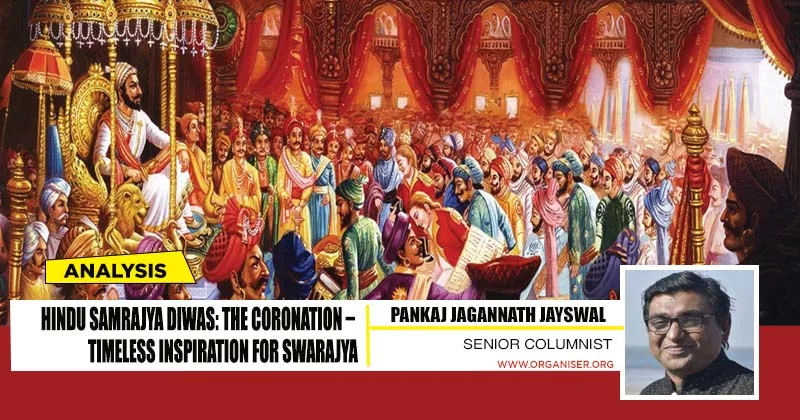
On June 6, 1674, the coronation of Chhatrapati Shivaji Maharaj (Shivrajyabhisheka) at Raigad Fort became a defining moment in Bharat’s history. It symbolised the rise of Hindavi Swarajya and the reawakening of a civilisation determined to govern itself according to its own values and traditions (sva-tantra). For Bharatiyas, the event represented not merely a political transition but the restoration of dignity, self-confidence, and cultural consciousness. More than three centuries later, the ideals embodied in that coronation continue to inspire leadership, nation-building, and the pursuit of collective self-respect.
It is time to memorialise this great warrior and a global inspiration beyond time, who possessed exceptional traits that no one else could equal. Chhatrapati Shivaji Maharaj is an icon because his legacy extends far beyond the battles he won. While he was an exceptional warrior, his innovative concepts about governance, inclusion, and strategic thinking make his life a timeless inspiration for leadership.
When Hindus had lost all hope, Shivaji Raje rekindled the fighting spirit and gathered an army to liberate the Maratha empire from mughal invasion. He revitalised Hindutva, leading the struggle against invasion, injustice, exploitation, and women’s safety. From his childhood, Jijamata raised him with a firm aim to establish Hindavi Swarajya to protect and elevate the great Sanatan tradition and restore its glory. He was raised on Mahabharat and Ramayan teachings and spent a lot of time with renowned sants of the time. He trained to battle with various weapons from famous fighters such as Dadoji Kondadev. Shivaji Raje was a natural leader who captivated all. He drew the best of the nation to his side and commanded faithful officers. His spectacular victories and ever-present smile made him the soldiers’ idol. One of the primary reasons for his success was his ability to judge true character of a person.
Leadership in Action
Shivaji Raje taught the Bharatiyas to cultivate self-confidence, and fight foreign invasions with fortitude. He cultivated native talent, stern discipline, and care for peasants, women, men, and children. His private life was characterised by high moral standards. He was a dedicated son, a nurturing father, and a loving husband. Raje reinstated Sanskrit and Marathi as the official languages in his court. This highlights how vital local languages are in preserving the culture, and facilitating communication with all segments of society, promoting cultural, social and economic growth.
True innovators excel at resource utilisation. Raje decentralised power through the Ashta Pradhan Mandal (Council of Eight Ministers), demonstrating how a great leader creates mechanisms that can function without continual micromanagement. In contemporary management discussions, we emphasise the importance of empathy and psychological safety — traits that Shivaji Maharaj naturally embodied.
Unlike rulers who stayed comfortably in palaces while their soldiers battled, he took significant personal risks. During the Battle of Pratapgad Fort, which marked his first major victory, Shivaji Raje confronted the deceitful strategy of Adil Shahi general Afzal Khan, who intended to murder him under the guise of peace negotiations. With keen awareness, intelligence, effective leadership, and guerrilla tactics, Raje devised a plan. He strategically positioned his army in the dense forests and hilly regions around Pratapgad to cut off the enemy’s escape routes. A hallmark of great leadership is placing the right people in key roles at the right time; Shivaji brought Jiva Mahal with him, recognising his capabilities even before they met in battle. When Afzal Khan attempted to assassinate him during an embrace in this meeting, Shivaji swiftly defended himself by using tiger claws to fatally wound Khan. Jiva Mahal also played a crucial role by quickly countering an attack from Sayyad Banda, ensuring Shivaji’s safety.
While Shivaji Raje and his son were under house arrest in Agra for nearly three months, Aurangzeb aimed to break their spirits before eliminating them. Nevertheless, Raje maintained unwavering confidence in himself and his faith in Ishwar. He exemplified a balanced approach, focusing on maintaining peace despite adversity. Rather than succumbing to despair, he devised a plan to escape. When the opportunity arose, he and his son cleverly slipped away using sweet baskets. Upon returning to Raigad about six months later, he was crowned. This illustrates how patience, courage, confidence, strategic thinking in the face of challenges, a goal-oriented mindset, dedication to society and the nation, and a commitment to one’s values can lead to divine protection and guidance.
The Art of Ganimi Kava
Shivaji faced a challenging task in overcoming the Mughals in open combat, as they possessed a vastly superior military force, weaponry, and resources. He had to engage in multiple battles against Mughal authority simultaneously. The teachings of Sri Krishna in Bhagvadgita about diplomacy helped him understand how to outmaneuver adversaries like the unethical Kauravas. During this time, Aurangzeb sent his general, Shaistekhan, to the Deccan region, initially taking over Lal Mahal in Pune. However, in the next three years, he could only manage to capture Chakan fort, and he was hesitant to confront Shivaji Maharaj, fearing a fate similar to that of Afzal Khan.
Shaistekhan aimed to lure Raje into a trap without any arms and preparation, but Shivaji Raje, through his spy network, was well aware of this scheme and the movements around Lal Mahal. Instead, Shaistekhan merely caused disturbances, prompting Shivaji to conduct a decisive commando-style operation to drive him out of his territory. This situation showcased incredible bravery, as Shivaji was familiar with Lal Mahal’s layout from his childhood yet took the time to strategise meticulously, delegating tasks according to individual abilities, and embodying the traits of an effective and dynamic leader.
One can only imagine the implications for Bharat had Shivaji been defeated by the Mughals. Diplomatic maneuvers are sometimes essential to counteracting enemies with harmful intentions towards society and the nation. Thus, Shivaji employed Ganimi Kava (Guerrilla tactics) aligned with dharma to counter adharma. He established a great defense mechanism without an easy beginning of vast fortune. He took what he had — rugged mountains, passionate locals, and limited resources — and transformed them into a superpower.
Moreover, he did not just address the immediate battles; he anticipated future threats and established a navy, foreseeing the potential for sea-based foreign colonisation. He is often regarded as the father of the Indian Navy. Despite the challenges posed by the difficult geography, particularly in the Konkan region, he transformed this adversity into an opportunity by creating a naval force and constructing forts along the coastline, aiding him in overcoming the huge Mughal army. The blend of intellect, a balanced mindset, and a broader vision fosters innovation and creativity in pursuit of ultimate goals.
What Leaders Can Learn
When pursuing success, it is essential to remain humble and grounded. Raje exemplified love and inclusivity towards all segments of society, treating everyone equally without regard to wealth, race, or caste. He often visited impoverished families, sharing meals with them and enjoying their hospitality. His inspirational legacy lies not just in constructing physical forts but in fostering self-belief among ordinary people who had lost sight of their own strengths. The fundamental aim of a truly great leader is to strengthen others, leaving them more capable and confident than before.
It is important to recognise your limitations. Experiencing setbacks is not a failure; rather, it serves as a critical learning opportunity. When Aurangzeb, aided by Mirza Jaysingh, laid siege to the city, Shivaji Raje had to leave twenty-three forts under the Purandar Treaty to safeguard his people. The loss of these forts after Murarbaji’s death allowed the Mughal forces to take control. Think of Murarbaji as a representation of your efforts — striving to protect you from defeat. If your attempts do not succeed, it is vital to acknowledge your failures. Recognising failure is far more crucial than becoming overconfident in your victories. Complacency after success can lead to downfall, while those who diligently work after setbacks are more likely to achieve lasting success. Continuous adaptation is vital for survival. In career or business planning, anticipating changes and proactively acquiring new skills is essential for remaining relevant.
If you want to make plans for a year, plant seeds. For a ten-year vision, grow trees. However, if you are looking to shape the next hundred years, invest in the right people. By developing individuals into leaders, your ideas, strategies, and actions can be remembered for generations. Shivaji Raje exemplified this type of leadership; he believed in nurturing and educating people rather than depending on followers. When Chhatrasal Bundela from Bundelkhand approached Shivaji Raje for a job, Raje encouraged him to fight for his state as a Kshatriya, instead of offering him employment. Inspired by Shivaji Raje, Bundela took the initiative to establish his own kingdom in Bundelkhand and fought against his enemies. Raje continues to be a source of inspiration because he instilled a sense of self-confidence in ordinary individuals who had lost sight of their own power.
The true significance of Hindu Samrajya Diwas (Maharaj’s Coronation Day) lies in its enduring message. It demonstrated that determined leadership, rooted in dharma, courage, and service, can transform the destiny of a people. The throne at Raigad was not merely a seat of power; it was a declaration that self-belief and self-governance are the foundations of lasting freedom. That legacy continues to inspire individuals and nations alike, reminding every generation that great leadership is measured not by authority acquired, but by confidence awakened in others.