Bhubaneswar: The Swami Laxmanananda Saraswati Smriti Nyas has called upon the Odisha government to locate the missing inquiry commission report within a stipulated timeframe and ensure that all those responsible for the seer’s murder are brought to justice without further delay.
Smriti Nyas Meets Chief Minister, Raises Alarm Over Missing Report
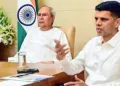
A delegation from the Smriti Nyas met Odisha Chief Minister Mohan Charan Majhi and submitted a memorandum expressing concern over reports that the judicial inquiry commission report concerning the murder of Swami Laxmanananda Saraswati and the subsequent violence has gone missing.
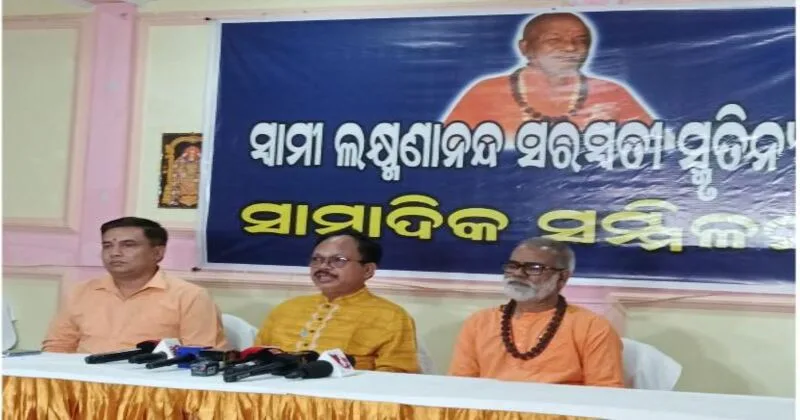
Addressing a press conference in Bhubaneswar on June 16, Nyas chairman Swami Jivanmuktananda Puri and trustee Rupendra Kahar stated that the issue has generated widespread concern across Odisha. They noted that recent media reports and public discussions surrounding the disappearance of the long-awaited inquiry report have led to growing dissatisfaction, uncertainty, and suspicion among citizens.
The delegation emphasized that this matter is not merely administrative but is deeply connected to the sentiments of Swami Laxmanananda Saraswati’s followers and the wider public. According to them, the situation demands a transparent, impartial, and time-bound investigation to restore public confidence.
Demand for Accountability and Time-Bound Action
The Nyas urged the Chief Minister to ensure that the missing report is located as soon as possible and that strict action is taken against any officials or individuals found responsible for negligence in handling sensitive judicial records.
It further demanded that all persons involved in the alleged conspiracy behind Swami Laxmanananda Saraswati’s murder be identified and prosecuted in accordance with the law. The organization emphasized that justice in the case remains incomplete without full disclosure and accountability.
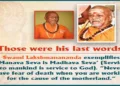
The Nyas also highlighted Swami Laxmanananda Saraswati’s contributions to the welfare of tribal communities and his efforts in preserving cultural and religious traditions. It noted that he was widely known for his opposition to what he described as illegal religious conversions.
Centenary Year Adds Emotional Weight to the Issue
The organisation pointed out that 2026 marks the birth centenary year of Swami Laxmanananda Saraswati, who was born in present-day Angul district of Odisha in 1926. It stated that commemorative programs are being planned throughout the year to honor his legacy.
However, it expressed disappointment that, at a time when tributes are being prepared, the controversy over the missing judicial commission report has resurfaced, adding emotional and public sensitivity to the issue.
The Nyas also called for the public release of other related inquiry reports, including the interim report submitted by Justice Sarat Chandra Mahapatra and the report of the commission headed by Justice Basudev Panigrahi. It argued that releasing these documents would help the public understand the findings of earlier investigations and address long-standing doubts surrounding the case
Government Files Police Case Over Missing Judicial Inquiry Reports
The controversy surrounding the disappearance of crucial judicial inquiry reports has intensified after the Odisha Home Department lodged a formal complaint at the Capital Police Station in Bhubaneswar.
Sarat Chandra Marandi, Joint Secretary of the Home Department, filed the complaint, seeking a detailed criminal investigation. In response, police registered a case under multiple provisions of the Bharatiya Nyaya Sanhita (BNS), including Sections 305, 316(2), 238(c), 241, and 61(2)(b), underscoring the gravity of the allegations.
These sections pertain to offenses such as criminal breach of trust, concealment, destruction, or unauthorized handling of official documents, indicating that authorities are treating this as a potential case of serious misconduct.
Official Movement and Missing Trail of Reports
According to the complaint, the inquiry reports, originally submitted by various commissions, were received by the Home Department and subsequently forwarded through official channels—via the Chief Secretary’s office—to the Chief Minister’s Office (CMO).
Specifically, the Justice A.S. Naidu Commission report was sent to the Chief Secretary’s office on September 16, 2016, and then forwarded to the CMO on September 19, 2016. Similarly, the RDC inquiry commission report was transmitted on May 23, 2018, and reached the CMO on May 24, 2018.
The Home Department has confirmed that both reports are currently untraceable within the CMO, despite extensive searches by concerned officials.
The complaint further highlights that several other files sent during the same period were returned to the Home Department on June 4, 2024. This date coincided with the vote counting for the Odisha Assembly elections, when a change in government became evident.
However, the two judicial inquiry reports were conspicuously absent from the returned documents. This discrepancy has sparked serious concern within administrative circles and raised suspicions about their current status and handling.
Authorities have stated that these circumstances create “reasonable suspicion” that the documents may have been intentionally removed, concealed, destroyed, or otherwise unlawfully dealt with. Given that these are judicial and quasi-judicial records, their disappearance is considered a matter of grave public concern.
VHP Demands CBI Inquiry
The issue has now garnered wider attention, leading to increasing calls for a deeper and independent investigation. The Vishva Hindu Parishad (VHP) has already demanded a Central Bureau of Investigation (CBI) probe, arguing that the disappearance of such crucial judicial records cannot be properly examined without the involvement of a central agency.
Mahesh Kumar Sahu, VHP Odisha (East) secretary, stated that the murder of Swami Laxmanananda Saraswati was not an ordinary incident and that the inquiry report should have been made public long ago. He added that the current situation raises serious questions about transparency and accountability in handling sensitive state records.