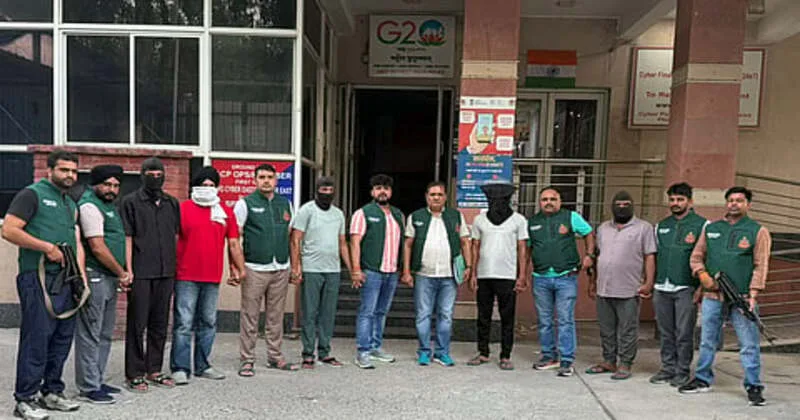
Delhi Police have dismantled an international terror-crime syndicate allegedly operating at the behest of Pakistan’s Inter-Services Intelligence (ISI), arresting seven operatives linked to Pakistan-based gangster-turned-terrorist Shahzad Bhatti and his close associate Ajmal Gujjar. The operation, carried out by the Special Cell’s Eastern Range team, is being viewed as a significant breakthrough in preventing a potential terrorist strike in the Delhi-National Capital Region (NCR).
According to investigators, the network was engaged in a range of activities, including terrorist planning, arms trafficking, narcotics smuggling, reconnaissance of potential targets, and recruitment of Indian youth for criminal and terror-related operations. Police officials stated that the module had established a sophisticated supply chain through which weapons, ammunition, and narcotics were smuggled from Pakistan into India via Punjab before being distributed across Delhi-NCR and other locations.
Intelligence-led operation
The Special Cell launched the operation after receiving specific intelligence inputs indicating that Pakistan-based handlers were actively coordinating a network inside India. Investigators employed technical surveillance, analysis of mobile phone records, digital communication tracking, and ground intelligence to identify members of the syndicate and map their activities.
Officials said the investigation revealed that the module was functioning under the direct guidance of Shahzad Bhatti and Ajmal Gujjar, who allegedly coordinated operations from Pakistan using encrypted messaging applications and social media platforms. The accused were reportedly tasked with receiving arms consignments, distributing narcotics, conducting reconnaissance of sensitive locations, and identifying targets for future attacks.
Seven accused arrested
The seven arrested individuals have been identified as:
Anas (26), resident of Loni, Ghaziabad
Mohit (26), resident of Loni, Ghaziabad
Deepak, resident of Techno City, Ghaziabad
Arif alias Pradhan, resident of Loni, Ghaziabad
Karanveer Singh, resident of Fatehgarh Sahib, Punjab
Jatan, resident of Techno City, Ghaziabad
Sabir, resident of Loni, Ghaziabad
Police records indicate that several of the accused have prior criminal backgrounds. Anas had allegedly been in regular contact with Shahzad Bhatti and Ajmal Gujjar since November 2025 and faces three previous criminal cases. Mohit was reportedly in direct communication with Ajmal Gujjar.
Deepak Agrola is a known gangster with 23 criminal cases registered against him, including charges of murder, robbery, attempted murder, and offences under the Gangsters Act. Arif has previously been booked under the Arms Act and the NDPS Act, while Karanveer Singh also faces a case under narcotics laws. Jatan has been linked to an attempted murder case.
Weapons, ammunition and digital evidence seized
During the operation, police recovered five sophisticated semi-automatic pistols, 41 live cartridges, seven mobile phones, a Scorpio vehicle, and records of multiple bank accounts allegedly used to channel proceeds generated through the sale of illegal weapons and narcotics. The mobile phones contained chats, voice messages, and other digital evidence that investigators believe establishes direct communication between the accused and Pakistan-based handlers.
Officials said the seized material is being examined to identify additional members of the network and trace the flow of money, weapons, and instructions across the border. One of the most alarming findings of the investigation relates to the reconnaissance activities allegedly carried out by the module. Police said members of the network surveyed crowded public places, important establishments, sensitive locations, and sites associated with religious leaders in Delhi-NCR. Photographs and videos of these locations were allegedly recorded and transmitted to handlers in Pakistan.
Investigators believe the objective was to identify targets that could create maximum public fear and disruption. Authorities stated that the planned attacks appeared designed to generate panic, destabilise public order, and potentially trigger communal tensions. Officials said the timely arrests prevented the network from moving beyond the reconnaissance stage and executing a larger conspiracy.
Drone-based smuggling route from Pakistan
The probe has also uncovered details of an alleged cross-border smuggling network that relied on drones to transport consignments from Pakistan into Punjab. According to investigators, weapons and narcotics were dropped at predetermined locations in Punjab, where local operatives collected the consignments before moving them to Delhi-NCR. Police alleged that Anas and Karanveer Singh were among those responsible for receiving these deliveries and arranging onward transportation. The smuggling route was allegedly used for both firearms and narcotics, including heroin and chitta, allowing the network to generate funds while simultaneously building operational capabilities.
Recruitment through social media
Investigators said Shahzad Bhatti and Ajmal Gujjar relied heavily on social media platforms and encrypted communication channels to identify potential recruits in India. Young individuals with criminal backgrounds were allegedly approached and promised quick financial rewards. Once contact was established, recruits were gradually drawn into criminal activities ranging from arms trafficking and extortion to narcotics distribution and reconnaissance assignments.
Police believe this strategy enabled Pakistan-based handlers to build a network of local operatives without maintaining extensive physical infrastructure inside India.
Earlier Arrests Point to a Wider Pakistan-Linked Network
The latest crackdown by Delhi Police comes amid a series of arrests across multiple states in recent weeks involving individuals allegedly linked to Pakistan-based handlers, organised crime syndicates, and espionage networks.
In May 2026, Delhi Police foiled a major terror plot allegedly linked to underworld don Dawood Ibrahim and arrested nine suspects accused of conducting reconnaissance of critical locations in the national capital. Investigators alleged that the accused were part of a larger network operating under instructions from handlers based in Pakistan and were gathering information on sensitive targets.
Just days earlier, the Uttar Pradesh ATS and STF busted an alleged sleeper cell in Saharanpur linked to Pakistan-based gangster Shahzad Bhatti. Four individuals were arrested for allegedly maintaining contact with foreign handlers and facilitating activities that investigators said posed a threat to national security. The case highlighted the growing nexus between organised crime networks and Pakistan-backed operatives.
In another significant development, the West Bengal STF arrested Sheikh Goutam for allegedly sharing SIM cards, OTPs, and other sensitive information with Pakistan’s ISI. Investigators claimed that the accused facilitated covert communication channels for Pakistani operatives and played a role in enabling espionage-related activities.
Taken together, these cases indicate a pattern of alleged Pakistan-linked networks operating through local criminal associates, sleeper cells, and espionage facilitators across different parts of India. Security agencies have maintained that such networks often rely on social media recruitment, encrypted communication platforms, and cross-border criminal syndicates to further their activities.