Why Chhattisgarh strengthened its anti-conversion framework
July 24, 2026
  • Read Ecopy
  • Circulation
  • Advertise
  • Careers
  • About Us
  • Contact Us
Android AppiPhone AppArattai
Organiser
  • ‌
  • Bharat
    • Assam
    • Bihar
    • Chhattisgarh
    • Jharkhand
    • Maharashtra
    • View All States
  • World
    • Asia
    • Europe
    • North America
    • South America
    • Africa
    • Australia
  • Editorial
  • International
  • Opinion
  • RSS @ 100
  • More
    • Op Sindoor
    • Analysis
    • Sports
    • Defence
    • Politics
    • Business
    • Economy
    • Culture
    • Special Report
    • Sci & Tech
    • Entertainment
    • G20
    • Azadi Ka Amrit Mahotsav
    • Vocal4Local
    • Web Stories
    • Education
    • Employment
    • Books
    • Interviews
    • Travel
    • Law
    • Health
    • Obituary
  • Subscribe
    • Subscribe Print Edition
    • Subscribe Ecopy
    • Read Ecopy
  • ‌
  • Bharat
    • Assam
    • Bihar
    • Chhattisgarh
    • Jharkhand
    • Maharashtra
    • View All States
  • World
    • Asia
    • Europe
    • North America
    • South America
    • Africa
    • Australia
  • Editorial
  • International
  • Opinion
  • RSS @ 100
  • More
    • Op Sindoor
    • Analysis
    • Sports
    • Defence
    • Politics
    • Business
    • Economy
    • Culture
    • Special Report
    • Sci & Tech
    • Entertainment
    • G20
    • Azadi Ka Amrit Mahotsav
    • Vocal4Local
    • Web Stories
    • Education
    • Employment
    • Books
    • Interviews
    • Travel
    • Law
    • Health
    • Obituary
  • Subscribe
    • Subscribe Print Edition
    • Subscribe Ecopy
    • Read Ecopy
Organiser
  • Home
  • Bharat
  • World
  • Operation Sindoor
  • Editorial
  • Analysis
  • Opinion
  • Culture
  • Defence
  • International Edition
  • RSS @ 100
  • Magazine
  • Read Ecopy
Home Politics

Chhattisgarh Anti-Conversion Law: Balancing religious freedom and protection from exploitation

The Chhattisgarh Dharm Swatantrata Adhiniyam, 2026 is seeking to curb religious conversions allegedly carried out through coercion, fraud, inducement, or psychological manipulation while safeguarding the fundamental right of every individual to choose and practise a faith of their own free will

Advocate Karan ThakurAdvocate Karan Thakur
Jun 14, 2026, 02:10 pm IST
in Politics, Bharat, Chhattisgarh
Follow on Google News
FacebookTwitterWhatsAppTelegramEmail

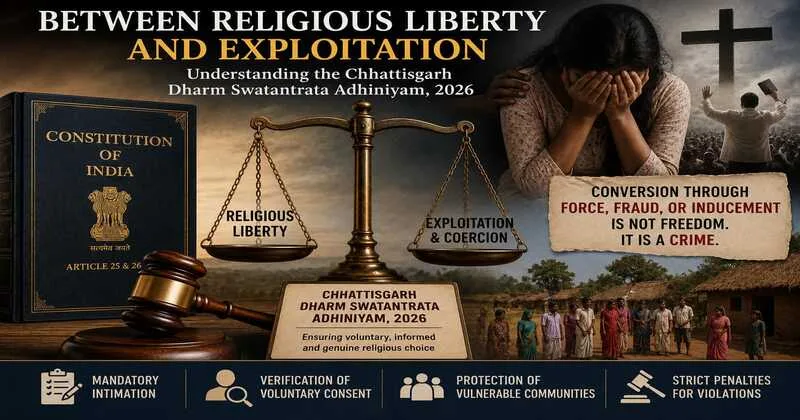
Religious freedom cannot become a shield for coercion, deception or exploitation. The Chhattisgarh Dharm Swatantrata Adhiniyam, 2026 seeks to protect genuine freedom of conscience while preventing manipulative conversions carried out under the guise of faith.

The Chhattisgarh Dharm Swatantrata Adhiniyam, 2026 represents an important constitutional and social intervention in the ongoing debate surrounding religious conversion in India. While Articles 25 and 26 of the Constitution guarantee every individual the freedom of conscience and the right to profess, practise and propagate religion, these freedoms were never intended to legitimise coercion, deception or organised exploitation carried out in the name of faith. The Constitution protects voluntary and informed religious choice, not conversion achieved through fear, inducement, fraudulent claims or psychological manipulation. It is this crucial constitutional distinction that forms the legal and moral foundation of the Chhattisgarh legislation. Judicial precedents, including Rev. Stainislaus v. State of Madhya Pradesh, have clarified that the right to “propagate” does not include the right to convert another person by force or deceit.

Read More: CJP Exposed: How leftist radicals & foreign media are trying to destabilise Bharat under the guise of youth activism

The debate surrounding anti-conversion laws is often reduced to a simplistic conflict between religious liberty and State regulation. However, the realities on the ground are far more complex. In several economically vulnerable and socially marginalised regions, particularly among tribal communities, Scheduled Castes and weaker sections of society, instances have emerged where religious influence is intertwined with promises of employment, healthcare, miracle healing, education, financial assistance or social mobility. In such circumstances, the issue before the State is not whether an individual may change religion, but whether such a decision is genuinely free, informed and free from external pressure or inducement.

The recent judgment arising from the Gariyaband district of Chhattisgarh serves as a disturbing reminder of the dangers associated with exploitative religious practices operating without scrutiny. The case involved the death of an 18-year-old Scheduled Caste girl who was subjected to severe physical abuse under the guise of ritualistic healing. Evidence before the Court revealed horrifying acts including pouring hot oil and water upon the victim and physically assaulting her as part of a so-called spiritual cure. Medical testimony confirmed that the victim suffered grave internal injuries which ultimately resulted in her death. Witness statements further suggested that the family was discouraged from seeking external help and was psychologically pressured through threats of divine displeasure.

Significantly, the Court observed that blind faith and manipulative spiritual claims had been used to exercise control over the victim and her family. The judgment treated the acts not merely as isolated assault, but as part of a pattern of exploitative conduct carried out under the cloak of religious intervention and superstition. The Court ultimately convicted the accused under multiple statutory provisions, including the Bharatiya Nyaya Sanhita, the SC/ST (Prevention of Atrocities) Act, the Chhattisgarh Tonhi Pratarna Nivaran Act, the Drugs and Magic Remedies Act and the Chhattisgarh Dharm Swatantrata Adhiniyam, 2026. The imposition of life imprisonment reflected the seriousness with which the judiciary viewed the intersection of coercive religious influence, superstition and criminal violence.

The significance of the case extends beyond one criminal prosecution. It reflects a broader structural concern where vulnerable individuals may become trapped within a network of superstition, emotional control, fraudulent healing practices and coercive religious influence. Such incidents raise serious constitutional and ethical questions regarding the boundary between genuine religious freedom and organised exploitation. A democratic State committed to protecting individual dignity cannot remain indifferent when faith becomes a mechanism of manipulation rather than conscience.

Critics of anti-conversion laws have frequently argued that such legislations may be misused or may interfere with legitimate religious activity. These concerns deserve careful consideration because every law affecting civil liberties must be implemented with fairness, restraint and accountability. However, the possibility of misuse cannot by itself invalidate the constitutional legitimacy of regulation. Every fundamental right operates within reasonable restrictions intended to protect public order, dignity and individual autonomy. The answer to misuse lies in balanced enforcement and judicial oversight, not in the complete absence of safeguards.

The Chhattisgarh Dharm Swatantrata Adhiniyam, 2026 must therefore be understood not as a prohibition upon religious choice, but as a regulatory framework intended to ensure transparency, accountability and genuine consent in matters relating to religious conversion. The legislation attempts to distinguish voluntary acceptance of faith from conversions facilitated through coercion, fraudulent claims, organised inducements or exploitative practices targeting vulnerable populations. In doing so, the State seeks to uphold both constitutional liberty and social justice.

Ultimately, the larger constitutional question concerns the meaning of genuine freedom itself. Religious liberty cannot be meaningful where consent is distorted by fear, poverty, emotional dependency or manipulation masquerading as spirituality. A constitutional democracy must protect both the individual’s right to faith and the individual’s right to remain free from exploitation committed in the name of faith. The Gariyaband judgment stands as a grim reminder that unchecked practices disguised as spiritual intervention can escalate into criminal violence and even loss of life.

Religious liberty remains meaningful only when faith is shaped by free conscience and not by fear, fraud or manipulation. The Chhattisgarh Dharm Swatantrata Adhiniyam, 2026 ultimately represents an attempt to balance constitutional freedom with the State’s duty to protect vulnerable individuals from exploitation carried out in the name of religion.


Topics: Chhattisgarh anti conversion lawGariyaband districtChhattisgarh Tonhi Pratarna Nivaran ActChhattisgarh Dharm Swatantrata AdhiniyamForced Conversion
ShareTweetSendShareSend
✮ Subscribe Organiser YouTube Channel. ✮
✮ Join Organiser's WhatsApp channel for Nationalist views beyond the news. ✮
Previous News

Baloch Liberation Army blows up bridges on CPEC road; Dozens of Pakistani vehicles carrying minerals set on fire

Next News

West Bengal needs truth and reconciliation commission for victims of political violence, says Mahesh Jethmalani

Related News

Representative Image

Pakistan: Police brutal crackdown on protestors demanding justice for abducted minor Hindu & Christian girls

The Muslim couple identified as Twana H.S. and Asia R.A. during the trial on May 19, 2026

Germany convicts ISIS couple for enslaving, raping and forcing two Yazidi girls to convert to Islam

Demonstrators rally for justice for 13-year-old Christian girl Maria Shahbaz and other religious minority girls in Pakistan

Pakistani court sends 13-year-old Christian girl Maria back to 30-year-old Muslim abductor, sparking global outrage

12 Love Jihad cases across India in 7 days: Identity fraud, blackmail, conversion claims under spotlight

Representative image

Love Jihad Tracker: 11 reported cases of fake identity, love traps and religious conversion in a week

EU Parliament slams Pakistan over forced conversion; Cites injustice in Maria case

EU Parliament slams Pakistan over abduction, forced conversion & marriage of minor girls; Cites injustice in Maria case

Load More

Latest News

Representative Image

Pakistan: Police brutal crackdown on protestors demanding justice for abducted minor Hindu & Christian girls

RSS Sarsanghchalak Dr Mohan Bhagwat addressing the gathering at Vishwamangalya Sabha in Delhi

Motherhood is an eternal truth; women are equal partners in building family & Nation: RSS Sarsanghchalak Dr Bhagwat

Transnational drug kingpin arrested by NCB

India-Myanmar drug network busted: Crackdown on international syndicate by NCB; Prime kingpin Nengzatuan arrested

Former Devaswom Board chief P.S. Prasanth

Sabarimala gold loot: Former Devaswom Board chief P.S. Prasanth, ex-member Ajikumar arrested

CJP's Abhijeet Dipke under fire after suspended cop from Uttarakhand presented as serving officer (Image Source: Video Grab)

Exposing fraud at CJP Protest: Abhijeet Dipke’s ‘Cop Resignation’ claim under scrutiny after suspension details surface

Congress Leader Rahul Gandhi and Prime Minister Narendra Modi

Fact Check | NEET Paper Leak: Rebuttal on Rahul Gandhi’s press conference & debunking fake allegations

Nihang Sikhs Demand Apology from Abhijeet Dipke for insulting them

Clashes erupt at Jantar Mantar as Nihang Sikhs confront CJP, demands apology from Abhijeet Dipke for demeaning them

Dr Vrushali Joshi, All India Organising Secretary of Vishvamangalya Sabha

Interview| ‘Motherhood is central to nation-building’: Dr Vrushali Joshi explains Yuganukul Matrutva

Representative Image

Zohran Mamdani and the Politics of the Ummah: From Anti-India rhetoric to the demand for Netanyahu’s arrest

Representative Image

Why loan planning should be part of your annual financial goals

Load More
  • Privacy
  • Terms
  • Cookie Policy
  • Refund and Cancellation
  • Delivery and Shipping

© Bharat Prakashan (Delhi) Limited.
Tech-enabled by Ananthapuri Technologies

  • Home
  • Search Organiser
  • Bharat
    • Assam
    • Bihar
    • Chhattisgarh
    • Jharkhand
    • Maharashtra
    • View All States
  • World
    • Asia
    • Africa
    • North America
    • South America
    • Europe
    • Australia
  • Editorial
  • Operation Sindoor
  • Opinion
  • Analysis
  • Defence
  • Culture
  • Sports
  • Business
  • RSS @ 100
  • Entertainment
  • More ..
    • Sci & Tech
    • Vocal4Local
    • Special Report
    • Education
    • Employment
    • Books
    • Interviews
    • Travel
    • Health
    • Politics
    • Law
    • Economy
    • Obituary
  • Subscribe Magazine
  • Read Ecopy
  • Advertise
  • Circulation
  • Careers
  • About Us
  • Contact Us
  • Policies & Terms
    • Privacy Policy
    • Cookie Policy
    • Refund and Cancellation
    • Terms of Use

© Bharat Prakashan (Delhi) Limited.
Tech-enabled by Ananthapuri Technologies