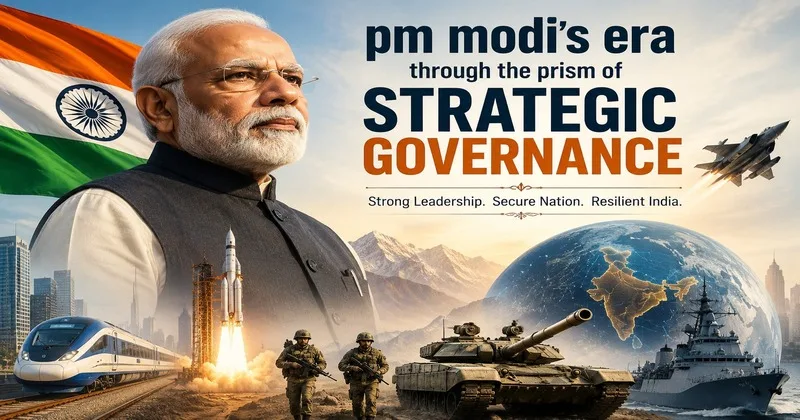
Heartiest congratulations to Prime Minister Narendra Modi for becoming the longest-serving Prime Minister of India (4399 days and counting), also for leading the NDA government at the centre for more than 12 continuous years since May 2014. Such record-breaking longevity in Indian politics, both at the state level (as CM of Gujarat from October 2001 to May 2014) and thereafter as PM of India from 26 May 2014 onwards, is a rare achievement for Shri Narendra Modi. It is important to understand the significance of such enduring performance for the rise of India, particularly as a major military power.
Before any appraisal of the towering performance of PM Modi is undertaken, it is important to understand the state of India before the year 2014, particularly under the PM Manmohan Singh-led UPA government from 2004 to 2014. In diplomatic parlance, India is often called the ‘Elephant’ to represent its massive size, huge population base, deep cultural heritage and steady economic growth. China, on the other hand, is referred to as the ‘Dragon’. But by the year 2014, the Indian elephant had become sluggish, appeared bogged down and was not sure of its forward journey. As a result, not only the Dragon but many other animals and countries surged ahead of India.
In India, there was a CM of Gujarat in the form of Narendra Modi who had put the state on a path of unprecedented growth trajectory. He gave the country the ‘Gujarat model of development’ with a focus on infrastructure and industrial development, and getting huge foreign investment through the Vibrant Gujarat Summit. During my military career, I had the opportunity to study the Gujarat model of development and found it to be a suitable roadmap for India’s growth journey. In classical cricketing parlance, India had a star cricketer at the Ranji Trophy level in the form of CM Narendra Modi. He had captained his team to victory through three consecutive trophies (victory in assembly elections) in the years 2002, 2007 and 2012.
Now the party (BJP) wanted him to lead the national side in Test cricket, that too as a first-time captain. Let me explain this through the example of Rajat Patidar of RCB in the T-20 Indian Premier League. Rajat Patidar was made captain of the RCB cricket team in 2025, and he led the team to its maiden title. Thereafter, he repeated the feat in the year 2026. Patidar was an unknown figure at the national level , and he achieved the rare feat of two consecutive IPL victories in the presence of stalwarts like Virat Kohli. The position of CM Narendra Modi when entrusted, the captaincy of the BJP for the Lok Sabha elections in the year 2014 was no different. BJP had a number of towering personalities, but the new captain had to call the shots.
Narendra Modi led the BJP to an absolute majority on its own in the 2014 Lok Sabha elections, by winning 282 seats, and the NDA secured 336 seats. This was after a gap of 30 years that a single party had won an absolute majority in the Lok Sabha after the 1984 general elections. Under the leadership of PM Modi, the BJP again won a spectacular 303 seats in the 2019 Lok Sabha elections. There was an unexpected dip in the 2024 Lok Sabha elections, where the BJP won 240 Lok Sabha seats, but the NDA had a comfortable majority with 293 seats. Under PM Modi’s stewardship, the BJP and the NDA are currently in power in 20 states and 2 UTs. That is a remarkable electoral success in a span of 12 years.
The achievements of PM Modi in the economic, agricultural, infrastructure development, social upliftment, etc., are well known. But it is important to understand how PM Modi has raised the strategic stature of Bharat manifolds. In India, the PMs usually keep themselves away from the defence and strategic issues. For example, PM Manmohan Singh relied largely on his defence minister AK Antony to look after the affairs of the military. Even the NSAs during the UPA regime, namely JN Dixit, MK Narayanan and Shivshankar Menon, were largely conformists. The defence acquisitions during the UPA regime were slow and cautious, fearing another Bofors scandal. Even General VK Singh, then Army Chief, had to write to PM Manmohan Singh in March 2012 about the critical shortages in tank and artillery ammunition, air defence being obsolete and the deficiency of essential weapons and military equipment. The elephant, as far as the defence preparedness is concerned, was clearly struggling.
PM Modi displayed an uncanny ability to quickly grasp the essentials of India’s defence and the armed forces as a whole. He immediately fulfilled the election promise of implementing the OROP in July 2014, which touched the hearts of millions of ex-servicemen. He made it a point to celebrate Deepawali with the soldiers in the forward areas from 2014 onwards. Manohar Parrikar, as the defence minister from 2014 to 2017, made a road map for quick defence acquisition and military modernisation, with a focus on self-reliance in defence. PM Modi also pushed for quality defence manufacturing and defence exports by encouraging private sector participation as well as corporatising the public defence production units. In short, the Indian armed forces are now a formidable military, acknowledged by the world.
But it is PM Modi’s decisive leadership that has made a major difference to the thought process in the defence forces. He has propagated jointness and synergy between the Army, Navy and Air Force. He overcame the bureaucratic lethargy by appointing a four-star CDS from 1 January 2020 onwards. He has pushed for creating the theatre commands, and a lot of ground has been covered in the last six years. I believe that PM Modi is most suited to don the mantle of Commander of the Indian Armed Forces. Today, the time has come when the PM of the country needs a hands-down approach towards national security. By officially being the Commander of the armed forces (Honourable President is the Supreme Commander), PM Modi is likely to bring a systemic change in the higher direction of war and strategic decision-making. With the appointment of CDS having stabilised, this is the next step towards complete strategic governance in Bharat.
Narendra Modi, as a person, brings that extra element of unpredictability, which is feared and admired by his adversaries. It is this personality trait that leads him to strike deep inside Pakistan during Operation Sindoor in May last year. By doing so, India called the nuclear bluff of Pakistan in one go. During my military career, we always struggled with the nuclear blackmail of Pakistan while making operational plans. No longer so. Similarly, PM Modi has given complete freedom to the Army to conduct counter-terrorist operations. During the PM Manmohan Singh era, we struggled with the bogey of human rights violations. In today’s complex military milieu, the country needs a decisive leader but also one who keeps the enemies guessing about India’s next move. The reports of India now having 12 nuclear warheads in a ‘deployed condition’ have to be seen in such light. The deployed condition means that the nuclear warheads are placed on the missiles or are with the operational forces. Such a critical shift in the government position can only come from a strong PM like Narendra Modi.
In the last 12 years, PM Narendra Modi has proved himself in so many traits of leadership. But he has changed the security and strategic discourse of Bharat like never before. PM Modi has demonstrated that he is the Dhurandhar of India, a master of every craft who carries the heavy responsibility of leading Bharat to eternal glory with ease. The consummate politician, Narendra Modi, would be conscious of the challenges to the rising elephant that is India.