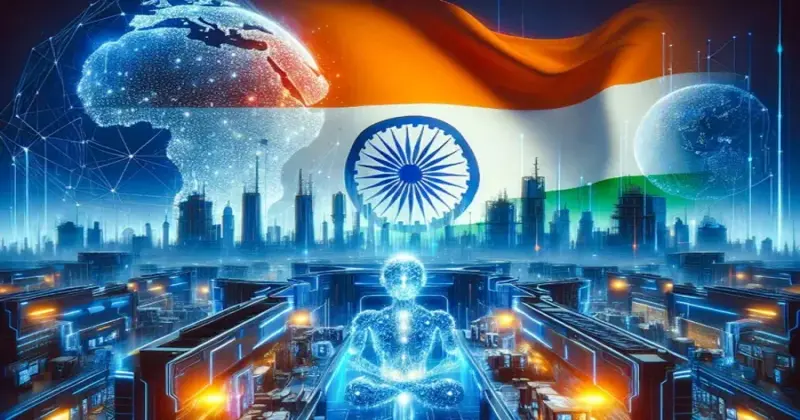
The geopolitical architecture is impoverished with immense faultlines. The spiralling hard-nosed contest in West Asia, fractured security architecture of Europe, the oscillating trade & tariff wars, mounting energy security conundrums, the global security & economic axis is witnessing immense fracture, as it is undergoing once-in-a-century transformation. The key instrument that is covertly but evidently extending its sphere of influence across this precarious world latitude is, technology, particularly the rigorously evolving Artificial Intelligence ecosystem.
When the rules of war are rewritten, when hegemonic calculations are being redefined, Artificial Intelligence is rapidly emerging as the foundational infrastructure of the 21st century. The pace in which AI is capturing the world raises apprehension that whether AI is disrupting the global order, intruding sovereign landscapes and facilitating to fulfill hegemonic deeds by eroding humanitarian aspirations. Concerns exist about a club of few nations dominating the AI latitude and dictating the globe to accomplish their disproportionate strategic goals.
What if the cutting-edge technology that is rewritting the fundamentals of the world order, becomes inaccessible to the larger population, especially in the Global South. What if few nations use AI and the critical data stored in it to dominate the world and dictate its terms? What if the youth of the solid emerging economies and Global South who hail from diverse cultural & linguistic backgrounds are drifted away from the benefits of the emerging technology? The answer to all these riddles lies in India and its emerging sovereign AI ecosystem that respects inclusivity, sustainability, accessibility and humane AI models.
G7 Summit: A prelude for India to push for humane AI apparatus
India as the 4th largest economy is set to emerge as the third largest global economic powerhouse. Its world’s largest population with highest demographic dividend & youth power and as a country that fuels global workforce with vast skill power, has overarching potential to lead the global AI discourse. The strong civilisational and humanitarian values rooted in India such as Vasudaiva Kutumbakam, diverse ethnic, cultural and linguistic mosaic of the country, sound vision and policy apparatus such as Atmanirbharata or self-reliance further acts as key imperatives & boosts the credibility of India for leadership in AI.
With this perfect blend of technological capabilities and civilisational values, India can harness the upcoming G7 Summit forum in Paris to articulate a human-centric global AI ecosystem and lead the vision from the forefront. It is a timely opportunity for India to explore with France and other partners regarding paths for carving the AI apparatus to accomplish humanitarian causes. India should utilise G7 to push western countries specifically, for open, inclusive, sovereign, participatory AI development that aids global well-being, especially for the people of Global South.
Humane AI for Global South
India has always acted as a responsible player for the benefit of the Global South. At multilateral platforms India strongly voices for the welfare and progress of the Global South. Thus, as the leader of these emerging economies, India should push for an inclusive, sustainable and humane AI ecosystem to ensure well-being, security and sovereignty of the Global South countries. In this direction, G7 is a timely opportunity especially when France is a like-minded partner with similar aspirations in the domain of AI.
At the G7, India should accelerate the technical architecture, governance norms and leverage strong institutional partnerships and form a global collaborative approach to carve a humane AI landscape for the benefit of all. New Delhi should voice the principle of “Build with the world, for the benefit of all humanity”. The technological revolution should respect human dignity, diversity and plurality. Indeed, India is the most apt country to highlight these underpinnings while framing global AI policies.
India-France strategic partnership for inclusive AI
To fulfill the aforementioned AI goals, New Delhi and Paris have partnered for a long-time now. The AI Impact Summit conducted in France and in India illustrates the shared vision of both the countries as responsible partners to carve humane and inclusive AI apparatus. Amidst escalating confrontations and confining emerging technology to bully or gain hegemonic ambitions, India and France are pushing for a sovereign and inclusive AI ecosystem. From scripting AI governance policy, capacity building to institutionalising AI in the domain of healthcare, education, disaster management, energy & food security etc., India-France partnership encourages open-source, participatory and sovereign models.
In association with start-ups & private entities, the goal is to erect AI as a digital public infrastructure for global well-being. India-France Joint Declaration on AI reiterates that design and development of AI should be for the public interest, respectful of human rights in compliance with applicable legal frameworks regarding intellectual property rights, privacy and use of personal data. Generative AI should not lead to discrimination, inequality and dissemination of bias and misinformation.
BharatGen: Sovereign model for inclusive AI
When AI is encompassing every sector across the globe such as education, healthcare, research, governance, national security etc., unfortunately the most capable AI systems are today being developed by a small number of elite technology hubs. This can lead to flip effects such as data breach, cyber threat, erosion of privacy & sovereignty and other geopolitical complications to yield hegemony.
However, to counter such threats it is not possible for any one nation. But a collaborative approach among partners always yields intended results, such as erecting a humane AI ecosystem. In this direction, Bharat Gen acts as a resounding example for the sovereign AI model. BharatGen is the government-supported, multilingual and multimodal sovereign-AI initiative led through an IIT Bombay-anchored consortium. It echoes India’s civilisational ethos, spirit of diversity and the aspirations of the Global South, which sets a global example for inclusive and sustainable AI apparatus, that is truly intended for people’s welfare. Through, BharatGen, India sends the message of:
- Linguistic and cultural diversity
- Code-mixed, speech-first, document-rich and multimodal use cases
- Population-scale public-service requirements
- Frugal engineering suited to resource-constrained environments
This is a sovereign model whose bedrock is civilizational tradition that has investigated knowledge, language, perception, reasoning, consciousness, ethics and human flourishing in articulating the cutting-edge technology.
BharatGen, thus, sends the message that AI must remain as a tool for strengthening human understanding and capacity. It should not reduce human beings to a commodity whose attention, preferences, language or behavior are dictated, extracted and monetized for the benefit of few.
Forming global alliances for furnishing humane AI
Apart from government-to-government partnerships, India can also partner with global non-profit and non-governmental AI coalitions to harness responsible AI. For example, Project Tapestry is an open-source initiative of the AI Alliance. The AI Alliance is a United States-based nonprofit open-AI coalition with more than 200 participating organizations. Project Tapestry seeks to enable globally federated development of frontier open models.
Participating institutions and nations can collaborate on a shared open foundation while retaining control over their data and the ability to build sovereign derivative models aligned with their own languages, cultures, laws, industries and values. The initiative is also drawing on open-source technical leadership associated with IBM and on contributions from leading universities, research laboratories, open-source organizations, sovereign-AI initiatives, data stewards and technical institutions across multiple continents. Collaboration with these global platforms will boost the research and innovation potential of India in the domain of AI.
India with cutting-edge innovations such as BharatGen coupled with civilisational imprints, presents the most suitable credible sovereign model & responsible statecraft mechanisms that advocates inclusive, accessible, open, locally adaptable and participatory AI. Harnessing this as the ultimate blueprint to articulate human-centric AI ecosystem, India should lead global AI discourses in forums such as G7 and beyond to realise the vision of “AI as global common resource”.