
The AMU judgment ultimately raises a far larger question than minority rights alone. It compels the Republic to confront whether India will continue to function through common constitutional standards applicable equally to all citizens, or whether constitutional exceptionalism rooted in identity politics will gradually redefine the character of public institutions themselves.
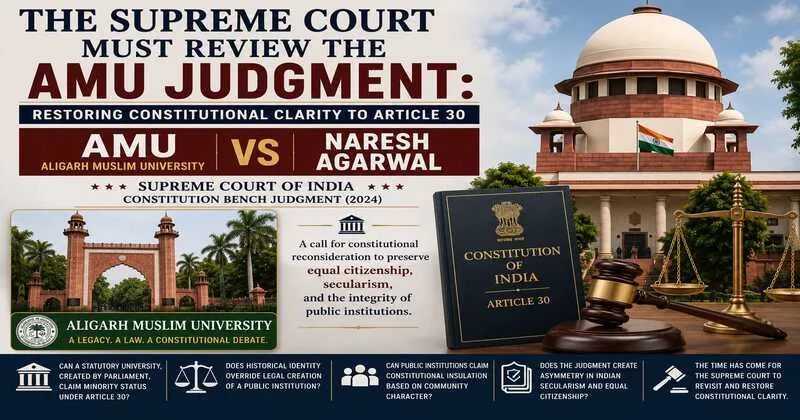
The 2024 Constitution Bench judgment concerning Aligarh Muslim University may ultimately be remembered as one of the most ideologically consequential constitutional rulings in post-Independence India. Far beyond an ordinary dispute over minority rights, the verdict represents a profound judicial shift in the interpretation of Article 30 and fundamentally alters the constitutional relationship between secularism, public institutions, minority rights, and equal citizenship within the Indian Republic.
Delivered by a sharply divided 4:3 Bench of the Supreme Court, the judgment substantially weakens the doctrinal foundation laid down in S. Azeez Basha v. Union of India, which had governed the constitutional position of AMU for nearly six decades. What makes the verdict particularly significant is not merely its legal conclusion, but the constitutional philosophy underlying it. The majority judgment departs from objective legal structure and increasingly embraces historical identity, sociological continuity, and symbolic reasoning as constitutional determinants. In doing so, the Court moves Indian constitutional jurisprudence away from institutional neutrality and closer toward identity-based constitutional exceptionalism.
At the heart of the dispute lies a deceptively simple but constitutionally explosive question: can a university created through parliamentary legislation, governed by statute, financed substantially through public money, and functioning as a national institution simultaneously claim constitutionally protected minority character under Article 30?
For decades, the answer provided by the Supreme Court was comparatively clear. In Azeez Basha, the Court had held that AMU could not claim minority status because it had not been “established” by Muslims within the constitutional meaning of Article 30. Its legal existence flowed directly from the Aligarh Muslim University Act, 1920 enacted by the legislature. The Court recognized an elementary but foundational constitutional principle: historical association cannot substitute legal creation. Once an institution is constituted through legislation and integrated into the framework of State governance, its constitutional character necessarily changes. Public institutions cannot simultaneously function as constitutionally insulated communal entities without undermining equal citizenship itself.
The 2024 majority judgment substantially weakens this principle.
The majority comprising D. Y. Chandrachud, Sanjiv Khanna, J. B. Pardiwala, and Manoj Misra rejected the narrow interpretation of “establish” adopted in Azeez Basha. According to the majority, statutory incorporation does not automatically extinguish minority character. The Court distinguished between “incorporation” and “establishment,” arguing that incorporation merely grants legal existence, whereas establishment concerns the historical foundation, community initiative, and ideological purpose behind an institution.
The majority therefore shifted constitutional focus away from legal structure and toward historical identity. It emphasized the role played by Muslim leadership in founding the Muhammadan Anglo-Oriental College established by Sir Syed Ahmad Khan, the sociological continuity between the college and AMU, and the “foundational purpose” of serving Muslim educational aspirations. According to the majority, minority character may survive even after statutory incorporation, parliamentary regulation, and integration into State structures.
This represents one of the most significant constitutional departures introduced by the judgment.
The constitutional weakness of the majority reasoning lies in its abandonment of objective legal standards. Constitutional law requires definitional discipline. Public institutions cannot operate on emotional or symbolic foundations alone. Yet the majority transforms “establishment” into a flexible sociological inquiry involving historical participation, ideological continuity, community sentiment, and institutional memory. Such standards may possess emotional appeal, but they are constitutionally unstable.
If statutory creation, parliamentary governance, and public funding no longer negate minority character, then the limiting principle of Article 30 becomes dangerously uncertain. Almost any institution possessing historical links to a religious community may potentially seek constitutional insulation despite functioning substantially as a public institution. The majority judgment fails to articulate any coherent constitutional boundary capable of preventing such expansion.
The constitutional depth of the 2024 AMU judgment becomes even more apparent when one carefully examines how radically the majority departs not only from Azeez Basha, but from the broader doctrinal structure of Article 30 jurisprudence itself. The ruling is not merely an isolated reinterpretation of one university’s legal status, it fundamentally alters the constitutional philosophy governing minority educational rights in India.
The majority repeatedly emphasized that “incorporation” and “establishment” are not constitutionally identical concepts. According to Chief Justice Chandrachud, an institution may continue retaining minority character even after statutory incorporation because incorporation merely grants legal personality while establishment concerns the original initiative, vision, and historical foundation behind the institution. This distinction forms the intellectual core of the majority reasoning.
However, this reasoning becomes constitutionally problematic the moment it is examined against the larger structure of Indian constitutional jurisprudence.
The original reasoning in Azeez Basha was rooted in a far stricter understanding of constitutional identity. The Court had held that once Parliament enacted the AMU Act of 1920, dissolved the earlier Muhammadan Anglo-Oriental College structure, transferred assets into the new statutory body, and created a legislatively governed university, AMU acquired a fundamentally different constitutional character. The university no longer remained a privately established denominational institution. It became a statutory public institution integrated into State structures.
That distinction was not technical formalism. It was essential to preserving secular constitutional order.
The majority judgment effectively dismantles this distinction by treating legal incorporation as secondary to historical continuity. Yet constitutional democracies function through legal identity, not emotional continuity. Public institutions derive legitimacy from law, not historical sentiment. Once statutory incorporation ceases to alter constitutional character, the boundary between public institutions and community institutions becomes deeply unstable.
This is precisely why the dissent repeatedly warned against doctrinal uncertainty.
Surya Kant emphasized that Article 30 requires satisfaction of both conditions: the institution must be established and administered by the minority community. The dissent recognized that the constitutional phrase “establish and administer” was deliberately conjunctive. The framers did not intend a symbolic or historical test. They intended an actual legal relationship between the minority community and the institution itself.
Justice Surya Kant’s dissent becomes particularly important because it restores constitutional focus upon institutional control and legal creation rather than sociological association. He argued that minority communities must demonstrate decisive involvement in conception, funding, charter formation, governance, and institutional administration itself. This approach preserved constitutional objectivity.
The majority, by contrast, transforms Article 30 into an increasingly subjective inquiry involving ideological aspiration, historical participation, and cultural association. Such standards possess no stable constitutional limits.
The danger becomes even clearer when the judgment is examined alongside earlier Article 30 precedents such as T. M. A. Pai Foundation v. State of Karnataka and P. A. Inamdar v. State of Maharashtra. Those judgments, despite broadly expanding minority educational autonomy, still operated on the assumption that minority institutions were fundamentally private educational enterprises established and controlled by minority communities themselves.
AMU presents an entirely different constitutional situation.
AMU is not merely aided by the State, it is substantially constituted through State authority itself. It is centrally funded, legislatively governed, and treated as a national institution. The majority judgment therefore extends Article 30 protections into terrain never previously contemplated with such breadth.
That extension creates serious structural contradictions within Indian secularism.
The majority attempts to present Article 30 as a constitutional guarantee of pluralism and diversity. Yet secular constitutionalism depends not merely upon diversity, but upon common civic standards governing public institutions. Once publicly funded institutions begin asserting constitutionally protected communal identity, the civic neutrality of public institutions gradually weakens.
This is why the dissent’s republican framework appears constitutionally more coherent.
Justice Dipankar Datta repeatedly warned against interpretative instability. His concern was not merely procedural. He recognized that constitutional adjudication cannot survive if legal tests become infinitely flexible. Once courts begin prioritizing sociological sentiment over institutional structure, constitutional predictability itself weakens.
The majority judgment also creates a significant jurisprudential inconsistency with the Court’s own secularism doctrine developed in earlier cases such as S. R. Bommai v. Union of India. In Bommai, secularism was treated as part of the Constitution’s basic structure precisely because the State was expected to maintain principled neutrality among religious communities. Yet the AMU judgment increasingly permits religion-linked constitutional insulation within publicly funded institutions themselves.
This introduces visible asymmetry into constitutional governance.
The State continues exercising extensive control over Hindu temples and majority-linked institutions under the language of reform, accountability, and secular regulation. Yet minority institutions invoking Article 30 receive heightened constitutional insulation even when operating inside publicly funded national structures. Whether intended or not, this creates the perception that Indian secularism imposes unequal constitutional burdens upon different communities.
The AMU judgment intensifies that perception significantly.
Another major constitutional weakness of the majority reasoning lies in its treatment of the 1981 Amendment to the AMU Act. Parliament had attempted to redefine AMU as an institution “established by Muslims of India” after Azeez Basha denied minority status. The deeper constitutional issue here concerns whether Parliament can indirectly rewrite constitutional identity through ordinary legislation after the Supreme Court has already interpreted constitutional meaning.
The majority does not directly endorse unlimited legislative override, but its reasoning substantially legitimizes Parliament’s attempt to politically reconstruct constitutional character through statutory amendment.
This has long-term implications far beyond AMU itself.
If legislatures can reshape constitutional identity through political amendments and courts subsequently validate those reconstructions through expansive interpretative reasoning, constitutional doctrine itself becomes vulnerable to electoral pressures and identity-based political mobilization.
That is precisely why the dissent’s insistence upon structural constitutional discipline becomes so important.
Perhaps the most striking aspect of the judgment is that despite substantially weakening Azeez Basha, the majority still stopped short of conclusively declaring AMU a minority institution. Instead, the Court remitted key factual questions for future determination.
This reveals internal uncertainty within the majority reasoning itself.
A seven-judge Constitution Bench fundamentally altered Article 30 jurisprudence yet refused to provide final constitutional closure. Such an outcome demonstrates that the issue is not merely technical interpretation, but a far deeper constitutional conflict over the nature of secularism, equal citizenship, and public institutional identity within the Indian Republic.
The judgment therefore leaves behind constitutional ambiguity at precisely the point where constitutional clarity was most necessary.
Ultimately, the controversy surrounding AMU is no longer merely about one university. It is about whether India’s public institutions will continue functioning through common constitutional principles applicable equally to all citizens, or whether constitutional identity politics will continue fragmenting the idea of civic neutrality itself.
History repeatedly demonstrates that republics weaken not only through majoritarian excesses, but also through the gradual erosion of common constitutional standards. Equality cannot survive where exceptions become permanent. Secularism cannot survive where constitutional morality becomes selective. And constitutional democracy itself cannot endure if publicly funded institutions slowly evolve into constitutionally insulated identity-based domains.
The framers of the Constitution sought to create citizens first, not permanently segmented constitutional categories.
The real constitutional question before India is no longer merely about AMU. It is whether the Republic still believes in one common constitutional framework for all citizens, or whether constitutional morality itself will now increasingly bend before the pressures of identity, appeasement, and institutional exceptionalism.