

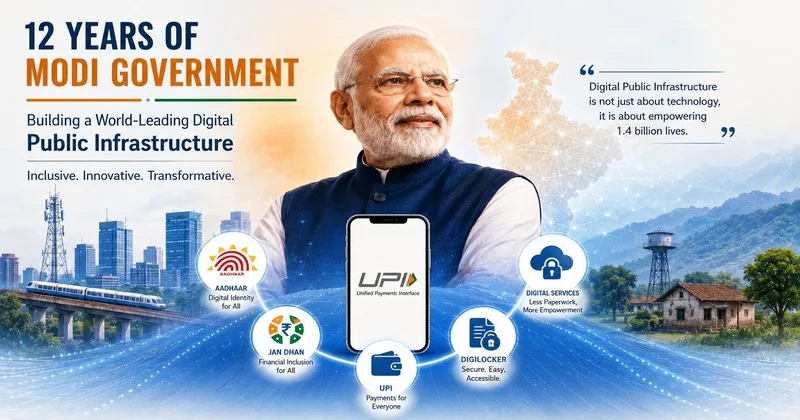
Power grids, ports, and highways are no longer the only components of infrastructure. It’s digital. According to the UN, digital public infrastructure is a collection of fundamental digital systems that serve as the foundation for contemporary societies. These platforms make interaction between individuals, companies, and governments safe and easy. DPI influences daily life by facilitating safe data transmission, rapid digital payments, identification verification, and bank account opening. In the contemporary economy, digital infrastructure now controls who has access to services, markets, and rights, much like railroads formerly linked areas to opportunities.
Bharat’s digital public infrastructure did not appear overnight. The Modi administration claimed to support a human-centric approach to technology and encourage more knowledge-sharing in related theme areas, including “DPI, financial inclusion, and tech-enabled development.” Identity, banking, and connection were purposefully brought together to seed it.
The JAM trinity emerged as a result of this convergence. The foundation for Bharat’s digital transformation was established by Jan Dhan bank accounts, Aadhaar enrolment, and significant mobile phone usage. When combined, they provided a direct and verifiable link between people and the state. Welfare payouts started to flow directly into bank accounts through JAM. There were fewer middlemen. Delays decreased. Leakage decreased. The scope of this integration set the stage for the eventual development of an all-encompassing DPI ecosystem.
A practical example of what population-scale digital public infrastructure may accomplish is provided by Bharat’s experience. For very little money, Bharat has constructed digital public infrastructure for more than 1.4 billion people. It is a network that is open, accessible, and supported by a variety of apps that update the economy, change governance, and improve people’s lives. The DPI ecosystem in Bharat operates under the tenets of trust, innovation, and inclusivity. Bharat has shown that digital platforms may accelerate development and strengthen democracy at a population size with quantifiable effects.
With the help of the G20 Digital Economy Working Group, the new high-level Task Force on DPI for Economic Transformation, Financial Inclusion and Development, and a number of G20 Engagement Groups, Bharat, as the G20 leader in 2023, has been able to raise an exceptional level of awareness about DPI among nations of the Global North and South. The DPI model is currently being explored, adopted, or modified by countries at widely disparate stages of development, and it has emerged as a major Bharatiya offering to the globe. Bharat became the first country to build all three of the fundamental DPIs: the Data Empowerment and Protection Architecture (DEPA), the Unified Payments Interface (UPI), and the Aadhaar unique identity—thanks to Bharat Stack’s innovative, integrated architecture.
The DPI strategy has received unqualified support from the UN and other international organisations, including the World Bank and the International Monetary Fund (IMF). The International Monetary Fund praised DPIs for facilitating direct benefit transfers and helping 87 per cent of Bharat’s impoverished households during the COVID-19 epidemic, and noted that Bharat’s DPI model offered important lessons for nations globally during an international seminar on DPI. In a similar vein, a World Bank report notes that DPIs have assisted Bharat in reaching 80 per cent financial inclusion in the last six years, an accomplishment that may have taken 50 years otherwise.
As the government expanded access to bank accounts, Bharat’s rapidly advancing fintech companies began rolling out digital wallets and mobile money solutions. These advancements simplified and reduced the cost of digital money storage and transfers, even for individuals without bank accounts. In response, authorities implemented an innovation by creating the Unified Payments Interface (UPI), which allowed banks to communicate and process payment instructions with nonbank entities. This initiative became the second layer of the Bharat Stack.
The new system allows street vendors and small traders without bank accounts to receive payments for their goods or services via a digital wallet. They can quickly send money to others—such as a relative in a distant village—as long as the recipient also has a digital wallet. In contrast, similar transfers in many developing countries can take days or weeks, often requiring a trip to a far-off bank and incurring substantial transfer fees.
By March 2026, over 1.44 billion Aadhaar numbers had been issued, showcasing its deep integration into daily life. In the fiscal year 2024-25, there were more than 27.07 billion authentication transactions. The number of Jan Dhan accounts surged from 147.2 million in 2015 to 577.1 million by March 2026. Deposits rose significantly from Rs 156.7 billion in March 2015 to Rs 29.4 trillion by March 2026. Beneficiaries received a total of 399.8 million RuPay debit cards, expanding financial inclusion. The formal system now captures savings, empowering individuals economically. With 85.5% of Bharatiya households owning a smartphone, mobile devices have transformed into banks, classrooms, and access points for public services. By the end of December 2025, wireless telephone subscribers reached 1.2587 billion, with 5G services available in nearly all districts, covering 85 per cent of the population, supported by over 518,000 5G base stations nationwide. The UPI system revolutionised retail payments, facilitating instantaneous, secure, and interoperable transactions between users and merchants. In January 2026, UPI handled 21.7 billion transactions valued at over Rs 28.33 trillion, demonstrating its integral role in commerce. With 691 banks active on the platform, UPI has gained widespread institutional support. The International Monetary Fund recognised UPI as the largest retail fast payment system by transaction volume in its June 2025 report on rising digital retail payments.
Initiated in December 2014, UPI was established for payment, accounting, and reporting under the Direct Benefit Transfer scheme, effectively eliminating duplicate and fraudulent beneficiaries and minimising leakage. Consequently, the government saved over Rs 4.31 trillion between 2015 and March 2024. By January 2026, the total transferred via DBT surpassed Rs 49.09 trillion, marking a transition toward targeted and accountable welfare distribution. Citizens can now access vital lifelong records anytime and anywhere, with DigiLocker reaching 676.3 million users by March 5, 2026, and over 9.5 billion documents issued, illustrating its increasing importance in public administration. The UMANG app, launched in 2017 for enhancing mobile governance, registered 102.5 million users and 7.2336 billion transactions by March 5, 2026, offering more than 2,400 government services and acting as a major link between citizens and the government.
Government E-Marketplace: By November 2025, approximately 3.27 crore orders had been processed, yielding a total Gross Merchandise Value surpassing Rs 16.41 lakh crore—comprising Rs 7.94 lakh crore from services and Rs 8.47 lakh crore from products. The platform features over 10,894 product categories and 348 service categories, with more than 1.67 lakh buyer organisations registered. Additionally, over 24 lakh sellers and service providers have completed their profiles, including upwards of 11 lakh Micro and Small Enterprises, which account for 44.8 per cent of the total order value, amounting to over Rs 7.35 lakh crore.
eSanjeevani: Since its launch in November 2019, eSanjeevani has enhanced healthcare access through telemedicine, facilitating remote consultations between doctors and patients, particularly in rural and underserved areas. This platform minimises travel expenses and wait times while providing specialist advice to distant communities. As of 5 March 2026, it has catered to 45.42 crore patients and onboarded 2.3 lakh healthcare providers. Teleconsultation has transitioned from a pilot initiative to a standard public health service.
Bharat’s experience with Digital Public Infrastructure highlights a significant transformation in the approach to development and governance in the digital era. What started as a push for financial inclusion and access to identity has evolved into a robust, interoperable framework vital for economic activities, public service delivery, and institutional growth. This model illustrates that scaling up does not have to undermine trust, and that transparency can be maintained alongside security and regulation. By merging technology with public objectives, Bharat has demonstrated that digital systems can bolster democracy and promote growth. As other countries aim to establish resilient and inclusive digital infrastructures, Bharat’s experience serves as more than just a case study; it acts as a touchstone for the future of public digital infrastructure.